If you have ever tried to hire someone to build a website, you have run into this confusion: one person calls themselves a web designer, another is a web developer, a third calls themselves a full-stack developer, and the agency says they do “design and development.” What does any of this mean?
Website design vs. web development is one of the most common sources of confusion in web projects. The terms are often used interchangeably in the market, sometimes carelessly, sometimes deliberately to obscure what a contractor or agency actually does. Understanding the real distinction helps you hire the right people, scope projects correctly, and avoid expensive mismatches.
The Simple Version
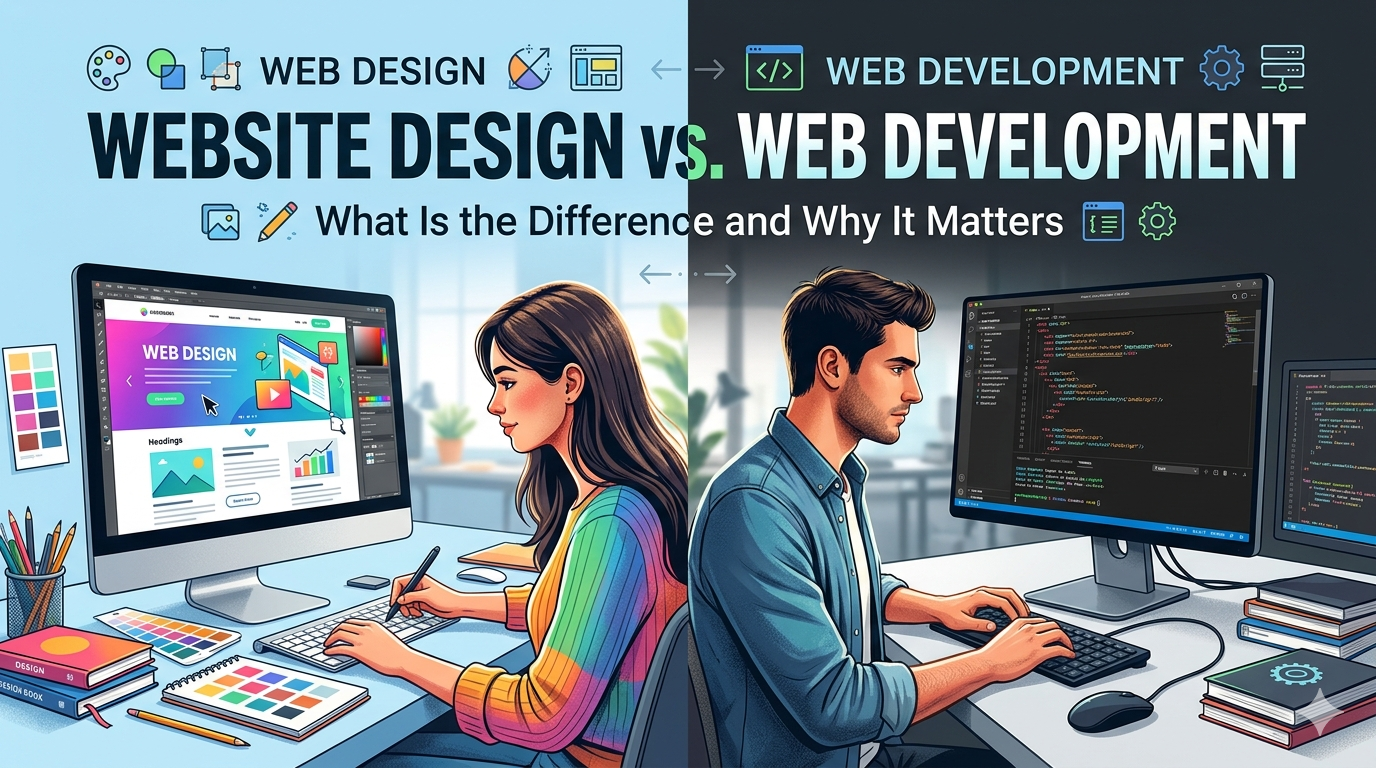
Website design is about how a site looks and feels. It covers layout, color, typography, imagery, and user experience, the visual and interactive layer that visitors see and interact with.
Web development is about how a site works. It covers the code, databases, servers, and integrations that make a site functional, the technical layer that makes a design come alive.
A useful analogy: in construction, a design is the architect’s plans. Development is the contractor who builds it. Both are essential. Neither is sufficient alone.
What Web Designers Actually Do
A web designer is responsible for the visual and experiential layer of a website.
This involves:
- User Experience (UX) design: Mapping out how users move through the site, the logical flow from landing page to contact form, from product listing to checkout. UX design focuses on making the journey intuitive and frictionless.
- User Interface (UI) design: The visual execution of the UX, what each screen looks like. Color palette, typography choices, button styles, spacing, imagery. This is what most people picture when they think of “web design.”
- Wireframing and prototyping: Building structural blueprints of each page before visual design begins. Wireframes show layout and hierarchy without color or imagery, they are used to validate structure before committing to a visual direction.
- Mockups: The visual version of wireframes. Full-color, typography-applied designs that show exactly what the finished pages will look like.
- Design systems: For larger projects, a component library that ensures consistency across all pages, the same button styles, heading sizes, and spacing rules applied everywhere.
A web designer typically does not write production code (the code that makes the site work in a browser). They produce design files, in tools like Figma or Adobe XD, that a developer then implements.
What Web Developers Actually Do
A web developer takes a design and turns it into a functional website using code.
The developer world is further divided into:
Front-End Developers
Front-end developers write the code that runs in a user’s browser and determines how the site looks and behaves. They work in HTML, CSS, and JavaScript, taking a designer’s mockups and building them into real, interactive pages. They handle responsive behavior (how the site adapts to different screen sizes), animations, and the interface between design and functionality.
Back-End Developers
Back-end developers work on the server side, the databases, APIs, and business logic that run behind the scenes. If a website has a member login, a CMS, a product database, a contact form that saves entries to a database, or any custom application logic, a back-end developer built it. They typically work in languages like PHP, Python, Node.js, or Ruby.
Full-Stack Developers
A full-stack developer can work on both front-end and back-end. They are generalists who cover the entire technical stack, useful for smaller projects where you need someone to handle everything from the user interface to the database.
Where the Lines Blur
In practice, the line between design and development is not always clean, and it has blurred further with modern tools.
WordPress is a good example. A skilled WordPress developer often handles both design and development, customizing themes, building page layouts, and implementing functionality. They might not produce formal UX wireframes or design mockups, but they do make visual design decisions.
Webflow blurs the line even further. Webflow is a visual development tool that lets designers build fully functional websites without writing traditional code. A “Webflow designer” is, effectively, doing both design and development simultaneously.
Template-based projects (Squarespace, Wix, Shopify themes) compress the distinction almost entirely, a single person can handle the whole project using platform tools.
For custom projects, sites with unique functionality, complex integrations, or e-commerce requirements, the distinction matters more. Custom work requires genuine separation of design and development skills, and getting the collaboration right between designer and developer is critical to the outcome.
Why the Difference Matters When Hiring
Understanding design vs. development becomes practically important when you are hiring.
If You Hire a Web Designer Without a Developer
You get beautiful mockups with no way to implement them. Many small businesses have been burned this way, a designer delivers stunning visual designs that then require an entirely separate developer engagement to build, adding cost and coordination overhead.
If You Hire a Developer Without a Designer
You get a functional site that may look generic, inconsistent, or outdated. Developers who build without design input often rely on off-the-shelf templates, which limits differentiation and brand alignment. The site works but does not convert.
If You Hire Someone Who Claims to Do Both
Genuinely skilled at both design and development, often called a unicorn in the industry, is rare and typically expensive. Most people who claim to do both are better at one than the other. Understanding which way they lean helps you evaluate their work and fill in gaps.
If You Hire an Agency
An agency that offers both design and development services handles the coordination internally. This is typically the most efficient approach for small businesses because it eliminates the translation gap between what a designer intended and what a developer builds. One contract, one point of contact, one integrated team. Our guide on how to choose a website design company covers what to look for when evaluating agencies.
The Technology Decision Sits at the Intersection
One of the most important choices in a website project, what platform or technology to build on, sits at the design-development intersection.
Choosing WordPress, for example, affects both the design possibilities (what themes and page builders are available, what custom designs are achievable) and the development requirements (what technical knowledge is needed to build and maintain the site).
Choosing a custom build (React, Next.js, or a custom backend) opens more design flexibility but requires stronger development skills to implement and maintain. Our guide on WordPress vs. custom web development covers this decision in detail.
For most small businesses, WordPress or a modern CMS is the right platform, it provides a good balance of design flexibility and development manageability without requiring a permanent developer on call.
What This Means for Your Website Project
For small business owners, the practical takeaway is this:
- Know what you are buying. When you get a proposal, clarify: does this include design mockups, or just development? Who is doing what?
- Match the resource to the need. If you have strong brand guidelines and just need them implemented, a skilled developer working from your brand assets may be more efficient than a full design engagement.
- Default to integration. For projects where both are needed, which is most projects, work with a partner who handles both. The integrated approach produces better results faster.
- Do not let the vocabulary confuse you. Whether someone calls themselves a designer, developer, or both, what matters is whether they have shown they can deliver what your project actually requires.
At DevVerx, our team covers both sides of the line. Our UI/UX design services and web development capabilities sit under one roof, with designers and developers collaborating from the beginning of every project. The result is sites where the design and the build reinforce each other, and where the handoff friction that slows down separated-team projects simply does not exist.
Our 4.8/5 client rating reflects what happens when design and development are treated as one integrated discipline rather than two separate vendor relationships.
If you are planning a website project and want to understand what the right mix of design and development looks like for your specific needs, contact our team. We will give you a straight answer about what your project requires and who should be doing what.