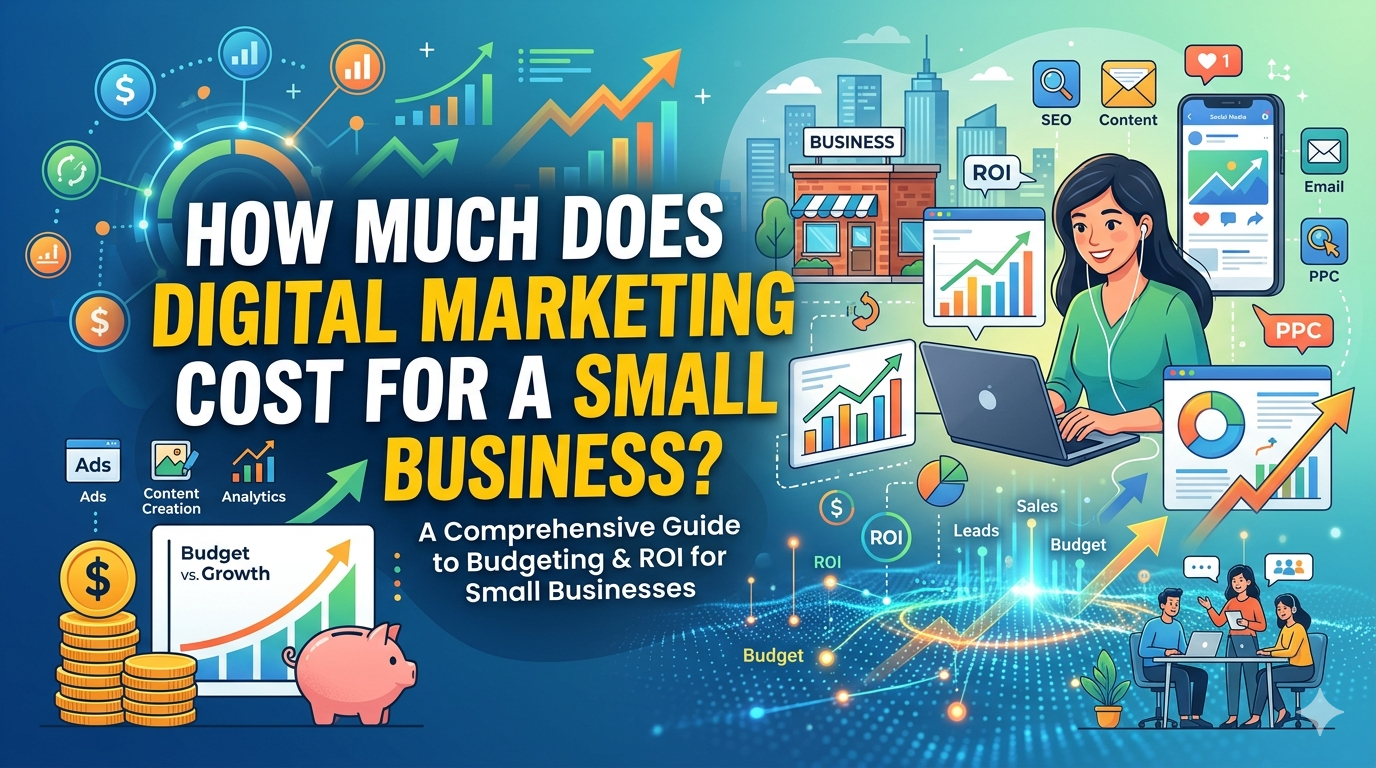
Budget questions are the most common barrier between small businesses and effective digital marketing. And the honest answer is: it depends but not in the unhelpful way agencies usually say that.
The cost of digital marketing for small business is highly variable. A local restaurant spending $300/month on Google Ads can see a meaningful return. A professional services firm investing $3,000/month in SEO and content may take a year to see results. A business trying to DIY everything spends time instead of money with inconsistent results either way.
This guide breaks down real cost ranges by channel, compares DIY versus professional costs honestly, explains what to expect for different budget levels, and helps you decide where to allocate marketing dollars for your specific situation.
For the broader strategic context, see our complete digital marketing guide for small business.
Why Digital Marketing Costs Vary So Much
Before getting into numbers, it helps to understand the three main cost drivers that make digital marketing pricing so variable.
Competitiveness of your market. Keywords and ad placements cost more in highly competitive industries (legal, insurance, home services, healthcare). A plumber in Miami faces dramatically more competition and higher advertising costs than a plumber in a smaller market.
Geographic scope. Local campaigns targeting a single city cost less than regional or national campaigns. Local SEO has lower barriers than competing nationally.
Do it yourself vs. professional management. Managing your own ads and content takes time but avoids agency fees. Hiring professionals costs money but typically produces better results and frees your time.
These three factors interact with each channel differently. Let’s go through the costs of each.
SEO: What It Actually Costs
Search engine optimization is the process of improving your website’s visibility in organic (unpaid) Google search results. It is the highest long term ROI channel for most small businesses but it also requires the longest time horizon before results appear.
DIY SEO Costs
If you manage SEO yourself, the direct costs are tool subscriptions:
- Google Search Console and Google Analytics: Free
- Keyword research tools: Ubersuggest (free tier), Google Keyword Planner (free with a Google Ads account), or paid tools like Ahrefs ($99-$199/month) or SEMrush ($119-$229/month)
- Content management: Usually built into your website platform
- Local citation management: Moz Local or BrightLocal ($14-$49/month)
Total DIY SEO tool cost: $0-$300/month, depending on which tools you use. The real cost is your time typically 5-15 hours per month to do it properly.
Professional SEO Costs
Hiring an agency or consultant for SEO introduces professional fees:
- Freelance SEO consultant: $75-$200/hour, or $500-$2,000/month for part-time ongoing management
- Small/boutique SEO agency: $1,000-$3,000/month for small business campaigns
- Mid-market digital marketing agency: $2,000-$8,000/month for comprehensive SEO programs
- Enterprise agencies: $5,000-$20,000/month and above
For most small businesses, a quality boutique agency or experienced freelance SEO specialist in the $1,000-$3,000/month range is appropriate. Be skeptical of providers offering comprehensive SEO for under $500/month – at that price point, the work is likely not substantial enough to move rankings.
What You Get at Different SEO Budget Levels
$0-$500/month (DIY or minimal): Basic on-page optimization, Google Business Profile setup, local citations. Suitable for businesses in low competition local markets with time to invest in self education.
$500-$1,500/month: Part-time SEO support typically keyword research, on-page audits, content briefs, and basic link building. Works in moderate competition markets with realistic timelines.
$1,500-$4,000/month: Comprehensive small business SEO full technical audit, content strategy and writing, local SEO, link building, and monthly reporting. Appropriate for competitive markets or businesses that want to rank for multiple service areas.
Content Marketing: Cost by Approach
Content marketing blog posts, guides, and educational content that earns organic traffic over time is closely tied to SEO but has distinct costs.
DIY Content Costs
Writing your own content has near zero direct cost beyond your time. Plan for 3-6 hours per 1,500-word article if you are a competent writer. If you are not a strong writer or the topic requires research, double that estimate.
Consistency is the challenge. Most business owners start a blog with good intentions and abandon it within three months. The companies that win at content marketing publish consistently for years.
Professional Content Costs
- Freelance writers: $0.10-$0.50/word for general business content. A 2,000 word article costs $200-$1,000 depending on expertise required.
- Specialized industry writers: $0.25-$1.00/word for technical or highly specialized topics
- Content agencies: $800-$3,000/month for a full content strategy including writing, optimization, and publishing
Quality matters more than quantity in content marketing. One well researched, thoroughly optimized article per month outperforms four thin, generic articles.
Social Media Marketing: What to Budget
Social media marketing costs depend heavily on whether you run organic social (free posting) or paid social (advertising).
Organic Social Media
The tools are free. The cost is time creating content, scheduling posts, and engaging with comments and messages. Budget 3-8 hours per week to manage two active social media channels properly.
If you hire help:
- Freelance social media manager: $500-$2,000/month depending on number of platforms and posting frequency
- Social media agency: $1,000-$5,000/month for strategy, content creation, and management across multiple platforms
Paid Social Media (Facebook and Instagram Ads)
Meta’s advertising platform is available at almost any budget level, but meaningful results typically require a minimum spend:
- Minimum viable test budget: $500-$1,000/month to gather enough data to optimize
- Established local business campaigns: $1,000-$3,000/month ad spend
- Management fee (if using an agency): 10-20% of ad spend, or a flat $500-$1,500/month
For small businesses targeting a local audience with specific offers, Meta Ads can deliver strong results at modest budgets. For broader awareness campaigns, budget requirements are higher.
Google Ads: Real Cost Ranges
Google Ads (pay per click search advertising) places your business at the top of search results for specific keywords. Unlike SEO, results are immediate but costs stop the moment your budget runs out.
Cost per click (CPC) varies enormously by industry and keyword competitiveness:
- Low-competition local services (bakery, photography): $1-$5/click
- Moderate-competition services (landscaping, cleaning): $5-$20/click
- High-competition services (legal, insurance, financial): $20-$100+/click
For a small business in a moderate market running local service ads:
- Minimum budget: $500-$1,000/month in ad spend to see meaningful data
- Practical starting budget: $1,000-$3,000/month in ad spend
- Agency management fee: $300-$1,000/month or 10-15% of spend
A well managed Google Ads campaign for a local service business can generate qualified leads at a predictable cost per lead. Poorly managed campaigns waste budget on irrelevant clicks. Professional management makes a significant difference.
According to WordStream’s Google Ads benchmarks, average cost per click across industries ranges from $1-$6 for most small business categories on the search network.
Email Marketing: The Most Cost-Effective Channel
Email marketing is often the most cost effective digital marketing channel for businesses with an existing customer base. If you have collected customer email addresses, you have an asset you can market to directly at minimal cost.
Email marketing tools:
- Mailchimp: Free up to 500 contacts; $13-$20/month for 500-5,000 contacts
- Constant Contact: $12-$35/month
- Klaviyo (e-commerce focused): Free up to 250 contacts; $20-$60/month for growing lists
- ConvertKit: Free up to 1,000 subscribers; $25-$50/month
According to HubSpot’s marketing statistics, email marketing delivers an average ROI of $36 for every $1 spent making it one of the highest return channels available at any budget level. Email marketing to a warm list of existing or past customers typically delivers higher ROI than any acquisition channel. If you are not doing it, start.
Total Digital Marketing Budget: What to Expect
Putting it all together, here is what small businesses typically spend at different investment levels.
Starter Budget: $500-$1,500/month
- Google Business Profile optimization (setup cost, then free)
- Basic local citation management
- DIY content (1 article per month)
- Email marketing platform
- Optional: Small Google Ads or Meta Ads test budget
Best for: Businesses in low to moderate competition local markets. Requires owner time investment. Sets the foundation for scaling up.
Growth Budget: $1,500-$4,000/month
- Professional SEO management (on-page, local, content)
- Consistent content production (2-4 articles per month)
- Social media management for one platform
- Google Ads or Meta Ads with meaningful budget
- Monthly analytics reporting
Best for: Businesses in competitive markets, businesses with growth goals, or businesses that have tried DIY and want professional execution.
Competitive Budget: $4,000-$10,000/month
- Full service SEO program
- Content marketing at scale
- Paid advertising across Google and Meta
- Social media management across multiple platforms
- Conversion rate optimization on website
- Advanced analytics and attribution
Best for: Businesses with established revenue, operating in highly competitive markets, or businesses targeting regional or national audiences.
What Digital Marketing Agency vs. DIY Actually Costs
The comparison between DIY and agency management is not as simple as fee vs. no fee. DIY has real costs: your time has value, mistakes have costs, and slower results mean delayed revenue.
A rough calculation: if you spend 10 hours per week managing digital marketing, and your time is worth $75/hour as a business owner, that is $750/week or $3,000/month in opportunity cost. Professional management at $2,000/month might actually be the more economical choice with better results.
See our full breakdown in Digital Marketing Agency vs. DIY: What Small Businesses Get Wrong for a complete cost comparison including hidden DIY costs.
How to Allocate Your Digital Marketing Budget
Where to start depends on where your business is right now. A general prioritization framework:
- Fix your website first. If your site is slow, outdated, or not converting, no marketing budget will compensate. Check our guide on signs your website is costing you customers before allocating marketing spend.
- Google Business Profile. Free, high impact, and especially critical if you serve local customers.
- SEO and content. Slow to start, but the compounding returns make it the best long term investment for most businesses.
- Email marketing. If you have a customer list, start emailing them. High ROI, low cost.
- Paid advertising. Once organic foundations are in place, paid ads amplify what is working.
Working With DevVerx on Digital Marketing
DevVerx offers full service digital marketing for small businesses SEO strategy, content production, local search optimization, and paid advertising management. We work with transparent pricing, clear deliverables, and monthly reporting so you always know what you are paying for and what results it is producing.
Our 4.8/5 client rating reflects a consistent focus on actual business outcomes leads, traffic, and revenue not vanity metrics.
Every engagement starts with a conversation about your business goals, your current digital presence, and your realistic budget. From there, we build a plan that prioritizes the highest impact activities first.
Contact DevVerx for a free marketing audit and budget recommendation. We will tell you where your money should go and what to realistically expect in return.
Digital Marketing Costs: The Bottom Line
Digital marketing for small business does not have a fixed price tag. What it costs depends on your market, your goals, and how much of the work you do yourself versus outsource.
What is consistent: investing the right amount in the right channels, consistently over time, produces predictable results. And not investing or investing poorly costs you customers every month to competitors who are.
Get the budget conversation started today. The best time to invest in digital marketing was a year ago. The second best time is now.
Ready to invest in digital marketing that produces real results? Contact DevVerx for a free marketing audit and budget recommendation tailored to your business goals.