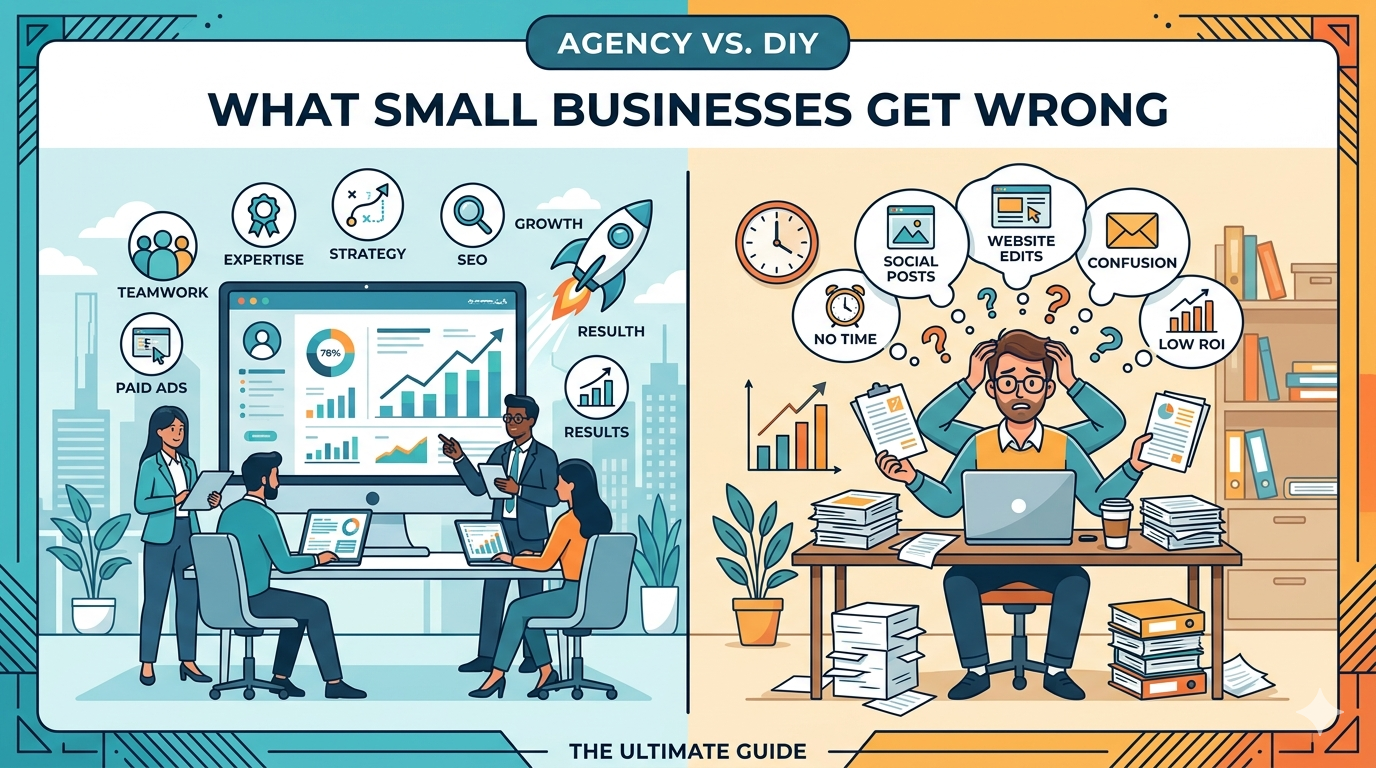
Almost every small business owner eventually reaches the same crossroads: keep managing their own digital marketing, or hire a professional digital marketing agency. Both camps have advocates. Both approaches can work. And both carry risks that most business owners underestimate going in.
The DIY camp underestimates how much expertise modern digital marketing requires and how expensive it is to learn on the job when mistakes cost you ranking positions and wasted ad spend. The agency hiring camp often underestimates how much variance exists in agency quality, and how easy it is to pay a monthly retainer for work that does not move the needle.
This guide is a real talk comparison. We look at what each approach actually costs (including the hidden costs most people ignore), what each approach can and cannot do for a small business, and how to tell whether you are in a situation that calls for one or the other.
For the broader context on what digital marketing includes and costs, see our complete digital marketing guide for small business and our breakdown of how much digital marketing costs.
The Case for DIY Digital Marketing
DIY digital marketing has real advantages, especially for businesses in the early stages or in lower competition markets.
You understand your business better than anyone. No agency will ever know your customers, your voice, or your competitive positioning as well as you do. Content and social media managed by the owner often has an authenticity that agency managed accounts cannot replicate.
Zero agency markup. You pay tool costs and your own time, not professional fees. In markets where SEO and content marketing can work with modest effort, DIY can produce results at a fraction of the cost.
Full control. You decide what gets published, when it gets published, and what the messaging says. No briefing an account manager, waiting for revisions, or hoping the agency understood your brand.
Speed of learning. Running your own marketing forces you to understand what actually drives business which channels produce leads, what messages resonate, what your customers care about. That knowledge is valuable even if you eventually hire professionals.
When DIY Actually Works
DIY digital marketing produces real results when:
- You are in a low to moderate competition local market where basic SEO and consistent social media can win
- You have genuine time to invest at minimum 5-10 hours per week, every week, not sporadically
- You are a strong writer or communicator (or willing to become one)
- Your business model works with a slower ramp up of digital results
- You have the discipline to be consistent for 12+ months before judging results
The critical word is consistent. Most DIY digital marketing fails not because the owner could not do the work, but because running a business eventually took priority and the marketing went quiet for weeks or months at a time. According to Search Engine Journal’s small business survey, inconsistency is the single most cited reason DIY digital marketing underperforms expectations.
The Case for Hiring a Digital Marketing Agency
The right agency brings capabilities most small business owners cannot replicate on their own, within a realistic time budget.
Technical expertise. SEO in competitive markets, paid advertising management, conversion rate optimization, technical site audits these require specialized knowledge and ongoing education. An experienced digital marketer has seen what works across dozens of clients. A business owner learning these skills starts from zero.
Time reclaimed. Your time is the most valuable resource in a small business. If digital marketing takes you 10-15 hours per week, and that time is worth $100/hour in opportunity cost, you are effectively paying $4,000-$6,000/month for results that a professional could produce more efficiently.
Faster results in competitive markets. In markets where first page Google rankings require sustained technical SEO, link building, and content at scale, agencies compress the timeline by executing more systematically than most owners can manage independently.
Tools and infrastructure. Agencies spread the cost of professional SEO tools, analytics platforms, and advertising management software across many clients. You get access to capabilities that would cost $500-$2,000/month to replicate yourself.
Accountability (when it is built in). Good agencies report on what is working, what is not, and what they are changing. That accountability keeps the strategy on track in a way that DIY rarely maintains.
When Hiring an Agency Makes Sense
Bringing in a professional digital marketing agency for small business produces the best results when:
- Your market is competitive you are fighting for rankings against established businesses with strong online presences
- You have tried DIY for six months to a year without meaningful results
- Your time is genuinely not available to do the work consistently
- You need expertise you do not have particularly in paid advertising, technical SEO, or analytics
- You have a marketing budget that can support professional fees without stretching the business too thin
What Small Businesses Get Wrong About DIY
These are the most common DIY mistakes that cost businesses time, money, and ranking positions.
Underestimating the Time Required
Most small business owners who try to self manage digital marketing underestimate the actual time commitment by a factor of two to three. Good SEO means keyword research, writing 1,500-2,500 word articles, technical audits, link building outreach, and monthly performance review. Social media means content creation, community management, and staying current on algorithm changes. These activities compound they get more efficient over time, but they are never truly low effort if done properly.
Treating Digital Marketing as Intermittent
Organic SEO and content marketing work on consistency signals. Google rewards websites that publish regularly and maintain active link profiles. Starting and stopping, publishing three articles and then going quiet for four months, creates a pattern that undermines the compounding benefits these channels depend on.
Optimizing for the Wrong Metrics
Many DIY marketers optimize for metrics that feel good but do not drive business: follower counts, social media likes, blog traffic from keywords that have no commercial intent. The right metrics are leads generated, calls received, and revenue influenced by digital marketing activities.
Learning on Mistakes That Cost Money
Paid advertising is particularly vulnerable to this. Google Ads and Meta Ads campaigns require specific expertise to run profitably. Common beginner mistakes too broad targeting, weak ad copy, no negative keywords, improperly structured campaigns burn through budget with minimal results. The cost of learning paid advertising yourself is often substantially higher than the cost of professional management from the start.
What Small Businesses Get Wrong About Hiring Agencies
The most common mistakes happen before the contract is signed.
Hiring Based on Price Alone
The cheapest agency is almost never the right choice. $300/month SEO retainers exist, but they typically produce low value work: generic content, spammy links, and activity reports with impressive looking numbers that do not connect to rankings or leads.
Quality digital marketing work for a small business in a competitive market costs a minimum of $1,000-$2,000/month. If the price is dramatically below that, understand what exactly is being delivered. Clutch’s research on digital marketing agencies consistently shows a direct correlation between agency pricing, service quality, and client satisfaction budget providers rank significantly lower on measurable outcomes.
Not Defining What Success Looks Like
Many agency relationships go sideways because the business owner and agency never agreed on what results were expected, on what timeline, and by what measurement. Before signing any contract, establish:
- Which metrics will be tracked and reported monthly?
- What baseline are we starting from?
- What are realistic targets for rankings, traffic, and leads at six months and twelve months?
- What happens if targets are not met?
A good agency will have direct, confident answers to these questions. Vague or evasive answers are a warning sign.
Not Checking References and Case Studies
Agencies sell themselves on proposals. References from existing clients tell you what the experience of working with them is actually like. Ask for two or three client references in businesses similar to yours similar size, similar industry, similar geographic scope. Then call them.
Case studies are more telling than testimonials. Look for specific results: keyword rankings achieved, organic traffic growth percentage, lead volume change. If an agency’s case studies are vague (“we improved their digital presence significantly”), ask for specific data.
Assuming the Agency Will Figure Everything Out
Even a great agency needs input from the business owner. They need to understand your services, your customers, your competitive positioning, and what kinds of leads you actually want. Agencies that are left to work completely independently without regular client involvement often drift from what would actually produce results.
Plan for monthly checkin calls, prompt feedback on drafts and recommendations, and proactive communication when your business priorities change.
What to Look for in a Digital Marketing Agency for Small Business
If you decide to hire, here is the due diligence process that protects you from a bad investment.
Ask for a specific work plan, not just a service list. “We do SEO, content, and social media” is not a plan. “We will audit your current rankings, identify 20 target keywords, produce two optimized articles per month, and build 3-5 local citations per month” is a plan.
Look for transparent reporting. Monthly reports should show rankings, traffic trends, leads generated, and what work was completed. Any agency that cannot show you these numbers is not accountable.
Avoid lockin contracts longer than three months for a new relationship. A reputable agency should be confident enough in their work to allow short initial contracts. Once you have seen results and trust is established, longer agreements make sense.
Verify technical capabilities. If the agency claims to do SEO, have them show you a technical audit they have done for a comparable client. If they manage paid ads, ask to see a sample campaign structure and reporting template.
Check their own digital marketing. An agency’s website, rankings, and content quality are a direct demonstration of their capabilities. An SEO agency that does not rank well for its own services is a warning sign.
The Hybrid Approach: What Many Small Businesses Do Best
The choice is not always binary. Many small businesses find the most success with a hybrid model:
- Handle content and social media inhouse (where owner voice and industry expertise are most valuable)
- Hire professionals for technical SEO, paid advertising, and analytics (where expertise gap is largest)
- Use an agency for strategy and templates, execute some tactics independently
This approach keeps costs lower than full service agency management while bringing in expertise where it matters most.
How DevVerx Approaches Small Business Digital Marketing
At DevVerx, we work with small businesses across the US on digital marketing that produces measurable results SEO, content strategy, local search, and paid advertising. Our approach is built around transparency: clear work plans, monthly reporting on the metrics that matter, and honest conversation when something is not working.
Our digital marketing services are designed for businesses that want professional execution without enterprise pricing. DevVerx pricing is consistently 40-60% below comparable mid market agencies backed by a 4.8/5 client rating that reflects the quality of results we deliver.
We do not disappear after the onboarding call. We stay invested in your results, month over month, as a longterm partner in your business growth. That is the difference between an agency relationship and a vendor relationship and it is the standard we hold ourselves to.
If your current digital marketing is not producing results whether you have been managing it yourself or working with an agency that is not delivering contact DevVerx for a free audit and honest assessment of what it would take to fix it.
Agency vs. DIY: How to Decide
Here is a simple decision framework.
Choose DIY if:
You are in a low competition local market
You have 10+ hours per week available for marketing
You have writing ability and willingness to learn SEO basics
Your business can afford a slower digital marketing ramp up
Your budget is under $1,000/month
Choose an agency if:
You compete in a market with established digital competitors
Your time is fully committed to running the business
You have tried DIY and seen limited results after 6+ months
Your business depends on digital leads to grow
You have $1,500+/month for professional digital marketing
Choose a hybrid if:
You have some capacity but not full time marketing availability
You are comfortable managing creative content but need technical expertise for SEO and ads
Your budget is moderate ($800-$2,000/month) and needs to be allocated carefully
The wrong answer is doing nothing. Digital marketing is not optional for small businesses competing in 2026. The question is only how to do it in a way that fits your capacity and produces results worth the investment.
Not sure which path is right for your business? Contact DevVerx for an honest, no pressure assessment of your current digital marketing and a recommendation on whether DIY, agency, or a hybrid approach fits your situation.