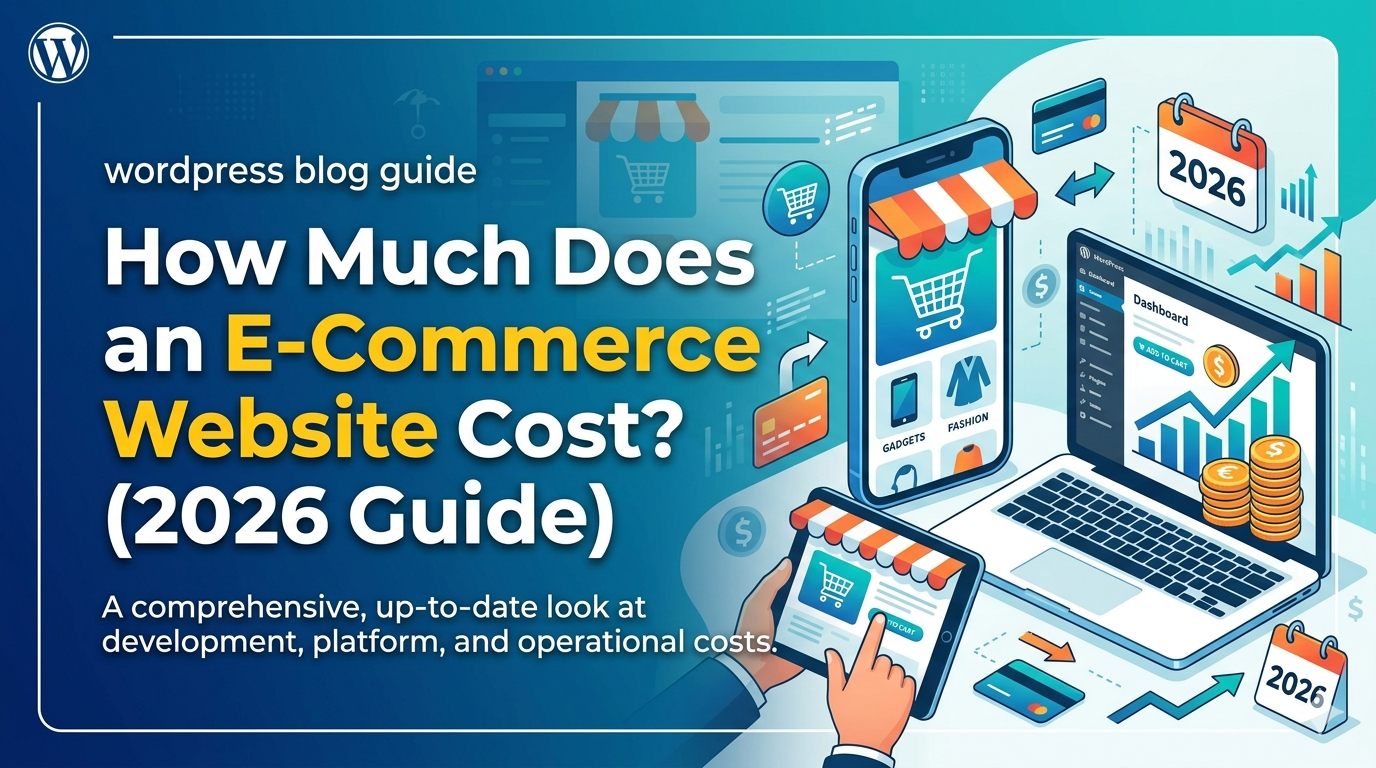
The range is genuinely wide: from $0 upfront for a DIY Shopify setup to $100,000+ for a custom enterprise platform. That’s not a dodge it reflects real differences in what you’re building, who builds it, and what platform it runs on. According to Statista’s e-commerce data, online retail continues to grow, making a well built e-commerce website cost a genuine business investment.
This guide breaks down exactly what drives e-commerce website costs, what you should expect to pay at each tier, and critically what the hidden ongoing costs are that most agencies don’t mention until you’re already signed.
By the end, you’ll know what a reasonable budget looks like for your situation and what to watch for when evaluating a quote.
Why E-Commerce Website Costs Vary So Much
Four factors account for most of the variation:
Platform: A Shopify subscription based store has a different cost structure than a self hosted WooCommerce build or a fully custom application. Shopify’s low upfront cost comes with higher recurring fees. WooCommerce’s lower ongoing costs come with higher upfront build investment. Custom has the highest upfront cost and the lowest per-transaction overhead at scale.
Scope: A 20 product simple store is not the same project as a 2,000 SKU catalog with variable products, subscription billing, and a B2B pricing tier. Scope the number of products, page types, unique features, and integrations – is the single biggest driver of build cost within any given tier.
Design: A template based build (buying a premium theme and customizing it) is faster and cheaper than a custom design. A custom design built from scratch for your brand delivers better performance, better differentiation, and no design ceiling, but costs more. The difference between “it looks professional” and “it was built for us” is real and measurable.
Who builds it: A solo freelancer offshore, a US based freelancer, a boutique agency, and a full service agency all price differently. So does the level of quality assurance, post launch support, and accountability that comes with each.
The 5 Cost Tiers
Tier 1: DIY SaaS Setup $0–$500 Upfront + $79–$399/Month
You build it yourself using Shopify’s interface and a free or included theme. No developer cost. You pay Shopify’s monthly plan fee, plus any apps you need.
What you get: A functional online store you manage yourself. Shopify’s built in checkout, payment processing (if you use Shopify Payments), and shipping calculator. A professional looking template shared with thousands of other stores.
What you don’t get: Custom design, performance optimization, SEO configuration beyond basics, or any professional guidance on catalog structure or conversion optimization.
Best for: Pre revenue projects and concept testing. Solopreneurs selling a single or small product line. Businesses where the website is a secondary channel, not the primary revenue driver.
The real cost: Don’t forget to add apps. Email marketing, reviews, upsells, subscription billing, advanced analytics a fully equipped Shopify store commonly needs $150–$400/month in apps on top of the plan fee.
Tier 2: Template Based Professional Build $2,000–$6,000
A developer (freelancer or agency) purchases a premium theme, customizes it to your brand, populates your catalog, configures payments and shipping, and hands it over. Available on both Shopify and WooCommerce.
What you get: A professional store that looks and works better than a solo DIY setup. Correctly configured payment gateway, shipping rules, and basic SEO settings. A developer who can answer questions during the process.
What you don’t get: A custom design (the template’s design limitations remain), performance optimization beyond the theme’s defaults, or significant post launch support beyond what you negotiated.
Best for: Small businesses with limited budgets that need a professional online presence quickly. Appropriate when the store is one part of a larger business, not the primary revenue channel.
Expect to revisit: Template based builds have a ceiling. Most businesses doing real volume revisit the decision in 2–3 years when the template’s constraints become real problems.
Tier 3: Custom WooCommerce E-Commerce $8,000–$20,000
A WordPress theme is built from code no page builder, no pre built template. The design is custom to your brand. WooCommerce is configured professionally with proper hosting, performance optimization, and SEO setup. This is the most common engagement for established small businesses where the online store is a primary revenue driver.
What you get: A fast, custom designed WooCommerce store on managed WordPress hosting. Performance scores that justify your investment (Google PageSpeed mobile 80+, Core Web Vitals passing). Full SEO control URL structure, schema markup, meta tags, sitemap configured correctly at launch. A codebase you own, on infrastructure you control.
What you don’t get: Custom application level business logic (multi vendor, complex configuration, proprietary system integration at depth). For those requirements, see Tier 4.
Best for: Established small businesses where the website is expected to generate meaningful revenue. Businesses with a content marketing or SEO growth strategy. Businesses transitioning from a template build or a platform they’ve outgrown.
DevVerx context: This is where most of our e-commerce work sits. Custom WooCommerce theme, proper hosting configuration, performance first build, and a defined post launch maintenance arrangement.
Tier 4: Custom E-Commerce Application $20,000–$60,000+
Your store is built from code not on WordPress or Shopify, but on a custom stack (MERN, Laravel, or similar). No platform constraints. Every feature is designed specifically for your business model.
What you get: A software product built for your exact requirements. Business logic that doesn’t exist as an off the shelf plugin. A codebase that extends cleanly as your requirements evolve. No dependency on a platform provider’s pricing decisions or product roadmap.
What you don’t get: The content management simplicity of WordPress, the built in app ecosystem of Shopify, or the cost efficiency of platform based development for standard requirements.
Best for: Businesses with unique purchasing flows (configure to order, multi vendor marketplace, complex B2B pricing). Deep system integrations (proprietary ERP, custom inventory system, contract based billing). Businesses where standard platform assumptions create real business constraints.
The cost justification: At $20,000–$60,000+ upfront, custom development needs to be justified by the business case. If WooCommerce can handle your requirements with one plugin, custom is overkill and a responsible development partner will tell you so.
Tier 5: Enterprise $60,000+
Large catalog operations, complex multi channel integrations, high transaction volumes requiring dedicated DevOps, and compliance heavy deployments. This is outside the scope of most small business e-commerce projects and outside DevVerx’s primary focus.
If you’re evaluating enterprise e-commerce, you’re likely already talking to Magento/Adobe Commerce, BigCommerce Enterprise, or headless commerce vendors.
What’s Included at Each Tier
| DIY | Template | Custom WooCommerce | Custom App | |
|---|---|---|---|---|
| Custom design | ✗ | Partial | ✅ | ✅ |
| Performance optimization | ✗ | Minimal | ✅ | ✅ |
| SEO setup at launch | ✗ | Basic | ✅ | ✅ |
| Managed hosting included | – | Sometimes | Usually | No (separate) |
| Post launch support | ✗ | Limited | Negotiated | Negotiated |
| Data ownership | Shopify’s servers | Varies | ✅ | ✅ |
| Custom functionality | ✗ | ✗ | Limited | ✅ |
| Core Web Vitals | Unpredictable | Varies | Passing (engineered) | Built to spec |
Hidden E-Commerce Costs Most Agencies Don’t Mention
The build cost is the visible number. These ongoing costs are what catch business owners off guard:
Hosting: $25–$80/month for managed WordPress hosting (required for a WooCommerce store that performs). Shopify includes hosting in the plan. Custom application hosting varies by architecture.
Maintenance: $150–$400/month for a WooCommerce store on a professional maintenance retainer plugin updates, security monitoring, performance checks, backup management, and emergency support. An unmaintained WordPress site accumulates vulnerabilities and performance debt.
Payment processing: 2.9% + $0.30 per transaction is the standard Stripe/PayPal rate. On Shopify, add 0.5–2% if you don’t use Shopify Payments. At $20,000/month in sales, that’s a meaningful number.
Apps and plugin licenses: WooCommerce plugin renewals run $100–$300/year. Shopify apps stack quickly $15–$50/month each for email, reviews, subscriptions, analytics, upsells. Budget $50–$300/month depending on your stack.
Product content: Photography and copywriting are usually not included in development quotes. Professional product photography runs $25–$75/image. Copywriting scales with catalog size.
Sales tax software: $19–$99/month (TaxJar, Avalara, or Shopify Tax) to handle automated multi state sales tax. Required if you sell to customers in multiple states.
Email marketing: Not included in the store platform. Klaviyo, Mailchimp, or similar runs $20–$300/month depending on list size.
The realistic monthly operating cost for a professional small business e-commerce store: $300–$600/month, all in.
Platform Fee Comparison: 3 Year Total Cost
Shopify’s $79/month plan looks cheaper than a $12,000 WooCommerce build until you do the full three year math.
| Shopify | Custom WooCommerce | |
|---|---|---|
| Initial build | $0–$500 (template) | $8,000–$15,000 |
| Monthly plan/hosting | $79–$399/month | $50–$80/month |
| Apps/plugins (annual) | $150–$400/month | $30–$100/month |
| Transaction fees | 0.5–2% (on non Shopify Payments) | $0 (standard gateway rates) |
| Maintenance | Minimal (Shopify manages) | $150–$300/month |
| 3 year total | $12,000–$35,000 | $17,000–$25,000 |
For a typical small business store, the 3 year total cost of ownership is often comparable. WooCommerce’s higher upfront cost is offset by lower recurring fees. The better question than “which is cheaper?” is “which gives me more of what I need?”
For the full platform comparison, see our Shopify vs. WooCommerce vs. custom guide.
How to Evaluate an E-Commerce Quote
When you receive a quote from a developer or agency, look for these:
A good quote includes:
temized scope specific deliverables, not “e-commerce website”
Platform and hosting recommendation with rationale
Timeline with milestones and revision cycles
Payment terms (typically 50% upfront, 50% on launch)
Defined post launch support what’s included and for how long
What happens after the project ends maintenance options
Red flags in a quote:
No itemized scope “full e-commerce website” with no specifics
Wildly below market pricing usually means cutting corners on performance, security, or support
No postl aunch plan the store needs maintenance; an agency that doesn’t offer it is leaving you exposed
Vague ongoing support or we’re available is not the same as a defined maintenance retainer
Questions worth asking:
What hosting do you recommend, and is it included?
What does the site look like on mobile PageSpeed?
What do you do when something breaks after launch?
What’s the plan if we need a new feature in six months?
Can you connect me with a current client to discuss their experience?
What DevVerx Charges and Why
We’re not the cheapest option in the market, and we’re not the most expensive. DevVerx holds a 4.8/5 verified client rating across our e-commerce engagements proof that professional quality and reasonable pricing aren’t mutually exclusive.
Most of our e-commerce work falls in the Tier 3 range $8,000–$20,000 for a custom WooCommerce build which is the right level of investment for a small business where the website is expected to generate revenue.
What’s included: a custom WordPress theme built from code (no page builders), WooCommerce configured on managed hosting, Core Web Vitals passing, full SEO setup at launch, and post launch maintenance options.
What we don’t do: template based builds for businesses where performance and customization matter, and projects where the budget doesn’t allow us to do it right. We’ll be direct about this in the first conversation.
If your budget is tighter than the Tier 3 range, see our honest take in our affordable e-commerce development guide.
Ready to talk about your project? Book a free strategy call we’ll give you a budget range before the end of the first conversation.
Explore our e-commerce development services.
Frequently Asked Questions
How much does an e-commerce website cost for a small business?
Template based builds run $2,000–$6,000. Professional custom WooCommerce stores run $8,000–$20,000. Custom application development starts at $20,000. These are build costs add $300–$600/month for hosting, maintenance, apps, and payment processing to get the full operating cost.
Is Shopify cheaper than WooCommerce?
Shopify is cheaper upfront (low or no build cost if you DIY, or lower cost for a template setup). WooCommerce often works out cheaper over three years because it has no monthly platform fee and no transaction fee surcharge. The right comparison is total cost of ownership over 2–3 years, not monthly plan price.
What’s the most expensive part of building an e-commerce store?
Design and custom development are the biggest drivers of build cost. A custom theme from code costs more than a template setup; custom application logic costs more than plugin based functionality. For ongoing costs, maintenance and payment processing are usually the largest line items.
Why do some agencies quote $2,000 and others quote $15,000 for the same project?
Usually it reflects real differences in what’s being delivered: custom design vs. template, performance optimization vs. default theme settings, proper hosting setup vs. shared hosting, post launch support vs. handoff and done. Occasionally it reflects offshore vs. US based labor rates. Ask exactly what’s included in each quote before comparing prices.
Do I need to budget for ongoing costs after my store launches?
Yes, always. Hosting, maintenance, payment processing fees, and apps are recurring costs that continue indefinitely. A realistic ongoing budget for a professionally built small business store is $300–$600/month. Build this into your business plan before committing to the build cost.