A mid level web developer in the US earns $85,000–$115,000 in base salary. Add benefits, payroll taxes, equipment, software licenses, and management overhead, and the loaded annual cost lands between $120,000 and $185,000. That is the number you are actually comparing when you look at a web development agency quote.
Most business owners never do that math. They compare the freelancer’s hourly rate to the agency’s project price, or they compare the developer’s salary to the agency retainer. Neither comparison tells the full story. The full story is what the in house option actually costs, what it does and does not cover, and whether your business genuinely has enough continuous development work to justify it.
This guide gives you that comparison clearly. By the end, you will know the real cost difference between a web development agency and an in house developer, the specific scenarios where each option genuinely makes sense, and the five questions that cut through the noise and get you to the right answer for your business.
Quick Answer: For businesses with high volume, continuous development needs where code is built and deployed daily, in house makes sense. For the majority of small and mid size businesses with project based or periodic web development needs, a web development agency delivers more capability at lower total cost with significantly less operational risk.
What You Are Actually Comparing
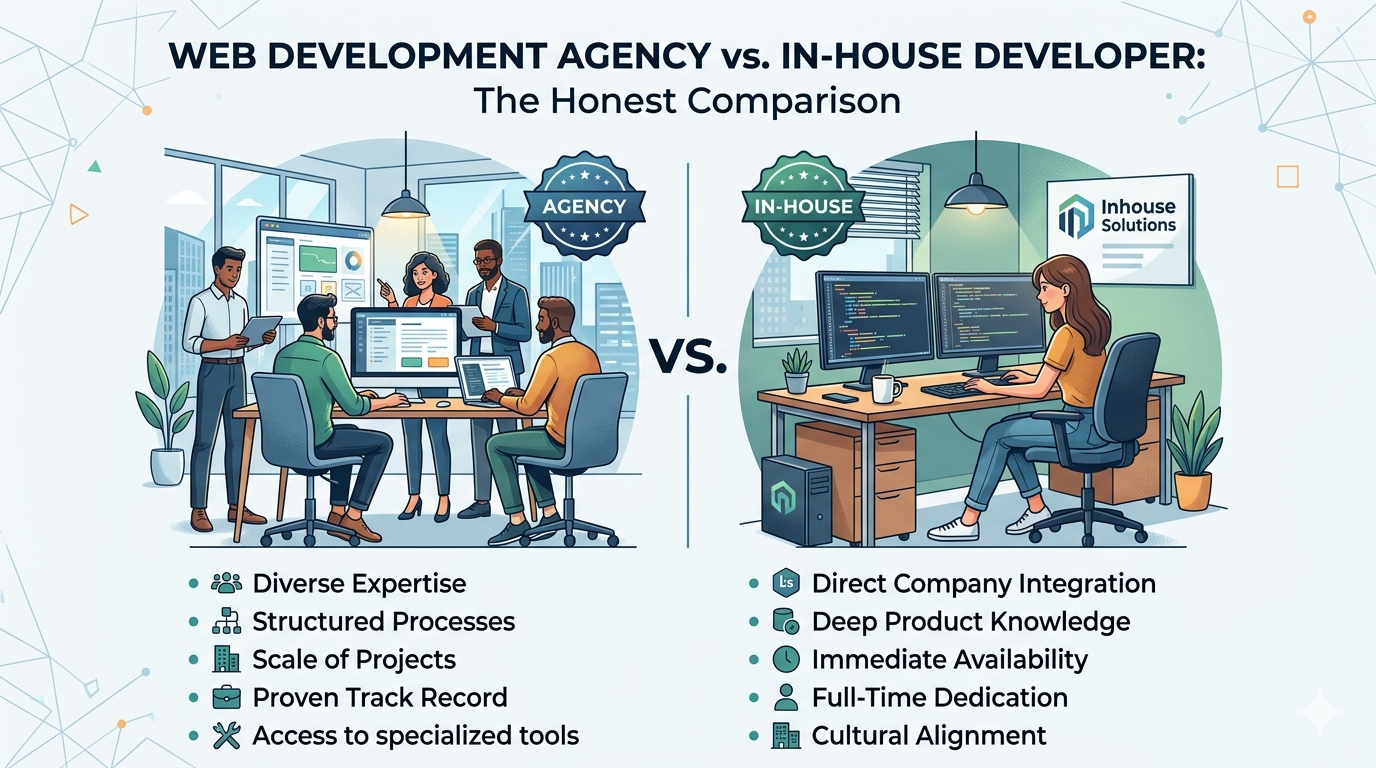
This decision is not as symmetrical as it looks. When you hire an in house developer, you are hiring one person with one skill set. When you engage a web development agency, you are buying access to a coordinated team: developers, designers, a project manager, QA engineers, and often a strategist who thinks about your business goals before writing a single line of code.
That gap matters more than most people realize before they have lived it.
What an in house developer delivers:
Dedicated availability during business hours
Deep familiarity with your codebase over time
Real time collaboration with your internal team
One specialty (front-end, back-end, WordPress, etc.), rarely all three
A fixed monthly cost regardless of how much work you actually have
What a web development agency delivers:
A full team covering design, development, QA, and project management
Multiple specialties in one engagement
Accountability as a business entity, not just an individual
Flexible scope, scale up for major projects, scale down for maintenance periods
Post launch support built into the relationship from day one
The honest framing: if you are choosing between an agency and one in house developer, you are not comparing equal things. You are comparing a person to a system.
The Real Cost of Hiring an In House Developer
The salary is not the cost. The salary is one line item in the cost. Here is what the full picture looks like for a mid level web developer in the US in 2026.
What the salary number hides
According to the US Bureau of Labor Statistics, the median annual wage for web developers is approximately $92,000. Mid level developers with three to five years of experience in competitive markets, React, WordPress, full stack, typically command $85,000–$115,000 in base salary.
That number is just the beginning.
Benefits and employer paid taxes add 25–35% on top of base salary according to SHRM’s employment cost research. That includes health insurance, dental and vision, 401(k) match, and employer side payroll taxes (FICA, FUTA, SUTA). On a $95,000 base salary, that is $23,750–$33,250 in additional annual cost.
Equipment and software run $3,000–$8,000 per year. A development workstation, software licenses, collaboration tools, and developer specific subscriptions add up fast.
Recruiting and hiring cost ranges from $8,000–$20,000 for a single hire. Job board fees, recruiter time, interview cycles, background checks, and offer negotiation all carry real cost. If you use a recruiting agency, add 15–20% of the first year’s salary.
Onboarding and ramp time means 45–90 days before the hire is operating at full productivity. According to LinkedIn Talent Insights, the average time to hire for a developer is 45–60 days before they even start. Add a 30–60 day ramp and you have roughly three months of close to full cost with partial output.
Management overhead is the hidden cost nobody puts in the spreadsheet. Developer management requires three to five hours per week minimum, sprint planning, code reviews, priority alignment, 1:1s. At an owner or manager’s time rate, that is $8,000–$20,000 in annual equivalent cost.
Put it together:
| Cost Component | Annual Estimate |
|---|---|
| Base salary (mid level) | $85,000–$115,000 |
| Benefits and payroll taxes (28%) | $23,800–$32,200 |
| Equipment and software | $3,000–$8,000 |
| Recruiting cost (amortized) | $3,000–$6,000 |
| Management overhead | $8,000–$20,000 |
| Total loaded cost | $122,800–$181,200/year |
For one developer. One specialty. One person.
The risks a salary sheet does not capture
Single point of failure. If your in house developer takes extended leave, resigns, or burns out, development stops. Not slows, stops. The average developer tenure in the US is 18–24 months. That means you are likely back in the hiring process within two years, paying recruiting costs again and absorbing another 45–90 day ramp.
Skill ceiling. A front-end developer is not a back-end developer. A WordPress specialist is not the same as a React developer. A single hire covers one part of the stack well. When your project needs something outside their specialty, you have a gap.
Utilization problem. Does your business have enough continuous development work to keep someone genuinely busy 40 hours a week, 52 weeks a year? Most small and mid size businesses do not. They have periodic projects interspersed with lighter maintenance periods. An in house developer in a light period is a fully burdened overhead cost with limited output.
Jordan ran a specialty retail business in Nashville. In 2023, he hired a full stack developer at $92,000, a move he was convinced would save money compared to agency costs. For the first six months, it worked. The developer built out a new WooCommerce store and kept busy. Then the major project wrapped.
For the following eight months, Jordan’s developer spent roughly 40% of their time on genuine development work. The other 60% was mixed administrative tasks, minor content updates, and projects that stretched to fill available hours. Jordan was paying $140,000 fully loaded for roughly $56,000 worth of productive development output. When the developer left for a larger company at month 14, Jordan was back to square one, and he called DevVerx.
What a Web Development Agency Costs, and What You Get
Agency pricing is project based or retainer based, and it scales with your actual needs.
For a small business site, a boutique agency like DevVerx runs $3,500–$15,000 for a full build, discovery, design, development, QA, and launch. For ongoing support and updates after launch, maintenance retainers typically run $500–$2,500 per month depending on scope.
Compare that to $122,000–$181,000 per year for an in house hire.
For a business that builds one major site every two to three years and needs periodic support in between, the math is not close. An agency project at $8,000 plus a $1,000/month maintenance relationship is $20,000 in year one and $12,000 in subsequent years. An in-house developer is $130,000+ every year, regardless of workload.
What that agency spend buys:
- A team of developers, not a single specialist
- A designer who is not your developer
- A project manager who runs the process so you do not have to
- QA testing before you see a bug
- A business entity accountable for the outcome, not just a person
- Flexibility to scale scope up or down based on your actual needs
For a detailed breakdown of what project pricing actually looks like across different business types, see our small business website cost guide.
When In House Makes Sense
In house development is the right call in specific circumstances. This article would be dishonest if it did not say so clearly.
Your development needs are continuous and high volume. If your business requires daily code pushes, new features, A/B tests, integrations, bug fixes, performance work, on an ongoing basis, in house makes economic sense. The fully burdened cost of $130,000+/year can be justified when the seat is genuinely full 40 hours a week, 52 weeks a year.
You are building a proprietary product. SaaS companies, tech platforms, and product led businesses where the code is the product benefit from deep institutional knowledge. A developer who lives inside your codebase for years understands its architecture in ways an agency working on a scoped engagement cannot replicate.
You have technical management capacity in house. Managing a developer well requires technical oversight, sprint planning, code review, architecture decisions. If your company already has a CTO or senior technical lead, adding a developer to that structure makes sense. Without that structure, the developer operates without accountability.
You have already validated the workload. Not theoretically, actually. If you can point to 12 months of development history and show that a full time developer would have been busy every week of it, you have a case for in house. If you are projecting forward from one upcoming project, you are guessing.
Sarah ran a SaaS company in Chicago with 18 employees. Her platform required continuous development: feature releases every two weeks, a mobile app in parallel, and constant integration work with third party APIs. She hired two in house developers at $95,000 each. Fully burdened, that was $280,000 per year. For her volume and continuity of work, it was the right call. Her developers were fully utilized, built deep product knowledge, and gave her the velocity her product roadmap required. In house was the correct decision, because the workload actually supported it.
When a Web Development Agency Is the Right Call
For most small and mid size businesses, the workload does not look like Sarah’s. It looks like a major project every 18–24 months with periodic maintenance and updates in between.
That pattern is exactly what agencies are built for.
Project based needs. If you need a site built, rebuilt, or significantly updated and then maintained, an agency scopes the project, delivers it, and transitions to a support relationship. No recruiting. No ramp time. No utilization problem.
Multiple disciplines required. Most web projects need design, development, QA, and often SEO and performance tuning. A single in house hire covers one of those well, maybe two. An agency brings all of them. For context on how long a professional website takes to build with a proper multi discipline process, the timeline differences between one person and a coordinated team are significant.
Speed matters. The average time to hire a developer is 45–60 days. Then add 30–60 days of ramp. An agency is available now. If you have a launch deadline, a campaign date, or a competitive window, that gap is real.
You have been burned by developer dependency before. Businesses that have experienced a key developer leaving mid project, or simply leaving, understand the operational risk of building on one person. An agency’s continuity structure is designed specifically to eliminate that risk.
When DevVerx worked with Dubai Fun Tour on their platform rebuild, the scope required coordinated work across development, UI/UX design, SEO architecture, and performance optimization, delivered as a unit on a defined timeline. One developer could not have executed that. The platform launched on schedule, handled international traffic, and improved conversion rates within the first 90 days. That outcome required a team, not a hire.
If you are also weighing a freelancer as a third option alongside in house and agency, our agency vs. freelancer comparison covers that decision in detail.
The Option Nobody Talks About: The Hybrid Model
Most articles frame this decision as binary. It is not.
Many businesses land in a middle position: they have ongoing light maintenance needs that do not justify a full time developer, but they also need periodic larger projects that require a full team. The hybrid model serves that reality.
Agency for the build, retainer for the ongoing. DevVerx builds the site or application, then transitions to a monthly maintenance retainer covering security updates, performance monitoring, content updates, and bug fixes. The client gets continuity and a team that already knows the codebase, without a full time salary on the payroll.
In house for content, agency for development. Some businesses maintain a marketing or content resource in house who handles day to day updates, while engaging an agency for development projects, technical changes, and performance work. This works well when the in house person has light technical literacy and the development needs are genuinely periodic.
Agency as the fractional dev team. Larger SMBs sometimes engage an agency on a structured monthly retainer, 20 or 40 hours per month, that functions like a part time in house team without the full time overhead. For what a full-service agency engagement at this level costs, the economics are often significantly better than a full time hire.
The hybrid model is worth considering if your honest assessment is that in house cannot be fully utilized, but you need more continuity than a pure project model provides.
Five Questions to Decide What Is Right for You
These questions cut through the noise faster than any framework.
1. How much development work do you actually have, continuously, not just for the next project?
Map out the last 12 months. How many hours per week would a developer have been genuinely busy? If the honest answer is 15–20 hours per week on average, you do not have full time utilization. An agency is more economical.
2. Can you absorb 45–90 days to hire and ramp before anything gets built?
If you have a time sensitive launch or competitive window, the hiring timeline alone may make in house impractical. Agencies start in days.
3. What happens to your business if that developer leaves?
If the answer involves operational disruption, projects stalled, institutional knowledge lost, recruiting cycle started again, that is the single point of failure problem in concrete terms. How much risk tolerance does your business have for that scenario?
4. Does your project require design, development, QA, and strategy, or just one skill?
Single skill need? In house may fit, or a specialist freelancer. Multi discipline need? That is agency territory. Almost all meaningful web projects require more than one discipline.
5. What is your honest 12 month development budget?
If the budget is under $150,000, in house is likely outside the range for a fully loaded mid level developer with proper benefits and recruiting cost. If the budget is $20,000–$60,000, that range covers significant agency project work and ongoing support, for a team, not an individual.
The Bottom Line on Agency vs. In House Development
The web development agency vs. in house developer decision comes down to one honest question: do you actually have enough continuous, high quality development work to justify the full loaded cost of a full time employee?
For most small and mid size businesses, the answer is no; not because they do not value web development, but because their needs are project based rather than continuous. Paying $130,000–$180,000 per year for work that genuinely requires $20,000–$40,000 per year is not a savings strategy. It is an expensive way to have someone available.
In house is the right call for product companies, SaaS businesses, and organizations with genuine daily development volume. For everyone else, an agency delivers more capability, more flexibility, and lower total cost, without the hiring risk, the utilization problem, or the single point of failure exposure.
The businesses that get this wrong almost always make the same mistake: they size the decision based on the upcoming project, not on the sustained workload. One major build ahead does not justify a full time hire.
DevVerx builds custom web development projects for small and mid size businesses across the US, from first professional websites to complex e-commerce platforms and custom web applications, with a 4.8/5 verified rating across 15+ years and 150+ US projects. If you are working through this decision and want a clear eyed assessment of what your project actually requires, book a free strategy call. We will tell you exactly what makes sense for your situation, even if that means recommending you hire in house.