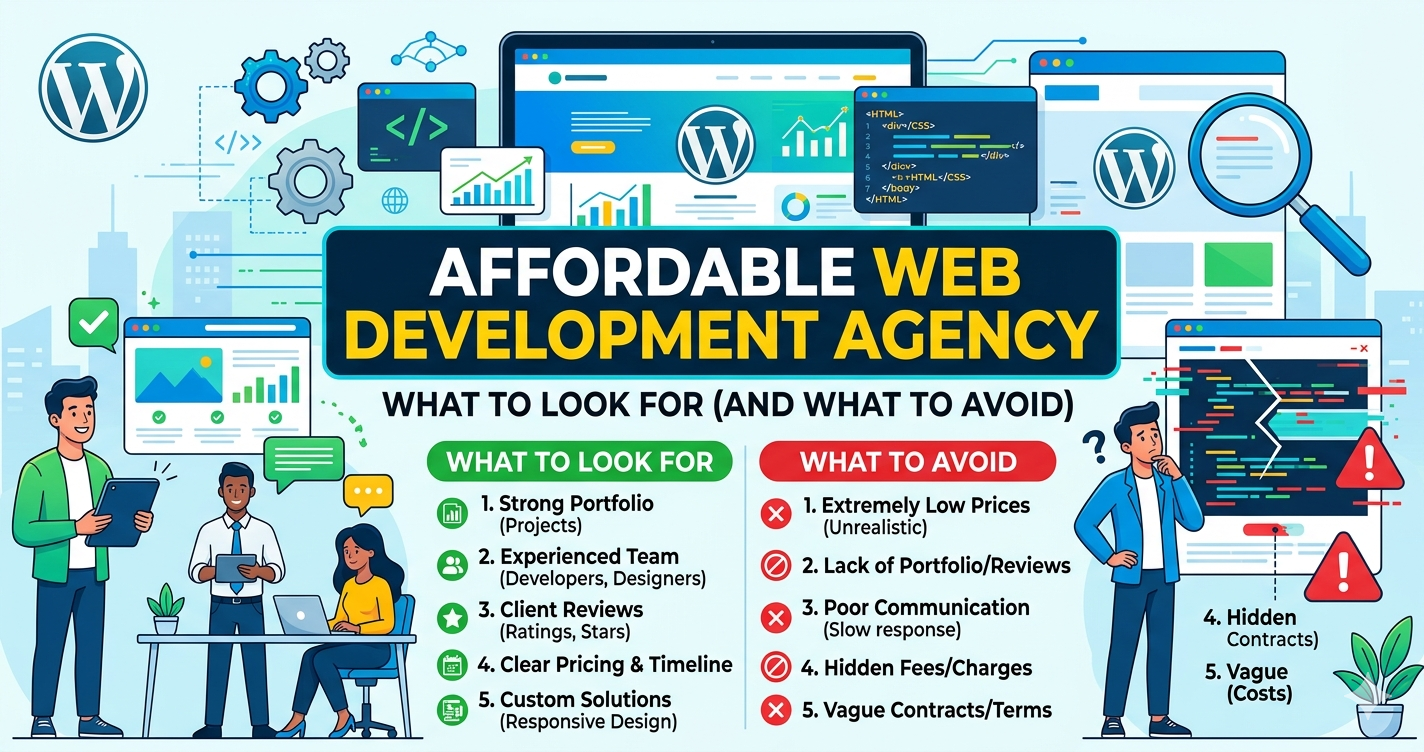
The word “affordable” appears on almost every web development agency website in the US. Most of them mean cheap. There’s a significant difference, and it’s going to cost you if you can’t tell them apart.
Most business owners evaluate an affordable web development agency the way they evaluate any purchase: find the lowest price and hope the output is good enough. That’s understandable, budgets are real, and a $9,000 agency quote is a serious number when you’re running a small business. But shopping on price alone is how business owners end up spending twice, once on the cheap option that fails, and again on the professional option to fix it.
By the end of this guide, you’ll know exactly what “affordable” should mean in web development, what fair pricing actually looks like across every tier, and the six specific signals that tell you whether an agency is genuinely affordable or just cheap with better marketing.
Let’s start with the word everyone misuses.
Cheap vs. Affordable: The Difference That Costs Thousands
These two words are not synonyms. Cheap describes the price. Affordable describes the value, what you get relative to what you pay. An agency can be cheap and terrible value. An agency can charge $7,000 and be genuinely affordable because the ROI justifies it. The confusion between these two ideas is where most web development disasters begin.
What “cheap” web development actually delivers
Cheap web development, whether from a Fiverr gig, an offshore team, or a no contract local provider, typically delivers one thing well: a low initial invoice. Everything after that gets complicated.
Cheap agencies and freelancers often skip the discovery phase (the structured process of understanding your business before writing a single line of code). They skip QA testing. They skip project management. They deliver something that technically exists on the internet, but may not load correctly on mobile, may not be optimized for search engines, and may not reflect what you actually asked for. And when something breaks, they’re often unreachable.
The bigger problem: cheap rarely stays cheap. Scope creep, revision cycles, and emergency fixes after launch add up fast.
What affordable web development actually delivers
Affordable web development means you’re getting strong value for the price, a site that’s built correctly, delivered on time, and performs reliably after launch, at a price that fits your business’s investment capacity. It means the agency ran a proper discovery process, wrote a scope you agreed on, delivered it on schedule, and is still reachable six weeks post launch when you need a change made.
Affordable doesn’t mean budget. It means the right price for what you’re actually getting.
For a small business owner, affordable website development for small business means one thing: a site that performs well enough to generate more revenue than it costs, built by a team that stays accountable through the full process not just until they’ve cashed the deposit.
Marcus’s story is worth telling here. He ran a service business and needed a professional website, nothing elaborate, a solid five page site with a contact form, service descriptions, and some SEO basics. He got three quotes: $2,600 from an Upwork developer, $5,200 from a boutique agency, and $11,000 from a larger firm. He took the $2,600 quote. Eight months later, he’d spent $6,800 across multiple revision requests, two stretches where the developer went silent for weeks, and a final push to a third contractor to finish the build. The site went live, but the SEO was a mess and mobile rendering was broken. The $5,200 agency quote would have had him live in six weeks with a full service build, QA, and support. He spent $1,600 more and got a significantly worse result.
That’s the cheap vs. affordable distinction in real life.
What Does an Affordable Web Development Agency Actually Cost?
The most common mistake business owners make when budgeting for a website is comparing the quote to the full cost of ownership. A freelancer’s $3,000 quote is not $3,000. It’s $3,000 plus your time managing the project, plus revision hours, plus QA failures you’ll catch after launch, plus the cost of any rework. A boutique agency’s $7,000 quote is often closer to $7,000, because project management, QA, and post launch support are already built in.
According to Clutch’s Web Development Pricing Guide, boutique agencies typically run $6,000–$12,000 for small business sites. That range often ends up comparable to or less than the full freelancer cost when you factor in rework and project management time. Here’s how the tiers actually break down:
| Option | Typical Range | What’s Included | What’s Often Missing |
|---|---|---|---|
| DIY builder (Wix, Squarespace) | $20–$50/mo | Templates, hosting | Your time, SEO constraints, platform lock in |
| Freelancer (Upwork/Fiverr) | $1,500–$4,000 | Development (one specialty) | PM overhead, revisions, QA, abandonment risk |
| Boutique agency | $4,000–$12,000 | Full service delivery | Minimal scope defined upfront |
| Enterprise agency | $15,000–$200,000+ | Enterprise scale delivery | Overhead passed to client, retainer requirements |
For most small businesses, the live comparison is between a freelancer around $3,000–$4,000 and a boutique agency around $6,000–$9,000. The gap looks significant until you populate the full cost of ownership column. When you account for project management time (yours, not theirs), revision cycles, QA gaps, and the risk of starting over, the gap often disappears, and sometimes inverts. For a detailed breakdown of how these costs actually compare, our full agency vs. freelancer comparison walks through the real numbers and risk factors side by side.
For a thorough breakdown of what drives these costs at each tier, our website cost guide for small businesses covers the full picture.
The real question isn’t “What’s the cheapest I can pay?” It’s “What’s the right investment for a site that actually performs?”
What an Affordable Web Development Agency Should Include
Not every agency that charges $6,000 is a boutique agency. Not every agency that charges $3,500 is a freelancer masquerading as a firm. The price tells you less than you think. What matters is what’s actually included in the scope.
A genuinely affordable web development company includes these elements without treating them as add ons:
Full service delivery. Design, development, QA testing, and project management should all be part of the scope. DevVerx’s custom web development services cover every layer of that stack from wireframe to post launch support without treating any of them as add ons. If you have to hire a separate designer, manage the developer yourself, or do your own QA, the agency’s price isn’t the real price.
SEO foundations built in from day one. A site that launches without proper title tags, meta descriptions, image alt text, sitemap structure, and site speed optimization is a site that starts behind. These aren’t optional extras, they’re part of a properly built site. If an agency treats them as a separate service to upsell, that’s a gap.
Post launch support defined upfront. Every site needs updates after launch. Bugs surface. Content changes. Google’s algorithm shifts. Ask before you sign: what does post launch support look like, and what does it cost? The answer should be specific, not vague. An agency that treats launch as a handoff and disappears is not a partner, it’s a vendor.
Transparent, fixed scope pricing. You should be able to read the proposal and understand exactly what you’re paying for and exactly what would trigger a change order. Vague proposals create expensive surprises.
Clear IP and code ownership at delivery. When the project is done, you own the code, the design assets, and the domain. Unconditionally. If an agency is evasive on this point, keep looking.
6 Signs an Agency Is Truly Affordable (Not Just Cheap)
Use this list before you sign anything. These are the signals that separate genuinely affordable agencies from the ones that present well in a sales conversation and deliver poorly afterward.
1. They run a discovery process before quoting.
A proper agency asks about your business goals, your audience, your technical requirements, and your timeline before they quote. Agencies that skip discovery and jump straight to a price are pricing on assumptions. Assumptions create scope creep. If they can quote you in 24 hours without understanding your business, that’s a red flag, not a convenience. Understanding how long a professional website takes to build by project type is also worth knowing before any agency conversation it lets you evaluate whether their proposed timeline is realistic or a promise they can’t keep.
2. You get a written scope with fixed deliverables.
The proposal should list exactly what will be built, what rounds of revisions are included, and what would trigger a change order. If it’s vague “professional website with all the features you need” the deliverable is undefined and the price is a floor, not a ceiling.
3. Their portfolio matches your project type.
An agency that has built 40 luxury brand sites may not be the right fit for a local service business. Look for projects at a similar scale, with similar functionality, and ideally in a sector adjacent to yours. If they can’t show you relevant work, ask how they’d approach your specific project type.
4. Reviews are specific, verified, and in volume.
One or two glowing testimonials on an agency’s own website mean almost nothing. Look for verified reviews on Clutch or Google reviews that include specific details like “delivered on time,” “fixed bugs within 24 hours,” or “the site ranked on page one within 60 days.” Volume matters too. A 4.8/5 rating from 50+ clients tells a different story than a 5.0/5 from four reviews.
5. Post launch support is defined upfront.
What happens after launch? If the agency treats this as a conversation to have later, or if the answer is “we’ll figure it out,” that’s a problem you’ll feel at the worst possible time, when something breaks. The terms of post launch support should be in the proposal, not negotiated after you’ve paid.
6. Payment is staged, not 100% upfront.
A reasonable payment structure is 25–50% at kickoff, with the remainder due at delivery or in defined project milestones. 100% upfront misaligns every incentive in the relationship. Once they have all the money, your leverage is gone. Any agency confident in its work has no reason to require full payment before starting.
Red Flags That Signal “Cheap” Disguised as “Affordable”
The previous list tells you what to look for. This one tells you when to walk away.
No written contract or scope of work. There is no legitimate reason a professional agency operates without a signed contract. The absence of one protects no one but the agency.
Vague answers about who builds the project. “Our experienced team will handle it” is not an answer. Who specifically will work on your project? What are their experience levels? A trustworthy agency answers these questions directly. Evasion is a signal they’re outsourcing to contractors they don’t manage well.
Full payment required upfront. Covered above this misaligns every incentive. Walk away.
No QA process mentioned. Quality assurance is not optional. If no one on the agency’s team is responsible for testing the site before launch, you’re the QA process, and you’ll find the bugs in the worst possible way.
Resistance to providing references. Any agency with a strong track record welcomes the reference check. Resistance, deflection, or “we can’t share client information” are patterns that rarely end well for the client.
Diane’s story is the cleanest example of this. She ran a boutique gift shop and wanted a new e-commerce site before the 2024 holiday season. She found an agency offering a “complete website solution” for $1,800 no contract, no scope document. She paid. She got a site. It wasn’t mobile responsive. The checkout flow was broken. When she flagged the issues, the agency became slow to respond, then stopped responding entirely two weeks after launch, right before her peak season. She brought the project to DevVerx. We rebuilt and fixed it at a cost of $4,500. Her total spent: $6,300. The original “$1,800 agency” was neither affordable nor professional. It was cheap, in every sense that matters.
The ROI Framing: What Affordable Really Means
Step back from the invoice for a moment. A website is not a cost, it’s an asset. The right framing for evaluating web development investment isn’t “how much does this cost?” It’s “how much does this generate?”
According to data from Marketing LTB’s Small Business Website Statistics, over 73% of small businesses report increased revenue after launching a professional website. And 31% of US shoppers have decided against purchasing from a small business specifically because the website looked unprofessional. Research by WordStream indicates that a well designed user interface can increase conversion rates by up to 200%.
When business owners search for a budget web development agency, what they’re usually after is the strongest return per dollar invested not necessarily the lowest invoice. That distinction is the entire point of this article.
The math on a $6,000 site that generates $40,000 in new business in its first year is completely different from the math on an $1,800 site that generates nothing, or worse, actively turns customers away.
A $6,000 site that works is more affordable than an $1,800 site that doesn’t. That’s what “affordable” actually means in this context: the return justifies the investment. The invoice is just one part of the calculation.
DevVerx has maintained a 4.8/5 client rating across 15+ years of projects with small and mid size businesses across the US. If you want to see what your budget can actually get you, start with a free strategy call.
How to Get a Fair Quote from an Affordable Web Development Agency
Knowing what to look for is one thing. Knowing the right questions to ask in the evaluation conversation is what separates informed buyers from ones who get burned. Before you sign with any agency, run through these five questions:
1. Who specifically will work on my project?
You want names and roles, not “our team.” Senior developer in the pitch, junior developer on delivery is a real pattern in agency land. Get specifics in writing.
2. What does your discovery process look like before you quote?
If they’ve already quoted you without conducting discovery, that’s your answer. A quality agency asks before it prices.
3. What’s included in the scope, and what would trigger extra charges?
Push for specifics. Rounds of revisions, third party integrations, content migration, training on the CMS every item that could become an extra invoice should be addressed in the proposal.
4. Can you share two or three client references from similar projects?
Similar in scale, similar in project type. A reference from a $50,000 enterprise project doesn’t tell you much about what your $7,000 small business site experience will look like.
5. What does post launch support look like and what does it cost?
The answer should be specific. A maintenance plan with defined response times and a monthly rate. Or a defined warranty period for bug fixes. “We’ll be available” is not an answer.
How to read a quote:
When you review a proposal, look for these elements before you consider the price:
- Fixed deliverables: You know exactly what will be built
- Staged payments: Not 100% upfront
- IP transfer clause: You own everything at delivery
- QA process mentioned: Someone is responsible for testing before launch
- Post launch terms: Defined, not vague
If any of these are missing, ask directly. The response tells you a lot about what working with that agency will look like. Our guide on how to choose a web development agency for small business covers the full evaluation process with additional questions to ask during vetting.
Conclusion: Affordable Means Value, Not Just Lowest Price
Affordable web development isn’t about finding the cheapest agency on Google. It’s about finding the agency that delivers the strongest return on your investment, at a price that makes sense for your business. Those are not the same thing, and confusing them is how business owners end up spending $6,300 to get something that should have cost $5,200 from the right partner in the first place.
“Affordable” and “professional” are not opposites. DevVerx’s 4.8/5 verified client rating proves that you don’t need a Fortune 500 budget to get enterprise quality results.
Tom runs a landscaping company in the Midwest. He was skeptical any real agency was in his budget. He was wrong. His DevVerx project came in at a price that fit his budget. His site went live in five weeks. Within 90 days, his landscaping business had its first Google page one ranking and was generating three inbound leads per week more than double his previous average from his old DIY site. He added a monthly maintenance plan shortly after. He considers it the best business investment he’s made. Not cheap. Affordable.
The difference is the return.
If you’re looking for affordable custom website development from a team that treats your business goals as seriously as their own, that starts with a clear scope, a real discovery process, and a partner who’s still reachable six months after launch.
Get a free project quote from DevVerx we’ll tell you exactly what your project requires, what it costs, and whether we’re the right fit. That conversation costs you nothing.