Most small business owners spend more time picking a logo than vetting the agency that will build their most important sales asset. Then they’re surprised when launch day slips six weeks, the quote doubles, and the development team stops returning calls.
You’ve probably heard a version of that story. Maybe you’ve lived it.
The web development industry has a real accountability problem, especially at the small business end of the market, where buyers have less leverage and fewer resources to absorb a bad outcome. Choosing the wrong web development agency for your small business doesn’t just waste money. It can set your growth back by months and leave you rebuilding from scratch.
This guide will change that. By the end, you’ll know exactly what a great web development agency looks like, what red flags to watch for, what to budget, and which questions will separate the real agencies from the ones that will cost you.
What a Web Development Agency Actually Does for Small Businesses
A web development agency is a team that handles the full lifecycle of your website or web application: strategy, design, development, quality assurance, launch, and ongoing support. You’re not hiring one person with one skill. You’re engaging a coordinated team with defined responsibilities and accountability built into the structure.
For small businesses, this distinction matters more than people realize. Small business web development done right means you get a digital asset that generates leads, not just a website that exists.
What’s Included in a Full Service Agency Engagement
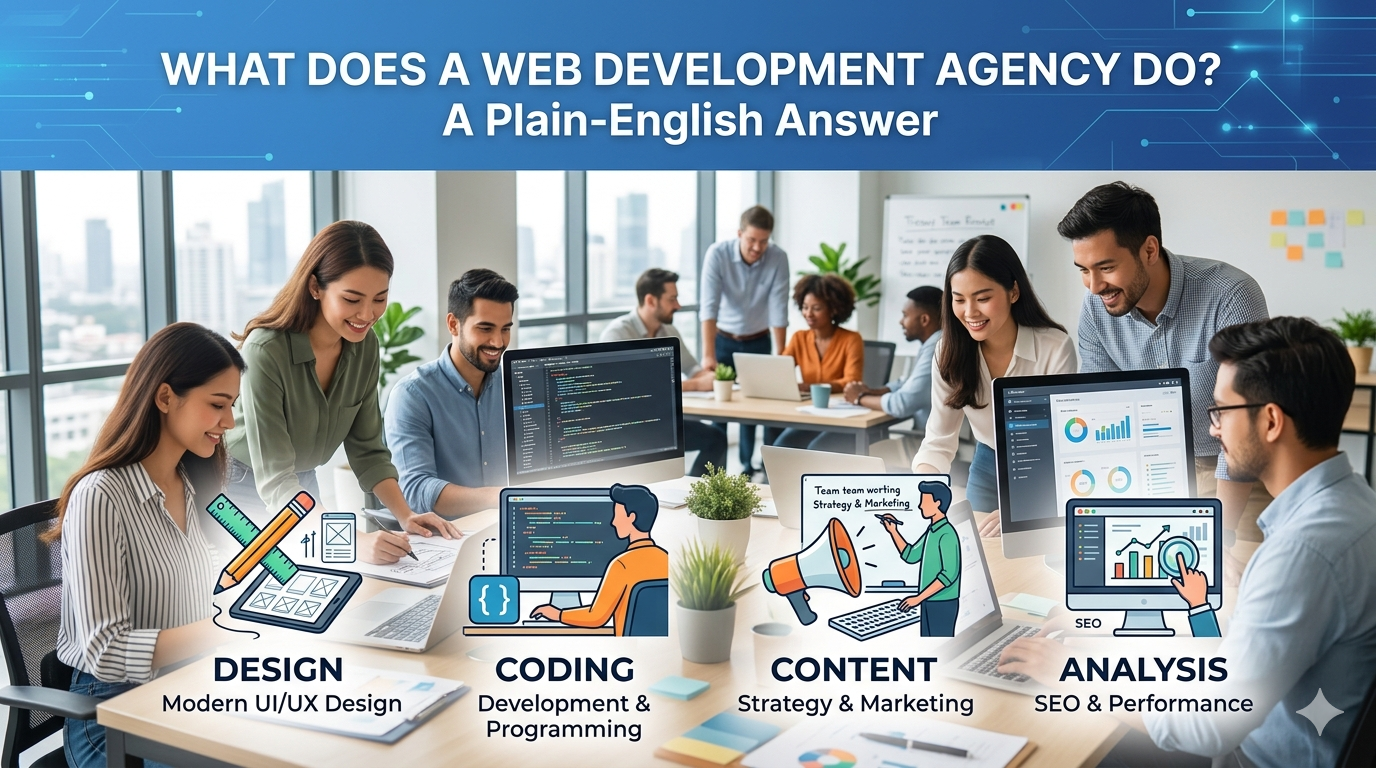
A legitimate full service agency covers all of the following:
- Discovery and strategy: Understanding your business goals, audience, and competitive landscape before writing a line of code
- UI/UX design: Creating wireframes and visual mockups that guide the user experience
- Front-end and back-end development: Building what visitors see and the systems that power it
- Quality assurance: Testing on multiple devices and browsers before anything goes live
- Launch and deployment: Coordinated site migration or new site launch with monitoring
- Post launch support: Ongoing maintenance, security updates, and feature additions
That’s a six discipline operation. A solo freelancer doesn’t cover all of it, which is exactly why the agency vs freelancer decision matters. If you’re comparing the two, our agency vs. freelancer comparison breaks down when each actually makes sense.
How This Differs from Hiring a Freelance Web Developer
A freelance developer typically specializes in one area: front-end design, back-end logic, or WordPress customization. They can execute a defined task well. What they can’t provide is coordinated delivery across disciplines, project management, QA coverage, and a post launch relationship.
For isolated, well defined projects, a freelancer can be the right call. For anything that needs to perform reliably as a business asset, the agency model is built for it.
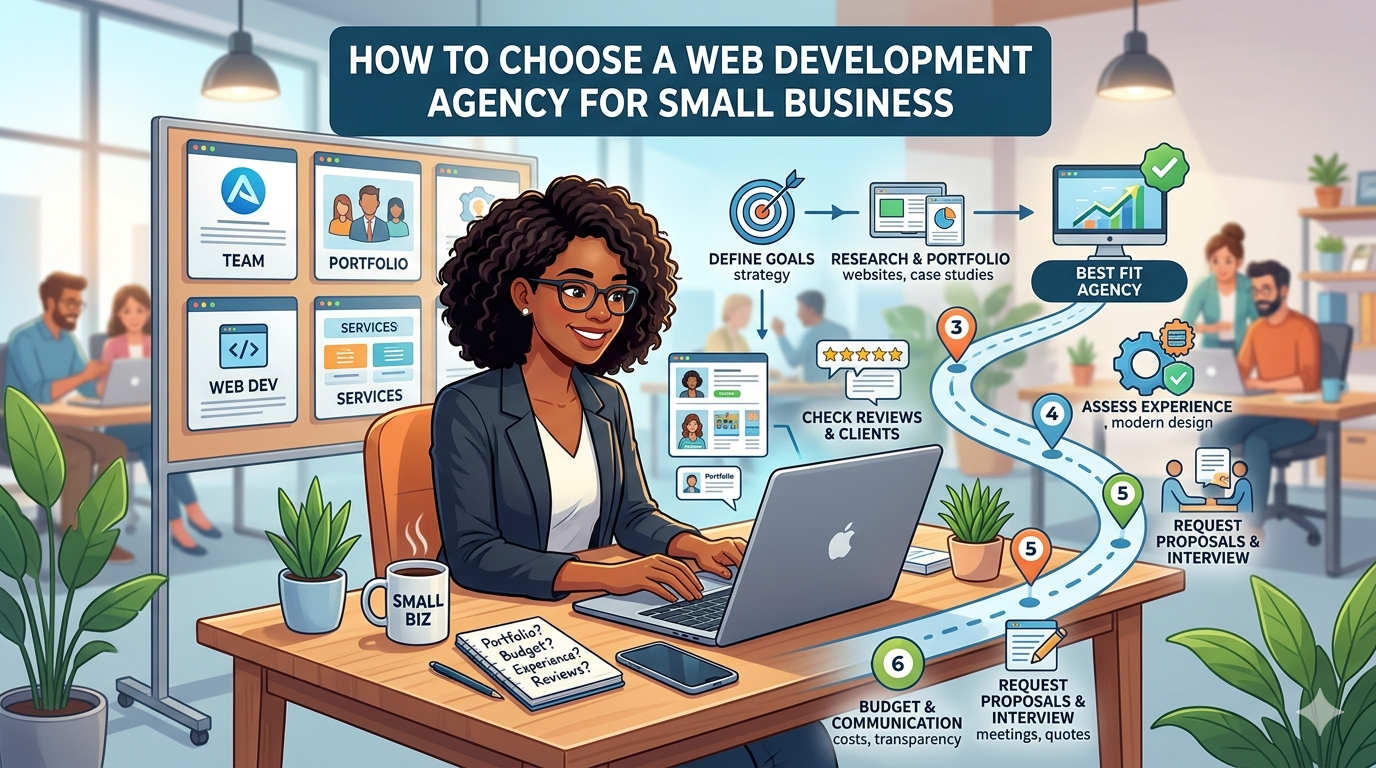
What to Look for in a Web Development Agency for Small Business
Not all agencies are created equal. Here’s what separates the ones worth hiring from the ones that will frustrate you.
- Relevant portfolio at your scale: A portfolio full of Fortune 500 work tells you nothing about how they handle a $6,000 small business project. Ask to see examples at your budget range and in your industry.
- Transparent team structure: Who specifically will work on your project? Junior developer? Senior? Offshore subcontractors? The sales team pitches you; the production team builds for you. Know who that is before you sign.
- A discovery process before pricing: Any agency that quotes your project within 24 hours without asking substantive questions about your goals is guessing. Guesses become scope creep, missed deadlines, and budget overruns.
- Verified third party client reviews: Clutch, GoodFirms, and Google Reviews all verify client relationships. Website testimonials do not. A 4.8/5 verified rating with detailed reviews from named clients is worth far more than five generic five star comments.
- A clear post launch support plan: What happens when something breaks three months after launch? Is that a retainer conversation, a per hour bill, or is it included? Get this in writing before you need it.
- Contract clarity on scope, revisions, and IP ownership: You own the code. You own the domain. You own all content and design assets. This should be unambiguous in the contract, not something you have to ask about after.
- Communication standards defined upfront: How often do they update you? Who’s your point of contact? What’s the expected response time? The agencies that are vague about this during the sales process stay vague after you pay.
Green Flags Worth Noting
The best agencies ask more questions than they answer in the first conversation. They show you work that didn’t go perfectly and tell you what they fixed. They introduce you to your actual project team, not just the person who sold you.
The Real Cost of a Web Development Agency for Small Business
Here’s the comparison most articles skip: real pricing by development option, not a meaningless $5K-to-$200K range.
If you’re researching what different options actually cost, our affordable web development agency guide covers the value vs price question in depth.
| Development Option | Price Range | Best For |
|---|---|---|
| DIY website builder (Wix, Squarespace) | $20-$50/month | Solopreneurs, placeholder sites, very limited budgets |
| Freelance web developer | $1,500-$5,000 | Simple brochure sites with narrow, clearly defined scope |
| Boutique web development agency | $4,000-$12,000 | SMBs needing strategy, design, development, and support |
| Mid market agency (WebFX, Thrive) | $10,000-$50,000 | Established businesses with complex needs |
| Enterprise agency | $50,000-$200,000+ | Large companies with enterprise scale applications |
Ready to see what your project would actually cost? Get a free, no-pressure quote from DevVerx and we’ll give you a real number based on your real scope.
DevVerx operates in the boutique agency range: full service delivery at SMB pricing. According to the Clutch Web Development Pricing Guide 2026, boutique agency pricing for small business projects typically falls between $6,000 and $12,000, a range that covers discovery, design, development, QA, and launch with post launch support built in.
For a detailed breakdown by project type and what’s included at each tier, see our small business website cost guide.
What Affects Web Development Agency Pricing
Project pricing varies based on platform choice (WordPress vs. custom), page count, custom features and integrations, design complexity, and timeline. A standard 10 page WordPress site with a contact form and basic SEO setup runs very differently from a custom web application with user accounts and payment processing.
Hidden Costs to Watch Before You Sign
This is where SMBs get burned most often:
- Hourly overflow: Vague scopes with hourly billing leave costs uncapped. Get a fixed price or a capped budget for any agency work.
- Revision limits: Some agencies cap revisions at two rounds. If you need a third, that’s an add on. Know this upfront.
- Content writing not included: Copywriting is often separate from development. Clarify who writes the page content.
- SEO setup not included: A site can be beautifully built and completely invisible to Google if on page SEO isn’t part of the scope.
- Maintenance not included after launch: Know whether post launch support is included for 30, 60, or 90 days, or whether it starts billing immediately.
Questions to Ask a Web Development Agency Before You Sign
Ask these before you commit. The answers will tell you everything.
- Who will specifically work on my project, names and roles? If they can’t answer, escalate. “Our experienced team” is not an answer.
- What does your discovery process look like before you finalize pricing? A legitimate agency has one. An agency guessing at scope doesn’t.
- Can you show me three portfolio examples at roughly my scale and budget? Impressive work at the wrong scale tells you nothing useful.
- How do you handle scope changes, and what do they cost? Scope changes happen. The question is whether they’re managed transparently or turned into surprise invoices.
- What is your post launch support policy? What’s covered? What’s billed? For how long?
- Who owns the website code, content, and domain at project completion? This should be in writing, not verbal reassurance.
- What does a realistic timeline look like for a project like mine? “Four to six weeks” is a realistic answer for a standard business website. “As fast as you need it” is a red flag.
Red Flags That Should Make You Walk Away
These aren’t minor concerns. Any one of these is a reason to move on.
- They quote you without asking about your goals. An agency that skips discovery is pricing assumptions, not your project.
- They can’t show relevant portfolio work. “Trust us” is not a portfolio.
- The salesperson disappears after you sign. If your main contact changes the moment you pay, you weren’t their priority.
- Full payment required upfront. A healthy payment structure is 25-50% upfront, with the balance tied to milestones or delivery. Full upfront is a risk you shouldn’t take.
- Vague answers about your tech access post project. You should be able to log into your own website, hosting, and domain registrar. If this is unclear, ask until it isn’t.
- No written contract or scope of work. Walk away. No exceptions.
- They promise guaranteed Google rankings or traffic results. No agency can guarantee organic rankings. Anyone who says otherwise is selling something they can’t deliver.
Web Development Agency vs Freelancer: When Each Makes Sense
This section exists because trust matters more than sales, and the honest answer is: sometimes a freelancer is the right call.
Consider a freelancer when:
- Your scope is narrow and clearly defined: a single landing page, a bug fix, a plugin customization.
- You have internal project management capacity to oversee the work.
- Your budget is genuinely under $2,000 and the scope fits within it.
- You need one very specific skill, not coordinated full service delivery.
Jennifer runs a small law firm in Austin. In 2024, she needed one change made to her existing WordPress site: a new intake form connected to her CRM. It took a developer three hours. A freelancer was exactly right for that task. Paying an agency’s project minimum would have made no sense.
The calculus shifts when you need coordinated strategy, design, development, SEO, and post launch support under one relationship. At that point, the accountability structure of an agency delivers real value that freelancer hourly rates can’t replicate.
For the full breakdown of when each makes sense and how the true cost compares, read our full agency vs. freelancer cost comparison.
What a Great Agency Partnership Looks Like After Launch
This is the most underrated section in any web development agency guide, because it’s where most agency client relationships break down.
According to Stanford’s Web Credibility Research, 75% of users judge a company’s credibility based on its website design. That judgment keeps happening every day after launch. The question isn’t just “who builds it?” It’s “who keeps it working?”
After launch, your website will need:
- Security updates: Plugins, themes, and CMS core files need regular patching. An unpatched WordPress site is a target.
- Performance monitoring: Page speed degrades over time as content accumulates and plugins multiply.
- Content updates: New services, updated pricing, seasonal promotions. If you can’t manage these yourself, you need a reliable partner who can.
- Bug fixes: Something will break. The question is how fast it gets fixed and what it costs.
Maintenance and Ongoing Support Options
Retainer model: Monthly flat fee covering a defined scope of updates, monitoring, and support. Predictable costs, predictable coverage.
Break fix model: You pay when something breaks. Unpredictable cost, slower response times during emergencies.
Managed care plan: Bundled maintenance that covers updates, backups, security monitoring, and a set number of content changes per month. Most SMBs are best served by this structure.
Ask your agency which model they offer before you sign. The agencies that don’t mention post launch support until after launch are telling you something important.
Why Boutique US Agencies Outperform Both Extremes
Most small businesses are choosing between two imperfect options: a large US agency that’s too expensive, or an offshore freelancer that’s too risky. The boutique US agency sits in the middle of that spectrum, not as a compromise, but as the option that actually fits.
| Factor | Large US Agency | Offshore Freelancer | Boutique US Agency |
|---|---|---|---|
| Price Range | $10,000-$50,000+ | $1,000-$5,000 | $4,000-$12,000 |
| Communication | Dedicated PM, slow escalation | Time zone gaps, variable | Direct access to your actual team |
| Accountability | Strong but corporate | Variable | High, reputation depends on it |
| SMB Focus | Nominal; enterprise first | Project focused only | Genuine, SMBs are the core client |
| Post Launch Support | Expensive retainer | Usually unavailable | Included or accessible |
| Quality Consistency | High but templated | Variable | High, small team, consistent standards |
Tom runs a regional HVAC company in Ohio. In early 2025, he had two quotes: $22,000 from a well known digital agency and $4,800 from a boutique agency. He went with the boutique. The site launched in five weeks. His organic lead volume increased by 34% in the first 90 days, because the boutique team built SEO foundations into the site from day one, not as an expensive add on.
Large agencies pass enterprise overhead to clients who don’t need enterprise scale. Offshore freelancers create communication and accountability gaps that cost money in rework and delays. A boutique US agency with a verified track record eliminates both problems.
DevVerx has maintained a 4.8/5 client rating across more than a decade of SMB projects, from Dubai Fun Tour’s online booking platform to 1World Resources’ enterprise web presence to ChildFree BC’s non profit site. See our custom web development services to understand what full service looks like at a boutique price point. The work varies. The standard doesn’t.
The Bottom Line: How to Choose the Right Web Development Agency for Small Business
Here’s what to take from this guide:
- Start with portfolio fit, not pricing: Find an agency with verified work at your scale before you compare quotes.
- Demand a discovery process: Agencies that quote fast are guessing. Guesses become overruns.
- Know who works on your project: The senior team sells; the production team builds. Find out which one you’re getting.
- Clarify post launch support before launch: This is where relationships break down most often.
- Watch for the red flags: No contract, full payment upfront, and guaranteed rankings are all reasons to walk.
- Boutique US agencies are the right fit for most SMBs: Full service delivery, real accountability, and pricing that works.
Choosing a web development agency for your small business is one of the most consequential vendor decisions you’ll make. Get the evaluation right and you’ll have a digital asset that generates leads, builds credibility, and scales with your business. Get it wrong and you’re rebuilding from scratch in 18 months.
DevVerx offers a free 30 minute consultation, no pitch, no hard sell, just honest advice about what your project needs and what it would realistically cost. Book your free consultation here and we’ll help you figure out the right path forward.