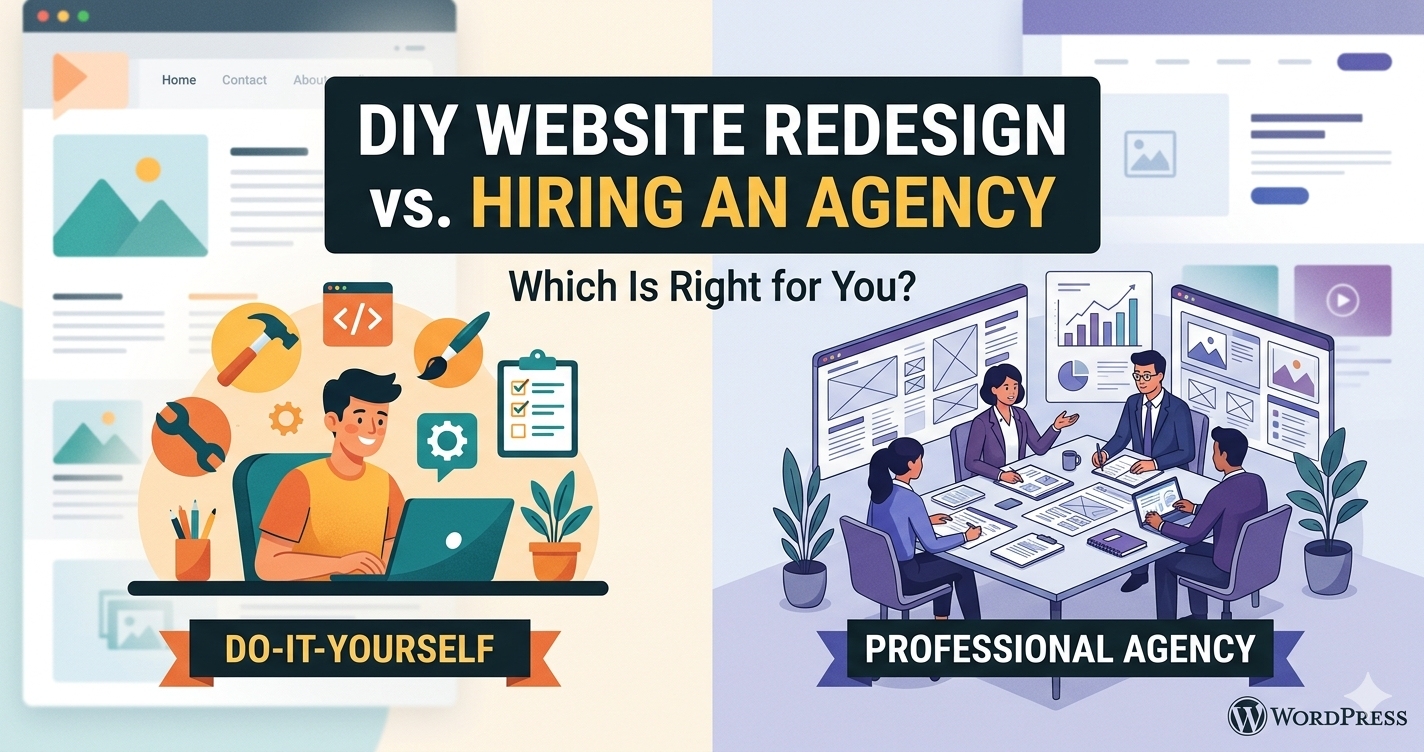
The first question most small business owners face when their website needs work isn’t “who should I hire?” it’s “should I even hire anyone at all?” Website builders have gotten remarkably capable, and the temptation to rebuild your own site is real, especially when you’re watching your budget.
But whether a DIY redesign or a website redesign agency is the right choice depends on your specific situation. This isn’t a question with a universal answer. The right approach depends on what you have now, what you need, and honestly what your time is actually worth.
This guide gives you an honest comparison so you can make the right call for your business.
The Case for DIY: When It Makes Sense
Let’s be direct: DIY website redesigns make sense in some situations. Here’s when they work.
Your site is genuinely simple
If you have five pages or fewer, no e-commerce, no custom functionality, and a very limited budget, a platform like Squarespace, Wix, or WordPress with a premium theme can produce a serviceable result. For a business that’s just establishing its online presence with a basic brochure site, the DIY route isn’t a bad starting point.
You have no organic traffic to protect
This is a critical factor. If your site currently gets meaningful traffic from Google, a DIY redesign carries real risk. Proper SEO migration URL redirects, metadata preservation, sitemap updates requires technical knowledge that most business owners don’t have. Make one wrong move with your redirect mapping and you can drop your rankings significantly. Google Search Central documents how to manage URL changes safely.
If your site currently generates almost no organic traffic, you have less to lose. The stakes of making a mistake are lower.
You actually enjoy this kind of work
Some business owners are genuinely capable designers and comfortable with website tools. If building a site is something you find satisfying and can do well, that’s a legitimate factor. The quality of a DIY site built by someone with design sensibility is very different from one built by someone who finds it frustrating.
Your budget is genuinely limited
If the choice is between a DIY site and no site at all, DIY wins. A basic Squarespace site is infinitely better than nothing. But if the real choice is between a $400/year Wix plan and a $7,000 agency built site, the ROI question is more nuanced than the price difference suggests.
The Hidden Cost of DIY: Your Time
The number one thing DIY proponents underestimate is the time cost.
Building a professional looking site with a website builder typically takes 40–100 hours for someone who isn’t experienced with the platform. Clutch research on web design timelines confirms that DIY projects routinely take longer than expected when business owners underestimate the learning curve. As a business owner, your time has a real dollar value. If your effective hourly rate is $75–$150 (a conservative estimate for an owner of an established business), 60 hours on a website redesign costs $4,500–$9,000 in opportunity cost before you account for the lost revenue from the sales, operations, and customer work you didn’t do.
That’s before factoring in the quality gap. Most DIY sites, even ones the owner is satisfied with, have recognizable tells that signal “template site” to visitors: generic stock photos, constrained layouts, default fonts, and navigation patterns that every Wix user shares. These signals affect whether visitors trust you enough to contact you.
The Case for Hiring a Website Redesign Agency
Hiring an agency makes sense in far more situations than many small business owners initially assume. Here’s when the decision becomes clear.
You depend on your website for leads or sales
If your website is a primary source of business for you whether through organic search, paid ads, or direct traffic the quality of the site is directly tied to your revenue. A professional redesign that improves conversion rate from 1.5% to 3% on a site that gets 500 visitors per month doesn’t just look better. It generates more customers.
You currently rank for keywords on Google
Protecting your existing SEO is a technical process that requires experience. Agencies handle this as standard practice redirect mapping, metadata migration, sitemap management. If you currently rank for any search terms your customers use, working with professionals who can preserve those rankings is worth the investment.
You need custom functionality
Booking systems. Member portals. Client login areas. E-commerce with real inventory management. None of these are things a website builder handles well. If your business needs any custom functionality, you need a developer either a freelancer or an agency.
Your time has a high opportunity cost
The time a business owner spends on a DIY redesign is time not spent on sales, client work, and operations. For many small business owners, the agency fee is well below the value of the time they’d otherwise spend on the project.
You’ve tried DIY before and weren’t satisfied
There’s a common pattern: business owner builds a site on Wix, launches it, is disappointed by the results, then hires an agency anyway. The agency first path, while more expensive upfront, is often cheaper total because you avoid the failed DIY attempt and its time cost.
The Freelancer Middle Ground
Between full DIY and a full service agency sits the freelancer option. A skilled independent web developer can redesign your site at a lower cost than most agencies and produce genuinely professional results.
The trade offs:
Single point of failure: Freelancers get sick, overwhelmed, or take on too many projects. A team has redundancy.
Scope limitations: A solo developer may handle build but not design or SEO, requiring you to coordinate multiple contractors.
No post launch support structure: When something breaks three months after launch, a freelancer may or may not be available to fix it.
Accountability: An established agency has reputation and business continuity. A freelancer on Upwork has a profile and reviews.
For simple sites with a client who can manage some of the coordination, a skilled freelancer is a solid middle ground. For anything complex, or for business owners who want the project managed from end to end, an agency is the more reliable option.
Our article on how to choose a web development agency walks through how to evaluate agencies specifically what to look for and what to watch out for.
Side by Side Comparison
| Factor | DIY (Builder) | Freelancer | Agency |
|---|---|---|---|
| Upfront cost | $0–$600/year | $1,500–$8,000 | $5,000–$20,000+ |
| Your time investment | High (40–100+ hrs) | Medium (10–30 hrs) | Low (10–20 hrs) |
| Design quality | Template constrained | Variable (skill dependent) | Professional custom |
| Custom functionality | Limited | Possible | Full capability |
| SEO preservation | High risk without expertise | Depends on freelancer | Standard process |
| Post launch support | None | Variable | Structured support |
| Accountability | You | One person | Team with process |
Questions to Ask Yourself Before Deciding
Use these questions to clarify your situation:
- How much organic search traffic does my current site get? If it’s significant, can I risk losing it during a DIY rebuild?
- How many hours per week can I realistically spend on this for the next 6–8 weeks?
- Does my site need any functionality a website builder can’t handle well?
- What is my effective hourly rate? Does the DIY time investment actually cost less than hiring an agency?
- Have I tried DIY before? What was the result?
- Is my current site’s performance (leads, conversions, rankings) important enough to warrant a professional approach?
If you answer “my traffic matters,” “my time is limited,” or “yes, I need custom features” the agency route is probably the better business decision.
What to Look for in a Website Redesign Agency
If you decide to hire an agency, the right choice matters almost as much as the decision to hire one. A few things to evaluate:
Process transparency: A good agency explains their process clearly before you sign anything. Discovery, design phases, review rounds, development, QA, launch each step should have a clear description and timeline.
Portfolio relevance: Look for examples that match your business type. A portfolio heavy in e-commerce is less relevant if you need a professional services site. Ask for case studies with results, not just visual examples.
SEO competence: Ask specifically how the agency handles SEO during a redesign. If they don’t mention URL redirects, metadata migration, and post launch monitoring, that’s a warning sign.
Post launch commitment: What’s included after launch? Most quality agencies offer at least a short support window post launch, with options for ongoing maintenance.
For a full vetting framework, see our detailed guide on choosing a web development agency for your small business.
DevVerx has handled website redesigns for businesses across travel, enterprise services, and nonprofit bringing the same full service process (strategy, design, development, SEO, and post launch support) to each project. Rated 4.8/5 by verified clients, our pricing is consistently 40–60% below comparable agencies while delivering equivalent results. You can review our web development services to see what we build.
The Bottom Line
DIY website redesigns work for simple sites with no organic traffic to protect and a business owner who has time and design aptitude. For most small businesses especially those that depend on their website for leads, rank for search terms, or need anything beyond the most basic functionality hiring a qualified agency is the better business decision.
The real question isn’t just “how much does this cost?” but “what is my current site costing me every month it underperforms?”
Contact DevVerx for a free strategy call. We’ll review your current site, define what a redesign would actually involve for your business, and give you a clear, honest proposal. No pressure just a real conversation about what makes sense for you.
For the full overview of what a redesign involves from start to finish, read our complete guide to website redesign for small businesses.