Most businesses don’t need custom e-commerce website development. Shopify and WooCommerce handle the vast majority of what small and mid sized businesses actually need to sell online and recommending custom development when a platform would work is how development agencies run up invoices, not how they serve clients. For a thorough overview of what e-commerce website development involves across all tiers, start there before evaluating a custom build.
But some businesses do need it. When your purchasing flow doesn’t fit a linear add to cart model, when your business logic requires calculations or decisions that happen before the price is even determined, when you need deep integration with a proprietary system that’s when custom development stops being overkill and starts being the only option.
This guide is about knowing which situation you’re in.
What “Custom E-Commerce” Actually Means
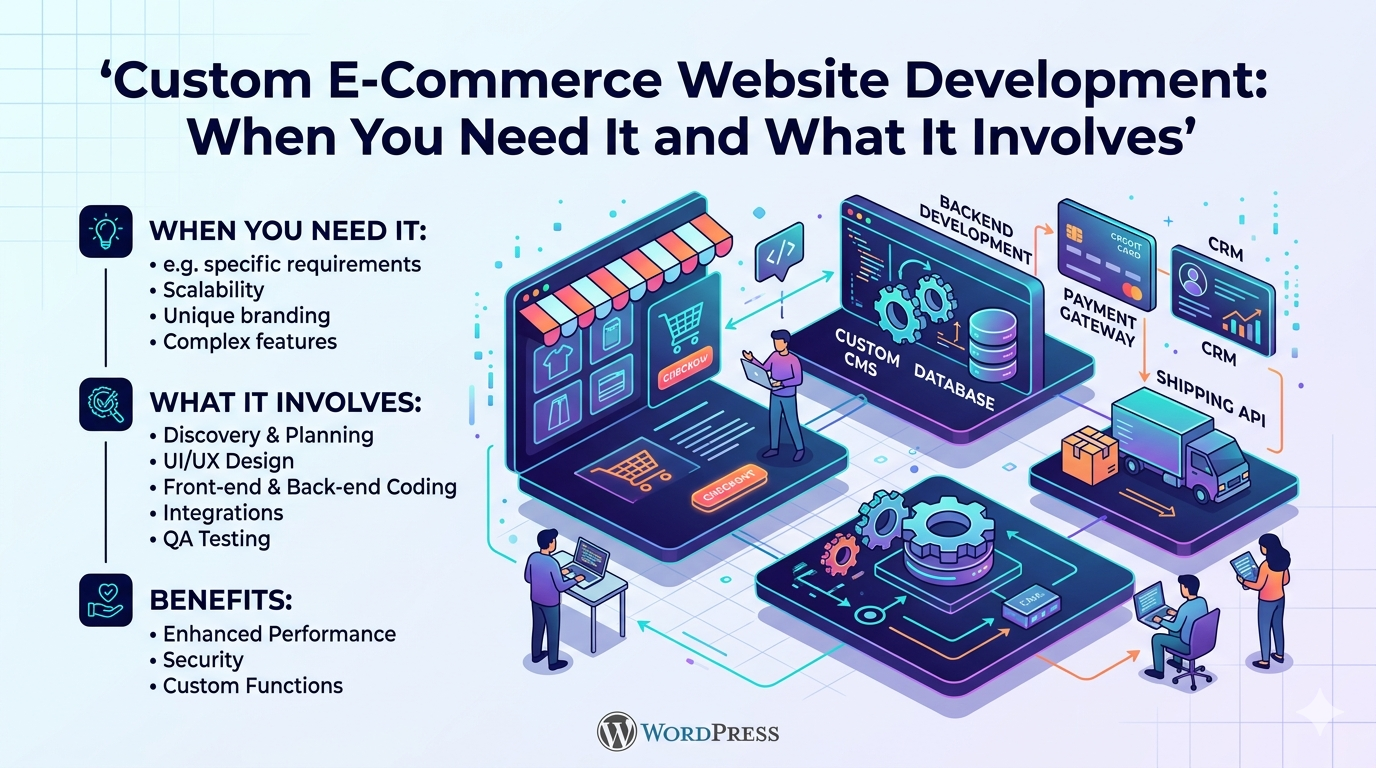
Custom e-commerce development means building your online store from code written specifically for your business not on Shopify’s SaaS platform, not on WooCommerce’s plugin framework, but on a codebase that belongs entirely to you and is designed entirely around your requirements.
In practical terms at DevVerx, custom e commerce runs on two stacks:
MERN stack (MongoDB, Express.js, React, Node.js): A JavaScript based architecture that runs consistently from database to frontend. MERN is best suited for stores with real time features (live inventory, dynamic configurators, instant pricing calculation), heavy React based UI requirements, and development teams that work primarily in JavaScript. The API first architecture makes MERN the natural foundation for headless or multi channel commerce.
Laravel/PHP: A mature PHP framework with strong ORM, query builder, and server side templating. Laravel is often the better choice for stores with complex data relationships, high transaction volumes that benefit from relational database structure, and backends that need traditional server rendered pages alongside any API endpoints. Most complex B2B e-commerce built in the last decade runs on Laravel or a similar PHP framework.
Both stacks produce production-ready, maintainable code that your team can own long-term. The choice between them depends on your requirements and the team that will maintain the codebase.
When Custom E-Commerce Is the Right Answer
Your purchasing flow doesn’t fit a linear model
Standard e-commerce platforms assume a specific flow: browse → select → add to cart → checkout. If your customers need to configure before they can purchase selecting components, specifying dimensions, answering a series of questions that determine the final product and price that assumption breaks down.
Plugins and apps can approximate configure to order flows on Shopify and WooCommerce, but they’re fighting the platform’s assumptions. Complex configurators on top of a standard platform tend to be slow, fragile, and expensive to maintain. A custom built configurator is faster, more reliable, and designed for exactly what you need.
You need a multi vendor marketplace
A platform where multiple independent sellers list their products, where commissions are calculated per transaction, where seller dashboards and payout schedules need to be managed this is a different application category than a standard store. WooCommerce has marketplace plugins, but they’re stretched to their limits on complex marketplace requirements. A properly architected custom marketplace is a fundamentally different project.
Your B2B requirements are complex
B2B e-commerce involves: company level account structures, contract pricing that overrides list pricing, net terms and invoice billing, purchase order workflows with approval chains, requisition lists, and minimum order quantities by product category. Standard platforms can handle some of these with plugins. When they all need to work together, cohesively, for an existing B2B customer base custom is usually cleaner than a stack of plugins fighting each other.
You need deep integration with a proprietary system
Integrating with Stripe, Mailchimp, or a standard 3PL is well supported on any platform. Integrating with a proprietary ERP that was built in 2008, a legacy inventory system that communicates via SFTP file drops, or a pricing engine that runs your industry’s specific calculation rules that requires custom integration work regardless of which platform you’re on. If you’re going to write significant custom integration code anyway, building on a custom foundation you fully control is often more rational long term.
Your projected scale creates platform constraints
WooCommerce runs efficiently for most small business stores. According to BuiltWith’s e-commerce data, WooCommerce powers a significant share of online stores globally but at 50,000+ SKUs with complex variable product relationships, at thousands of concurrent users during peak periods, or at transaction volumes that push the limits of shared database tables you may encounter constraints that are difficult to resolve without architectural changes that effectively amount to custom development anyway. Building custom from the start, designed for your actual data model and load profile, can be the cheaper decision over a 5 year horizon.
When Custom E-Commerce Is Overkill
Honest answer: most of the time.
You want a unique design: Custom design is solved by building a custom WooCommerce theme not by building a custom platform. A skilled WordPress developer can build a bespoke design on WooCommerce that looks completely unlike any other store. You do not need a custom application for a unique visual design. Our WordPress vs. custom development guide covers exactly when each approach is appropriate.
You need a feature that exists as a WooCommerce plugin: Subscriptions, bookings, downloadable products, wholesale pricing, bundles, gift cards, wishlists these all have mature WooCommerce plugin implementations. Before scoping custom development for any of these, evaluate whether the plugin version meets your needs.
Your catalog is large but standard: 1,000 SKUs of simple physical products is a WooCommerce project, not a custom application project. Catalog size doesn’t determine the need for custom catalog complexity and purchasing flow do.
You’re not ready to manage a software application: A custom e-commerce application is software. It requires developers to maintain, extend, and debug. If you don’t have a development team or a clear path to ongoing developer support, you should strongly consider a platform based approach that has a broader support ecosystem.
The test: can Shopify or WooCommerce handle your requirements with standard functionality or one well supported plugin? If yes custom is overkill.
What the Build Process Looks Like
A custom e-commerce build has a different process from a platform based build. Here’s what to expect:
Discovery and requirements: 2–4 weeks of structured requirements gathering. Business logic mapping, data model design, integration specifications, and UX wireframes before a line of code is written. This phase is more extensive than a WooCommerce project because there are no platform defaults to fall back on. Everything is designed from scratch.
Architecture and technical design: 1–2 weeks. Database schema, API structure, authentication model, third party integrations, hosting architecture, and CI/CD pipeline design. This doesn’t happen in WooCommerce projects because the platform makes most of these decisions. In custom development, they’re explicit choices.
Development: 6–12 weeks for a standard custom store. Frontend and backend developed in parallel. API integrations built and tested in a staging environment. Admin panel development (or integration with an existing back office system) included.
QA and testing: 2–3 weeks. Cross browser, cross device, payment testing, load testing, edge case testing. Custom applications require more testing than platform builds because there’s no platform QA baseline.
Launch and stabilization: 1–2 weeks. Go live in a controlled way (soft launch or phased rollout), monitoring, and rapid response to any production issues.
Total timeline: 12–20 weeks for a production ready custom e-commerce application. Significantly longer than a WooCommerce build plan accordingly.
Cost and Timeline
| Project Type | Timeline | Starting Cost |
|---|---|---|
| Basic custom e-commerce (MERN/Laravel) | 12–16 weeks | $20,000 |
| Custom store with configurator | 14–18 weeks | $30,000 |
| Multi vendor marketplace | 16–24 weeks | $40,000+ |
| Complex B2B platform | 20–30 weeks | $50,000+ |
These are starting points. Actual cost depends on: scope specifics, number of integration points, catalog complexity, admin panel requirements, and whether the client has technical staff who can handle portions of the work.
Ongoing costs after launch: Hosting (cloud infrastructure, typically $80–$200/month depending on scale), and ongoing development (maintenance, feature additions, security updates) either on a retainer or on call. Budget $500–$2,000/month for a custom e-commerce application operating in production.
The business case for custom development: if the platform constraints would cost you more in conversion rate, missed functionality, or ongoing workaround development than a custom build, custom is the right investment. Run the numbers before deciding.
How DevVerx Builds Custom E-Commerce
We build on MERN and Laravel depending on requirements, and maintain a 4.8/5 verified client rating across our e-commerce engagements. Our process for custom e-commerce:
Discovery first: We won’t scope a custom project without a discovery phase. The requirements need to be understood before the cost can be real.
API first architecture: Whether MERN or Laravel, we build APIs first and frontends against them. This gives you flexibility: add a mobile app, a wholesale portal, or a different frontend later without rebuilding the backend.
Admin panel included: Every custom store needs an admin panel for catalog management, order processing, and reporting. We build this as part of the project scope not as an afterthought.
Staging environment and CI/CD: Automated deployment pipeline, staging environment that mirrors production, and rollback capability. Updates go through staging, not directly to your live store.
Post launch retainer: Custom applications need maintenance. We offer a defined retainer for ongoing updates, feature additions, and production monitoring.
Explore our e-commerce development services or start a conversation about your requirements.
For context on where custom development fits relative to Shopify and WooCommerce, see our platform comparison guide. For a full cost breakdown across all e-commerce tiers, see our e-commerce website cost guide.
Frequently Asked Questions
What is custom e-commerce website development?
Custom e-commerce development means building an online store from code written specifically for your business not on Shopify, not on WooCommerce, but on a custom tech stack (MERN, Laravel, or similar) designed around your exact requirements. No platform constraints, full ownership of the codebase.
When should a business choose custom e-commerce over Shopify or WooCommerce?
When your business logic doesn’t fit the platform’s model: configure to order products, multi vendor marketplace, complex B2B workflows, or deep integration with a proprietary system. If a WooCommerce plugin or Shopify app can handle what you need, custom development is overkill.
How much does custom e-commerce development cost?
Custom e-commerce applications start at $20,000 for basic stores and reach $50,000+ for complex configurations. Add $500–$2,000/month for ongoing hosting and maintenance. The cost is justified when platform constraints would cost more over time than a custom build.
What tech stack does DevVerx use for custom e-commerce?
MERN (MongoDB, Express, React, Node.js) for JavaScript first applications and real time features; Laravel/PHP for complex relational data, high transaction volume, and server side rendering requirements. The choice depends on your specific requirements and the team that will maintain the codebase.
How long does custom e-commerce development take?
12–20 weeks for a production ready custom application. Discovery and architecture phases are more extensive than platform builds this is not a project to rush. The up front planning time directly reduces rework and post launch bugs.