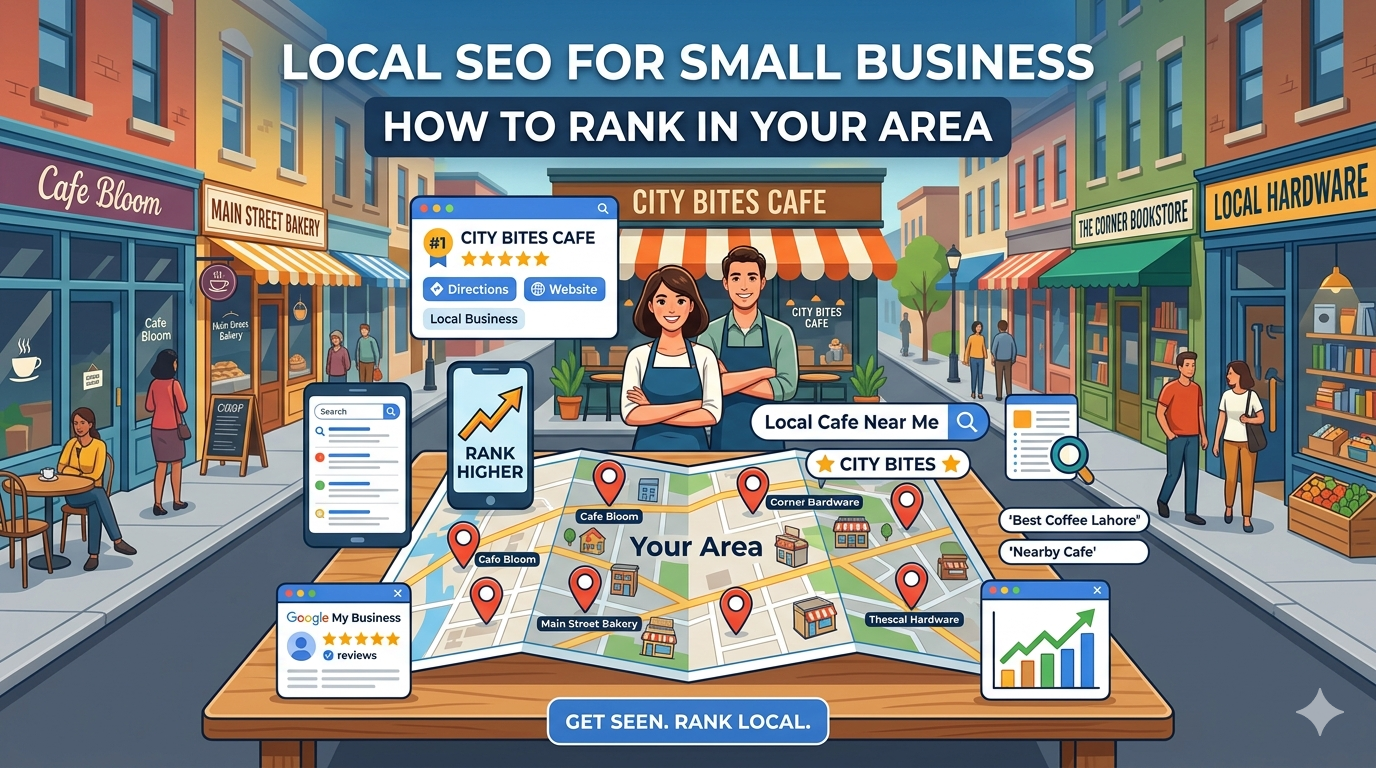
When someone in your area searches for the service you provide and you do not show up a competitor gets the call. That gap between being invisible and being the first result on Google Maps is what local SEO closes.
Local SEO for small business is the set of strategies that determine how prominently your business appears in Google’s local search results: the map pack, the Google Business Profile, local organic results, and “near me” searches. Unlike broad SEO, local SEO is geographically targeted you are not competing against the whole internet. You are competing against the handful of businesses near you that serve the same customers.
For most small businesses that operate in a defined geographic area restaurants, contractors, healthcare providers, retail stores, professional services local SEO is the highest ROI digital marketing investment available. This guide covers everything you need to know to rank in your area, including the tactics that matter most in 2026.
For the broader digital marketing context, see our complete digital marketing guide for small business.
What Is Local SEO and How Does It Differ from Regular SEO?
Regular SEO focuses on ranking in national or global organic search results the ten blue links that appear when you search a general topic. Local SEO focuses on ranking in the local search ecosystem, which includes:
- The Google Local Pack: The map with three business listings shown at the top of local search results
- Google Maps results
- Google Business Profile (formerly Google My Business) listings
- Local organic results regular search results that are specifically relevant to a location
Local SEO uses different signals than regular SEO. While both reward quality content and credible backlinks, local SEO also weighs:
- Proximity: how close your business is to the searcher
- Relevance: how well your listing matches the search query
- Prominence: how well known and trusted your business is based on online signals like reviews, citations, and backlinks
Understanding these three factors proximity, relevance, and prominence is the foundation of a successful local SEO strategy.
Google Business Profile: Your Local SEO Foundation
Your Google Business Profile is the most important single asset in your local SEO strategy. It is the free listing that controls how your business appears on Google Maps, in the local pack, and in knowledge panels when someone searches your business name directly.
A complete, optimized Google Business Profile significantly outperforms an incomplete or neglected one. Google’s own guidelines confirm that businesses with complete profiles are twice as likely to be considered reputable by customers.
How to Optimize Your Google Business Profile
Claim and verify your profile. If you have not already claimed your listing at business.google.com, do it now. You will need to verify ownership through a postcard, phone, or email process.
Complete every field. Business name (exactly as it appears on your storefront and website), address, phone number, website URL, hours of operation, and business category. Incomplete profiles rank lower.
Choose the right primary category. This is the most important classification decision you make. Select the category that most precisely describes your core business, not a broad or aspirational one.
Write a compelling business description. Use your primary keywords naturally. Describe what you do, who you serve, and what makes you different. This is not just for Google, it is the first thing many customers read before deciding to call.
Upload photos regularly. According to Google’s own data, businesses with photos receive 42% more requests for directions and 35% more clicks to their website. Add exterior shots, interior shots, team photos, and product or service images.
Use Google Posts. These short updates appear in your profile and signal to Google that your listing is actively managed. Post about offers, events, new services, or helpful content.
Enable messaging. Allows customers to contact you directly through your Google Business Profile. Respond quickly response time affects your profile’s ranking signals.
For a complete optimization checklist, see our dedicated guide on Google Business Profile Optimization: The Small Business Guide.
Local Citations: Why Consistency Across the Web Matters
A local citation is any mention of your business’s Name, Address, and Phone number (NAP) on an external website. This includes directories like Yelp, Angi, YellowPages, Apple Maps, Bing Places, and hundreds of industry specific platforms.
Citations serve two purposes in local SEO:
- They signal to Google that your business is real, established, and consistently located where you say it is
- They create additional opportunities for customers to discover you outside of Google
NAP Consistency: The Most Common Local SEO Mistake
Inconsistent NAP data your address listed slightly differently across different directories undermines your local SEO. Google uses citations to verify the accuracy of your business information. Inconsistencies create confusion and reduce trust.
Common inconsistencies to watch for:
- “Street” vs. “St.” vs. “St”
- Suite 100 vs. Ste. 100 vs. #100
- Phone number format differences (555-123-4567 vs. (555) 123-4567)
- Business name variations (DevVerx vs. Dev Verx vs. DevVerx LLC)
Audit your citations with a tool like Moz Local or BrightLocal to identify and correct inconsistencies. The audit is worth doing even if you think your citations are consistent discrepancies often appear in places you forgot about.
Priority Citation Sources for Small Business
Start with these high authority directories:
- Google Business Profile (claim and optimize first)
- Bing Places for Business
- Apple Maps Connect
- Yelp
- Facebook Business Page
- Better Business Bureau
- Chamber of Commerce (local)
- Industry specific directories (Houzz for home services, Healthgrades for healthcare, Avvo for legal, etc.)
Consistency and completeness across these sources has more impact than having citations on hundreds of obscure directories.
Reviews: Local SEO’s Most Powerful Trust Signal
Reviews affect local SEO rankings in two ways: directly (Google weighs review quantity and quality as a ranking signal) and indirectly (good reviews drive more clicks and calls, which create positive engagement signals).
According to BrightLocal’s Local Consumer Review Survey, 87% of consumers read online reviews for local businesses, and businesses with a higher average rating and more reviews consistently outrank competitors with fewer or lower rated reviews.
How to Get More Reviews Without Violating Google’s Guidelines
Google prohibits incentivizing reviews (offering discounts, gifts, or other rewards in exchange for reviews). But there are effective, compliant tactics:
Ask directly at the point of satisfaction. When a customer expresses happiness with your service in person, by phone, or by email that is the moment to ask. “Would you mind leaving us a Google review? It really helps our business.” Most satisfied customers will say yes.
Send a follow up email. After completing a service, send a brief email thanking the customer and including a direct link to your Google review page. Make it one click friction kills conversion.
Add a review request to receipts or invoices. A simple note at the bottom: “Happy with our service? Leave us a review on Google.”
Respond to every review. Both positive and negative. Responding to reviews signals to Google that you are engaged, and it demonstrates professionalism to potential customers reading the reviews.
Responding to negative reviews is particularly important. A thoughtful, non defensive response to a negative review often impresses potential customers more than the absence of negative reviews would.
Local Content: Building Geographic Relevance on Your Website
Your Google Business Profile handles a lot of the local SEO heavy lifting, but your website plays an important supporting role. Local content signals to Google that your site is genuinely relevant to a specific geographic area.
Location Specific Pages
If you serve multiple cities or neighborhoods, create a dedicated page for each location. Each page should include:
- The city or neighborhood name in the H1, title tag, and meta description
- Specific information about your services in that area (not just a generic service description with the city name swapped in)
- Local testimonials or case studies where possible
- Embedded Google Map of your location or service area
- Local phone number if you have one
Generic location pages where the only difference is the city name in a template are less effective than pages with genuinely location specific content. Google is increasingly good at distinguishing the two.
Blog Content With Local Relevance
Publishing content that references local events, issues, or community context builds your geographic authority. A plumber in Austin writing about “how Austin’s hard water affects your pipes” creates stronger local relevance than a generic article about hard water.
This type of content is also more likely to earn local backlinks from community sites, local news, and business associations which directly supports both local and organic SEO.
Local Link Building: Earning Backlinks in Your Community
Backlinks from locally relevant websites carry significant weight in local SEO. A link from your city’s Chamber of Commerce website is more valuable for local rankings than a generic national directory.
Practical local link building tactics:
- Sponsor local events or organizations. Sponsorship often comes with a link from the event or organization’s website.
- Get featured in local news. Reach out to local journalists with a story angle related to your business or expertise.
- Join the Chamber of Commerce. Most chambers link to member websites.
- Partner with complementary local businesses. A wedding photographer and a florist can swap links naturally. A contractor and a real estate agent serve overlapping audiences.
- Submit to local resource pages. Many cities, neighborhoods, and community organizations maintain resource pages that link to local businesses.
Tracking Your Local SEO Performance
Measuring local SEO progress requires looking at the right metrics. General website traffic is not the right indicator local search visibility is.
Track:
- Google Business Profile insights: How many people are viewing your profile, requesting directions, clicking your website, and calling you directly from Google
- Local pack rankings: Monitor where you appear in the local pack for your key search terms using tools like BrightLocal or Local Falcon
- Google Search Console: Track impressions and clicks for location specific keywords
- Review quantity and average rating over time
- Citation accuracy across directories (audit quarterly)
Improvement in local SEO is typically visible in profile views and direction requests before it shows up as increased website traffic or phone calls.
How DevVerx Helps Small Businesses Win Local Search
Local SEO is one of the highest leverage investments a small business can make and one of the most often done halfway. Setting up a Google Business Profile is easy. Getting it to outrank every competitor in your market requires a systematic approach: complete optimization, consistent citations, a review generation process, local content, and ongoing monitoring.
At DevVerx, our digital marketing services include local SEO strategy and execution for small businesses across the US. We have helped clients move from invisible on Google Maps to consistently appearing in the top three local results for their most important service terms.
Our 4.8/5 client rating reflects that this work produces real business outcomes more calls, more direction requests, more customers walking through the door.
If your business is not showing up where your local customers are searching, that is a fixable problem. Contact DevVerx for a free local SEO audit and let us show you exactly where the gaps are.
Local SEO for Small Business: Key Takeaways
Ranking in your area comes down to getting the fundamentals right and maintaining them consistently:
- Claim and fully optimize your Google Business Profile
- Build consistent NAP citations across all major directories
- Generate reviews through a systematic, compliant ask process
- Create location specific pages on your website where relevant
- Earn local backlinks through sponsorships, press, and community involvement
- Track your local pack rankings and GBP insights monthly
The businesses ranking at the top of Google Maps for your service area are not there by accident. They did this work. The question is whether you do it before or after your competitors do.
Ready to rank higher in local search? Contact DevVerx for a free local SEO audit and a clear plan to outrank your competition.