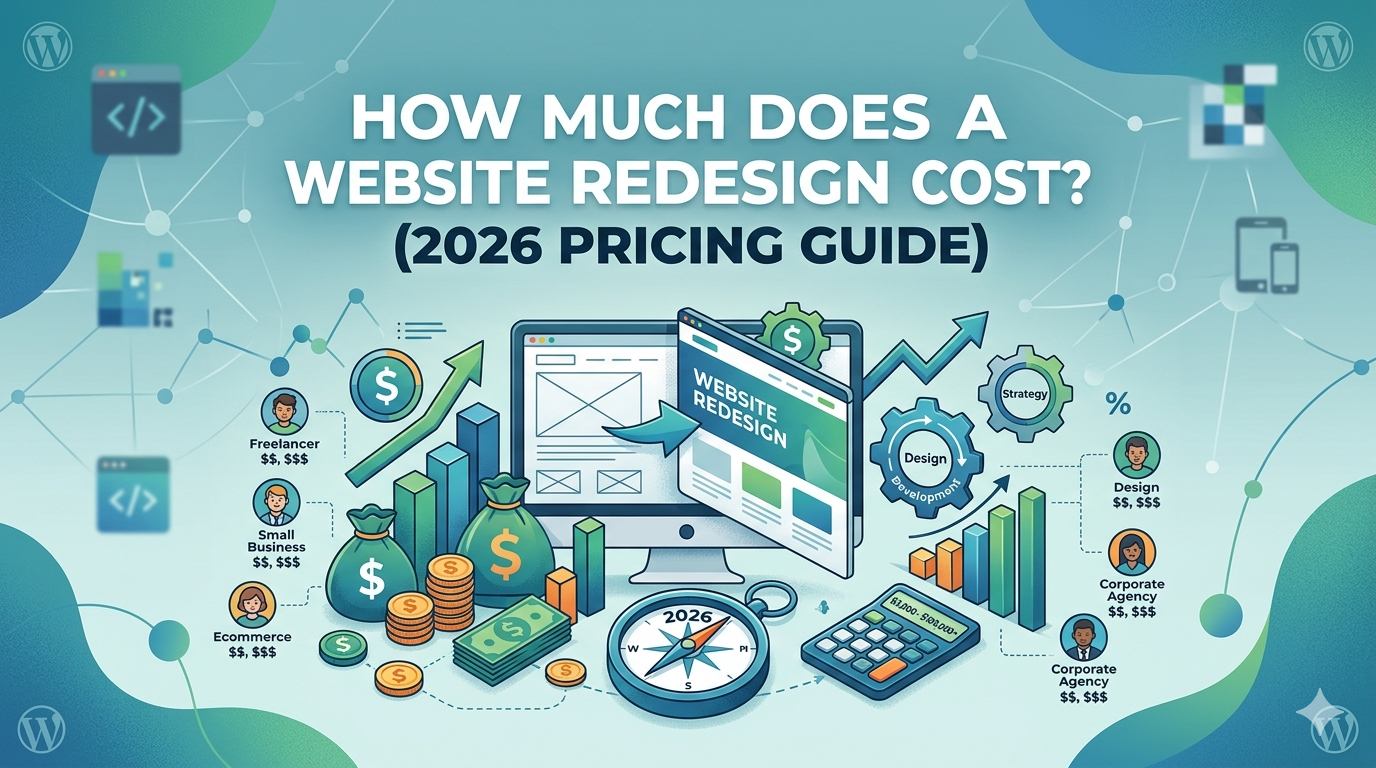
The most common first question when a business owner realizes their website needs work is the same one: “How much is this going to cost?” The honest answer is that website redesign cost varies enormously from a few hundred dollars for a DIY rebuild to $200,000+ for an enterprise overhaul. What matters is understanding which range applies to your business and why.
This guide breaks down 2026 pricing across every option from DIY platforms to full service agencies and explains exactly what drives costs up or down. By the end, you’ll know what a fair price looks like for your specific situation, what to watch out for in quotes, and how to avoid paying too much (or too little, which often costs more in the long run).
What Drives Website Redesign Costs?
Before looking at numbers, it helps to understand the variables that determine price. Every redesign quote should reflect these factors:
Number of Pages and Complexity
A five page business brochure site costs far less than a 50 page site with service specific landing pages, a blog, team directory, and client portal. Each page requires design, development, and content costs add up proportionally.
Custom Design vs. Templates
Custom design means a designer builds your visual identity from scratch wireframes, layouts, color systems, typography all unique to your brand. Template based design starts with a pre built framework and customizes it. Custom costs more upfront but delivers a site that doesn’t look like 10,000 other businesses.
Functionality Requirements
Does your site need e-commerce, booking systems, member logins, inventory integration, or custom databases? Every piece of custom functionality adds development hours. A brochure site with a contact form is a very different build than a site with a client portal or appointment scheduler.
Content Creation
Some agencies quote design and development only. Others include copywriting, photography sourcing, and SEO copywriting. Content is often underestimated as a budget line item good copy takes real time.
SEO Work
A redesign done without proper SEO attention can tank your Google rankings. According to Search Engine Journal, URL changes without 301 redirects are one of the most common causes of post redesign traffic drops. Proper SEO work preserving redirects, migrating metadata, optimizing the new structure adds cost but protects an investment your business has been building for years.
Agency Size and Location
A solo freelancer in a low cost of living market charges very differently from a mid market US agency with a full team. Neither is automatically better you’re buying different things.
Website Redesign Cost Ranges: 2026
Here’s an honest breakdown of what you can expect to pay across each tier:
DIY Platforms (Wix, Squarespace, Webflow)
Cost range: $200–$600/year for platform subscription + your time
DIY website builders have improved significantly. For a very simple business site with no custom functionality and no existing Google rankings to protect, they’re a workable option. The real cost here is your time expect to spend 40–80 hours building something that looks professional.
Best for: Side projects, hobby sites, very early stage businesses with no existing SEO equity.
Limitations: Template constrained design, limited custom functionality, technical SEO restrictions, and you’re doing all the work yourself.
Freelance Designer/Developer
Cost range: $1,500–$8,000
The lower end of the freelance range gets you a designer who customizes a premium theme for your business. The higher end gets you a more senior freelancer who can do original design and basic custom development.
Quality varies enormously. Platforms like Upwork and Fiverr host everything from excellent independent professionals to contractors who disappear mid project. Vetting matters more than price in this tier.
Best for: Very simple sites with minimal custom needs and a business owner who has time to manage the project closely.
Limitations: Single points of failure (what happens when they’re sick or unavailable?), limited scope, no strategic input, and often no post launch support.
Small/Boutique Agency
Cost range: $5,000–$20,000
This is the sweet spot for most small businesses. A qualified small agency brings a team designer, developer, project manager, and often an SEO specialist at a price that’s accessible without sacrificing quality.
At the lower end ($5K–$10K), expect a WordPress redesign with custom design, standard pages, and basic SEO setup. At the higher end ($10K–$20K), you’re getting more custom development, deeper content strategy, and more thorough optimization work.
DevVerx operates in this range. Rated 4.8/5 by verified clients, including work for Dubai Fun Tour and 1World Resources, we consistently deliver at 40–60% below comparable mid market agencies without reducing scope or quality.
Best for: Small businesses that depend on their website for leads or sales and want professional results without enterprise pricing.
Mid Market Agency
Cost range: $15,000–$50,000
Mid market agencies add more process, more dedicated specialists, and more layers of account management. Some of that overhead translates to better results and some of it just inflates invoices.
This tier makes sense when your site is complex (50+ pages, multiple user types, custom integrations) or when you need deep strategy work as part of the engagement.
Best for: Businesses with complex sites, larger content libraries, or enterprise level integration needs.
Enterprise Agency
Cost range: $50,000–$250,000+
Enterprise redesigns involve large teams, extended timelines, stakeholder management across departments, and custom functionality at scale. This is not a small business category.
What’s Typically Included (and What’s Not)
When comparing quotes, make sure you’re comparing the same scope. Ask every agency to specify:
Usually included:
Discovery and strategy
Wireframing and visual design
Development and build
Basic SEO setup (redirects, meta tags)
QA testing
Launch support
Often quoted separately:
Copywriting and content creation
Photography or custom illustration
E-commerce functionality
Third-party integrations
Ongoing maintenance after launch
Google Ads or SEO campaigns post launch
A $6,000 quote that includes copywriting may be a better deal than an $8,000 quote that doesn’t. Always read scope documents carefully.
The Real Cost of Going Too Cheap
The temptation to find the lowest quote is understandable. But websites are business assets a poorly executed redesign costs real money in missed leads and wasted time.
According to a Clutch survey, 38% of businesses that hired the cheapest web design option reported needing to redo the work within 18 months. Factor in the cost of the second redesign, plus the leads lost during the period your site underperformed, and the “cheap” option often ends up being the most expensive choice.
Common consequences of an underpriced redesign:
Poor SEO that drops your rankings
Slow site speed that hurts mobile conversions
Inadequate mobile design
Broken functionality discovered by customers (not QA)
No postlaunch support when problems arise
For context on broader website budgeting, see our guide on how much a website costs for a small business.
How to Evaluate Any Redesign Quote
When you receive a proposal, here’s what to assess:
Is the scope clearly defined?
A good proposal details exactly what’s included: number of pages, specific functionality, content work, SEO deliverables, and post launch support terms. Vague scope leads to scope creep and budget surprises.
Does it reflect your business goals?
A proposal that doesn’t reference your goals for the redesign more leads, better rankings, improved mobile experience isn’t a strategy document. It’s a task list. You want a partner who understands what you’re trying to achieve, not just what you’re asking them to build.
What’s the payment structure?
Most agencies require a deposit (typically 25–50%) upfront with milestone based payments tied to design approval and launch. Be cautious of any agency asking for 100% upfront or 100% on delivery with nothing in between.
What happens after launch?
Ask directly: “What does post launch support look like?” A clear, specific answer indicates a team that’s thought about this. A vague response is a warning sign.
How to Budget for a Website Redesign
Knowing the price ranges is one thing. Knowing how to budget intelligently for your specific situation is another. Here’s a practical approach.
Start With Your Business Case
Before setting a budget, quantify what your current site is costing you. If you can estimate:
Your current monthly organic visitors
Your current contact form or lead conversion rate
The average revenue value of a new client
then you can calculate the revenue impact of a 1% improvement in conversion rate. For most businesses, this math makes the redesign investment look obvious rather than scary.
Set a Realistic Floor
There’s a minimum quality threshold for a redesign to actually deliver results. Below roughly $5,000, you’re unlikely to get proper strategy, custom design, SEO preservation, and QA all of which matter for the outcome. Setting a budget below the quality floor and expecting professional results is the most common source of redesign disappointment.
Allocate for Content
Many business owners budget for design and development but forget about content. If you need new copywriting, professional photos, or updated case studies, budget for those separately or confirm they’re included in any agency proposal you evaluate.
Plan for Post Launch Costs
A website isn’t a one time purchase. Hosting, security updates, plugin licenses (for WordPress), and occasional maintenance or feature additions are ongoing costs. A quality agency will give you a realistic picture of what ongoing support looks like before you sign anything.
What the ROI Actually Looks Like
Cost without ROI context is just a number. The right question isn’t “how much does a website redesign cost?” it’s “how much is my current site costing me?”
A site that converts at 1% when industry average is 2.5% is leaving money on the table every day. If your site generates 1,000 visitors per month and an average lead is worth $500, the gap between 1% and 2.5% conversion rate is worth $7,500 per month – $90,000 per year.
Against that number, a $10,000–$15,000 redesign investment looks very different.
If you’re not sure whether your current site is underperforming, start with a read of signs your website is costing you customers before deciding whether a redesign is the right move.
For the full picture on planning a redesign from scope to execution read our complete guide to website redesign for small businesses.
Get a Quote That Reflects Your Actual Project
Website redesign cost depends on your specific situation there’s no universal price. The best next step is a conversation with a team that can assess your current site, understand your business goals, and give you a realistic, itemized proposal.
Contact DevVerx for a free strategy call. We’ll review what you have, define what you need, and give you a clear, honest quote no pressure, no generic packages.
Your website is too important to buy on price alone. Let’s make sure you’re investing in the right thing.