Every agency article on this topic reaches the same conclusion: hire an agency. Every freelancer platform article reaches the opposite conclusion: hire a freelancer. Neither is written to help you make the right decision for your specific situation.
This guide is different. We’re a WordPress development agency, which means we have an obvious financial reason to recommend agencies. We’re going to set that aside and give you the honest version including the scenarios where hiring a freelance WordPress developer is genuinely the smarter call.
Because the right answer depends entirely on what you’re building, what your budget is, and what happens after launch.
The Real Difference Between a WordPress Developer and a WordPress Agency
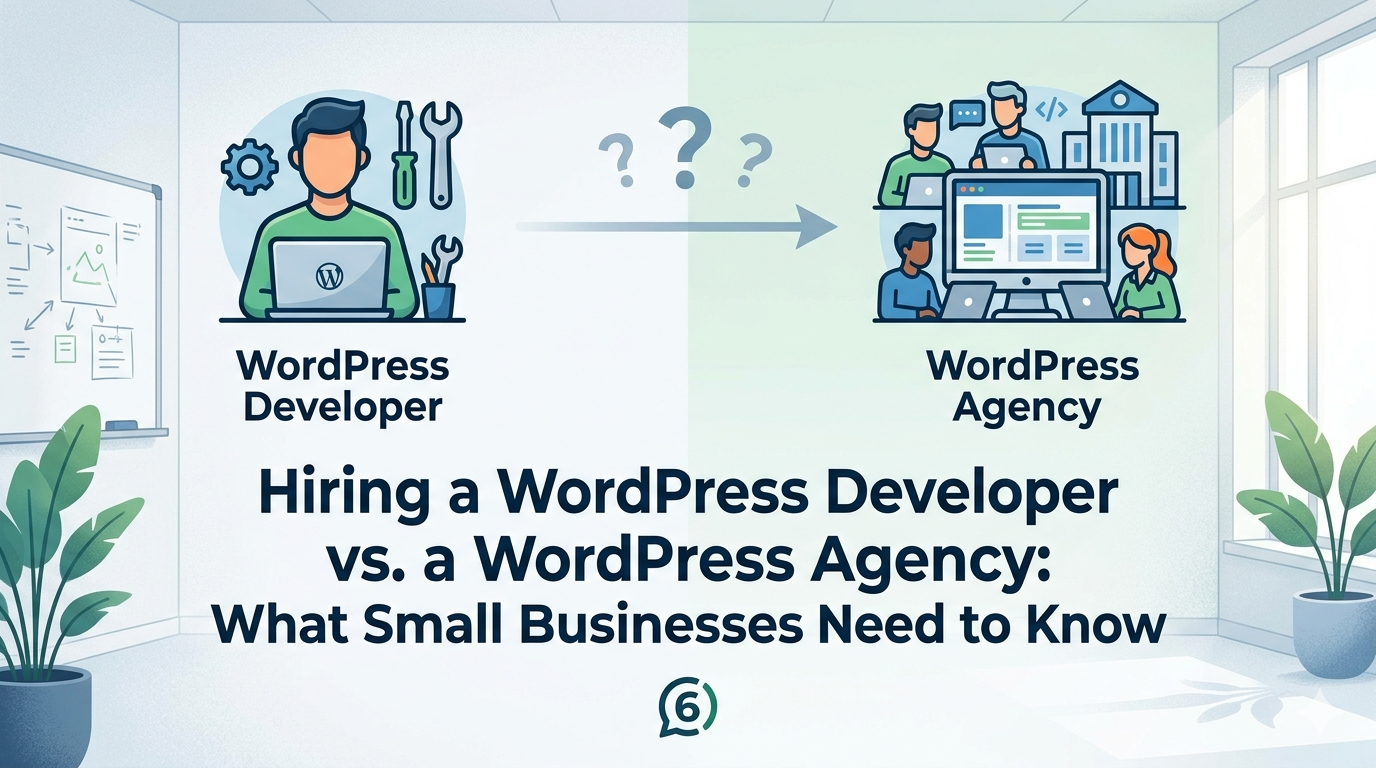
A WordPress developer is one person. They have a specific skill set typically strong in one area (front-end development, back-end logic, WooCommerce configuration, or theme development) and variable in others. They work independently, manage their own schedule, and are accountable only to themselves.
A WordPress agency is a team. Developers, designers, a project manager, QA testers, and typically a strategist or account manager. Each person covers their area of the stack. The agency manages the workflow, the communication, and the accountability structure on your behalf.
That team structure creates something a single developer cannot: continuity and coverage. If a developer gets sick, takes another client, or disappears mid project, your work stops. An agency doesn’t stop because one person is unavailable.
It also creates overhead and that overhead is what you’re paying for in the price premium. Whether that premium is worth it depends on your project.
The Case for Hiring a Freelance WordPress Developer
Freelancers are not a bad choice. They’re a wrong choice for the wrong project. There are clear scenarios where hiring an independent WordPress developer makes legitimate sense.
When the scope is small and clearly defined: A specific plugin integration, a bug fix, a page template you need added to an existing site, a speed optimization pass. The work is bounded. The risk of it expanding or going wrong is low. A freelancer is efficient and cost effective for this type of work.
When budget is the hard constraint: If your total budget is $1,500–$3,000 and you need a functional WordPress site, a freelancer may be your only realistic option. A capable freelancer can deliver solid work within those constraints. An agency at that budget level is doing template work with minimal support the freelancer may actually be the better value.
When you have strong internal technical management: If you have a developer or technical project manager in house who can write clear specs, review code quality, and manage the freelancer’s output, the accountability gap narrows significantly. You’re providing the project management the agency would otherwise handle.
When it’s a non critical prototype or MVP: Building something to test a concept before investing in production quality. Speed and cost matter more than long term code quality.
The honest risks of freelancers:
- Single point of failure: One person. If they get overloaded, sick, or simply move on, your project stalls. There’s no team to absorb the gap.
- Limited range: Most freelancers are strong in one area. Design + development + SEO setup + ongoing support from one person usually means one of those things gets shortchanged.
- Variable reliability: The freelancer market spans a wide quality range. A 4.9 star rating on Upwork tells you past clients were happy it doesn’t tell you why they moved on or whether the code holds up.
- No post launch structure: Most freelance engagements end at launch. When something breaks three months later, you’re back on the open market finding someone new who doesn’t know the codebase.
The Case for Hiring a WordPress Agency
An agency is worth the premium when the stakes are high enough that the freelancer risks would likely cost more than the agency’s overhead.
When your website is a primary revenue driver: If site downtime, broken checkout flows, or slow load times directly cost you leads or sales, you need the reliability and accountability structure an agency provides. The risk of a freelancer going quiet mid project is tolerable when the project is a landing page. It’s not tolerable when it’s your primary e-commerce store.
When you need multiple disciplines: Design, development, QA, SEO setup, and performance optimization under one roof. A freelancer typically specializes in one or two. Coordinating multiple freelancers yourself adds project management overhead that erodes the cost savings.
When you need it done right the first time: Rebuilding a poorly built site is more expensive than building a good one. Agencies have QA processes, code review, and defined handoff procedures that reduce the probability of delivering something that needs immediate remediation.
When you need ongoing support: Most agencies offer defined maintenance and support retainers. You have a named contact, a response time commitment, and a team that already knows your site. Most freelancers don’t offer this and finding a new freelancer who’s willing to take over someone else’s codebase is harder than it sounds.
When the project has complex requirements: Multiple custom post types, WooCommerce with custom integrations, membership systems, third party API connections complexity requires coordinated expertise across design, front-end, and back-end. An agency is built for this. A single freelancer is usually not.
Side by Side Comparison
| Factor | Freelance Developer | WordPress Agency |
|---|---|---|
| Typical cost | $50–$120/hr (US) / $15–$40/hr (offshore) | $100–$200/hr blended rate |
| Project pricing | Hourly or fixed per task | Fixed scope or retainer |
| Team depth | One person | Full team (dev, design, PM, QA) |
| Design capability | Variable often separate | In house |
| QA process | Minimal or none | Defined |
| Project management | You manage | Agency manages |
| Accountability | Individual only | Agency level |
| Post launch support | Ad hoc | Defined retainer |
| Continuity risk | High | Low |
| Best for | Isolated tasks, tight budget, clear scope | Complex projects, ongoing needs, business critical sites |
5 Questions to Ask Before You Hire Anyone for WordPress Development
Whether you’re evaluating a freelancer or an agency, these questions expose quality faster than reviewing a portfolio alone.
1. Can you show me the PageSpeed score on a recently completed build?
Run it yourself at Google PageSpeed Insights. A freelancer or agency that builds performant sites will welcome this question. A score below 70 on mobile on a recent build is a signal.
2. Do you test updates on a staging environment before pushing to production?
For ongoing work and post launch support, this is non negotiable. An affirmative answer with a clear process is what you want. “We’re careful” is not an answer.
3. What does post launch support look like?
Get specifics. A freelancer saying “I’m available for questions” is not a support plan. An agency saying “we have a maintenance retainer that covers X” is. Either way, know what you’re signing up for.
4. Who owns the code and the WordPress installation at the end of the project?
You should. Full stop. You should have admin access to the WordPress installation, the hosting account, the domain registrar, and the GitHub or Git repository if one is used. Any arrangement where the developer or agency retains control of your site after the engagement ends is a red flag.
5. What happens if the timeline slips?
Not “will the timeline slip?” assume it might. How does the developer or agency communicate delays? What’s the process for handling scope changes that affect the timeline? A professional has a clear answer. Evasiveness here is a signal.
The Hidden Costs of the “Cheap Developer” Option
The cheapest hourly rate rarely produces the cheapest outcome.
Scope creep without management: A developer working without project management delivers what they understood you wanted, not necessarily what you actually need. When the gap emerges, closing it costs more hours.
Code quality debt: Quickly written code that works today can be expensive to modify tomorrow. When a developer builds for speed rather than maintainability, every future change takes longer because the codebase wasn’t designed to be extended cleanly.
QA gaps: Most freelancers don’t have a QA process. The first round of testing happens when the site goes live in front of your customers. Bugs found after launch are more expensive to fix than bugs found in a staging environment.
The rebuild cost: A site built poorly enough that it needs a full rebuild within 18 months costs more than a properly built site would have. We see this pattern regularly: a business saves $4,000 by hiring cheap, then spends $12,000 on a rebuild 14 months later.
The disappearance: It’s more common than anyone admits. A developer takes on more clients, gets overcommitted, goes quiet, delivers something incomplete. You’ve paid a deposit, you have nothing usable, and you’re starting over. Agencies have redundancy built in this failure mode doesn’t exist in the same way.
For a detailed breakdown of total costs of ownership across development tiers, see our WordPress development cost guide.
When a Hybrid Approach Makes Sense
Some businesses find the optimal structure is an ongoing agency relationship for core work site architecture, complex features, performance combined with a specific freelancer for a narrow specialized skill.
For example: a DevVerx built WordPress site with a maintenance retainer, plus a contracted SEO specialist who handles content strategy and keyword targeting independently. Or a custom WooCommerce store managed by an agency, with a freelance copywriter handling product descriptions.
The key is defining clear boundaries: who owns what, who is accountable for what, and how they communicate when work overlaps. Blurring those lines is where hybrid arrangements go wrong.
How DevVerx Compares to Hiring Freelance
We’re not the right choice for every project. Here’s an honest summary:
Choose a freelancer when: Your budget is under $3,000, your scope is a clearly bounded task, or you have internal technical management that can run the engagement.
Choose DevVerx when: Your site is a primary revenue driver, your project requires design + development + QA under one roof, you need a defined post launch support structure, or you want a team that has built 100+ WordPress sites and won’t learn on yours.
What we bring specifically: 15+ years building WordPress sites for US small businesses, a 4.8/5 client rating, senior developers who build custom themes from code (not Elementor installs), and a post launch maintenance structure that means you have a real point of contact when something needs attention.
Book a free strategy call and we’ll tell you honestly whether we’re the right fit for what you need or whether a freelancer makes more sense.
Explore our WordPress development services to see what a full engagement includes.
Frequently Asked Questions
How much does it cost to hire a WordPress developer?
Freelance WordPress developers in the US typically charge $50–$120/hour. Offshore freelancers run $15–$40/hour. For project based work, a simple site from a US freelancer might run $2,000–$6,000; from an offshore freelancer, $500–$2,500. According to Clutch’s web development pricing data, WordPress agencies charge $100–$200/hour blended, with project based pricing typically starting at $5,000–$8,000 for custom work.
Where do I find a good freelance WordPress developer?
Upwork and Toptal are the most established platforms for US and international freelancers. Toptal has a more rigorous vetting process; Upwork has more volume and a wider range of quality. For local developers, Google searches for “[city] WordPress developer” and referrals from other business owners are reliable sources. Review their live portfolio sites, check PageSpeed scores, and always do a paid discovery call before committing to a full project.
Can I switch from a freelancer to an agency mid project?
Yes, but it’s disruptive. An agency inheriting a half built project spends time understanding someone else’s decisions before they can move forward efficiently. If you’re considering switching, the cleanest transition point is at a defined milestone not mid development sprint. Be prepared for the agency to assess the existing code and, in some cases, recommend starting over if quality is significantly below their standards.
What should I include in a contract with a WordPress developer or agency?
At minimum: scope of work (specific deliverables), timeline with milestones, payment schedule (never 100% upfront), revision policy (number of rounds included), ownership of all code and assets upon final payment, post launch support terms, and a process for handling scope changes. Any developer or agency uncomfortable with a written contract is a red flag.
Is it worth paying more for a US based WordPress developer vs. offshore?
For complex projects where communication, timeline management, and quality accountability matter, yes typically. US based developers and agencies work synchronously, communicate clearly, and are accountable under US business norms. Offshore can work well for simple, tightly scoped work with clear specs. For anything where real time collaboration, nuanced feedback, or business context understanding is important, the timezone and communication gap is a real cost.
The Bottom Line
Hiring a freelance WordPress developer is the right call for some projects. Hiring a WordPress agency is the right call for others. The difference is scope, stakes, and what you need after launch.
Simple task, clear scope, tight budget: freelancer.
Complex site, multiple disciplines needed, business critical, ongoing support required: agency.
If you’re not sure which side your project falls on, we’re happy to tell you honestly even if the answer is that a freelancer is your best option. Book a free strategy call with DevVerx to talk it through.
For a broader look at what a WordPress development agency does and what to look for in one, see our complete WordPress development agency guide.