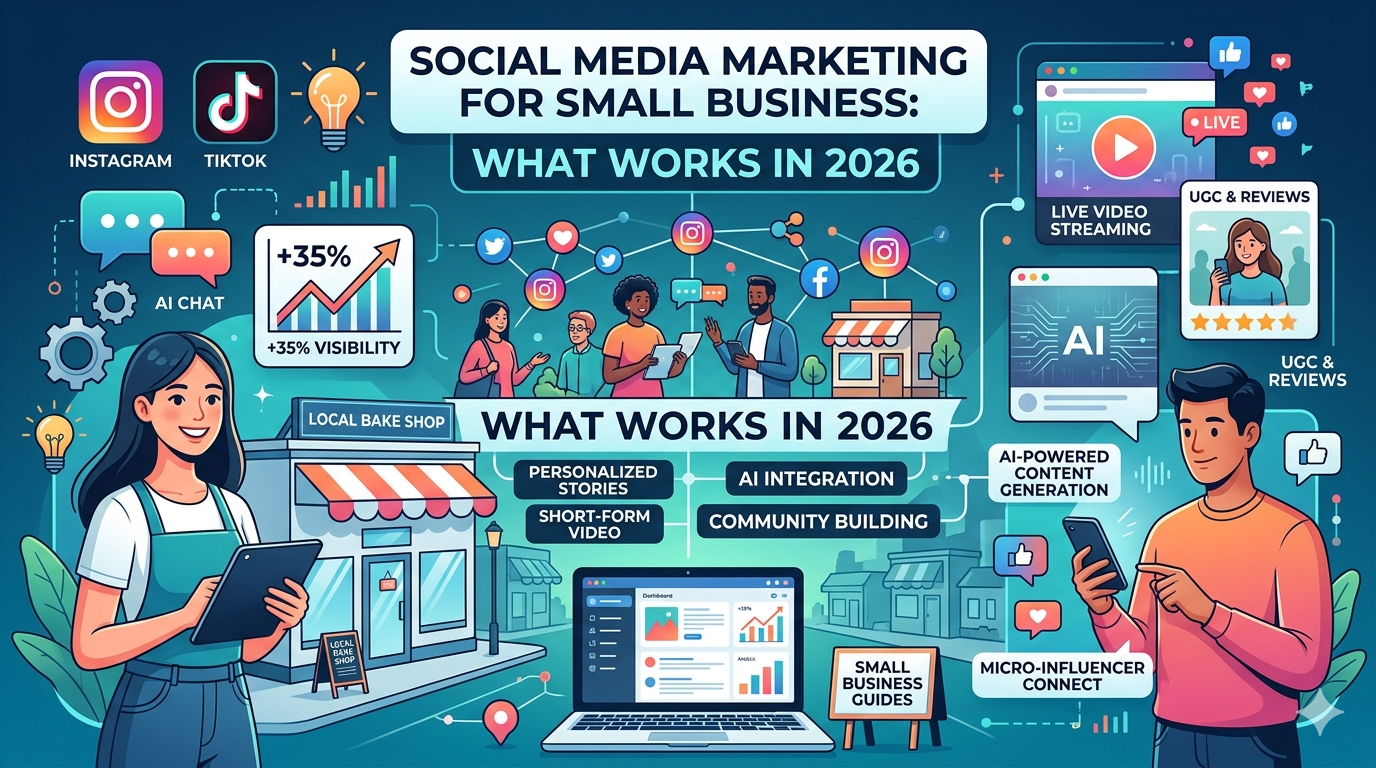
Social media is where most small businesses start their digital marketing and where most waste the most time and money. The gap between businesses that get real results from social media and businesses that just feel busy posting is almost never about the platform. It is about strategy, consistency, and understanding what social media can and cannot do.
Social media marketing for small business in 2026 looks different than it did even two years ago. Organic reach has declined on most platforms. Algorithm changes have shifted what gets shown. New platforms have emerged while others have declined. And the way customers use social media to research and choose businesses has evolved.
This guide is built around what actually works right now not theory, not aspirational best practices, but practical tactics that small businesses can implement with realistic budgets and modest teams. We cover which platforms deserve your time, what content consistently performs, how to turn followers into customers, and when paid social media is worth the investment.
For the broader digital marketing context, see our complete guide to digital marketing for small business.
What Social Media Can (and Cannot) Do for Small Business
Before investing time and money in social media, it is worth being clear about what you are trying to achieve and what social media realistically delivers.
What social media does well:
- Build brand awareness with an existing or new audience
- Demonstrate expertise and personality that builds trust
- Create community around your brand or industry
- Drive traffic to your website (when content is share worthy)
- Retarget people who have already visited your site (paid social)
- Provide social proof through reviews, testimonials, and user generated content
- Enable direct customer communication and service
What social media does not do well:
- Generate high intent, ready to buy leads at scale (that is Google Ads and SEO)
- Replace a website or Google Business Profile for local search visibility
- Guarantee organic reach to your followers (especially on Facebook)
- Produce predictable, measurable ROI without paid advertising
Social media is primarily an awareness and trust building channel. It works best as part of a broader digital marketing strategy not as a standalone lead generation system.
Choosing the Right Platforms for Your Small Business
The biggest mistake small businesses make is trying to maintain an active presence on every social media platform. The right number of platforms for most small businesses is two and for some, one is enough.
Choose based on where your customers actually spend time, not where you personally spend time or where you feel you should be.
Still the dominant platform for local business marketing and the most versatile for small businesses. Facebook has the most sophisticated advertising platform available at small budgets precise geographic and demographic targeting, retargeting, and a wide range of ad formats.
Organic reach has declined significantly most business page posts reach only 1-5% of followers. According to Hootsuite’s Social Media Trends report, paid social investment among small businesses continues to grow as organic reach declines. But Facebook’s advertising platform makes paid social accessible starting from as little as $5/day.
Best for: Local service businesses, restaurants, retail, community oriented businesses, B2C companies targeting 35+ audiences.
Owned by Meta and deeply integrated with Facebook advertising. Instagram rewards visual content high quality photos, short-form video (Reels), and stories. The platform skews younger than Facebook and performs well for visually appealing products and services.
Key fact: Instagram Reels consistently receive higher organic reach than static posts in the current algorithm.
Best for: Food, hospitality, retail, fashion, fitness, home design, beauty, personal brands any business with visual content to share.
The professional network and the primary B2B platform. For businesses selling to other businesses, professional services targeting specific industries, or owners building a personal brand, LinkedIn is worth the investment.
Organic reach on LinkedIn is currently better than Facebook for business content thoughtful industry commentary and practical advice tend to spread well.
Best for: B2B businesses, professional services (accounting, legal, consulting, HR), technology, and any business selling to corporate decision makers.
YouTube
The world’s second largest search engine and one of the most underutilized platforms by small businesses. Video content on YouTube can rank in both YouTube search and Google search, giving it unique dual channel value.
The barrier to entry is higher than other platforms video content requires more production effort. But the potential reach and longevity of YouTube content is significant. A well produced tutorial video can generate views for years.
Best for: Service businesses that can demonstrate their work visually, educational content, product reviews, how to content, and any business targeting DIYers who might refer or become customers.
TikTok
Massive reach, especially for under-40 audiences. The algorithm gives organic content unusual reach a video from a brand new account can go viral with no follower base. But TikTok requires frequent publishing and authentic, native feeling content professional production often performs worse than casual, real content.
Best for: Consumer brands, food and beverage, retail, entertainment, personal brands, and businesses whose owners are comfortable being on camera.
What Content Works on Social Media in 2026
Content that performs consistently on social media has a few things in common regardless of platform: it is useful, it is specific, and it does not feel like an advertisement.
The Content Types That Drive Results
Educational content. Teach your audience something genuinely useful about your industry. A plumber explaining how to prevent frozen pipes. A financial advisor explaining the difference between a Roth and traditional IRA. This type of content builds expertise and trust.
Behind the scenes. Show what it actually looks like to do your job. Customers are curious about businesses they are considering hiring demystifying your process builds confidence.
Social proof. Customer testimonials, before and after transformations, reviews, and case studies. Real results from real clients are your most persuasive marketing content.
Personality content. Business owners who show their personality on social media build deeper connections than businesses that only post about their services. A regular “check in” or commentary on something relevant to your industry makes your brand feel human.
Local content. For local businesses, content that references your community local events, local shoutouts, neighborhood context performs better than generic content and builds local affinity.
Video Reels and short form content. Across Facebook, Instagram, LinkedIn, and TikTok, short form video consistently outperforms static content in organic reach in 2026. A 30-60 second video showing a tip, a transformation, or a quick story reaches more people than an equivalent image post.
What Not to Post
- Pure promotional content with no value (announcing your services every post)
- Stock photos that feel generic and impersonal
- Reposted inspirational quotes with no connection to your business
- Content that looks like it was generated without care or thought
- Political or divisive content (unless your business is explicitly values based around those topics)
Content Frequency: What Is Realistic?
A realistic posting schedule for a small business managing social media without a dedicated team:
- 3-4 posts per week on your primary platform
- 2-3 posts per week on your secondary platform (if applicable)
- Stories or more casual content daily if time allows (less production, lower stakes)
Do not let perfect be the enemy of good. Three well thought out posts per week will outperform seven rushed ones. And consistency over time matters more than any individual post.
Turning Followers into Customers
Follower counts are a vanity metric. What matters is whether social media is driving business results: website visits, inquiries, bookings, or purchases.
Conversion Tactics That Work
Every post should have a purpose. Before publishing, know what you want someone to do after seeing it. Click to your website? Save for later? Call you? Send a message? Even if the primary goal is awareness, a soft call to action is always appropriate.
Include clear calls to action. “Book a free consultation,” “DM us for a quote,” “Click the link in our bio to schedule.” Make the next step obvious.
Use link in bio strategically. On Instagram (where clickable links in posts are limited), your bio link is premium real estate. Change it to match your current campaign or most valuable offer, and reference it in posts and stories.
Respond to every comment and message. Response rate and time affect how your profile is ranked by platform algorithms. More importantly, every comment and message is a potential customer. Treat them that way.
Run promotions tied to specific actions. Offer something valuable in exchange for an action a free resource for email signup, a discount for referrals, a giveaway for follows and shares. Be compliant with platform rules on contests and giveaways.
Paid Social Media: When to Invest and What to Expect
Organic social media is free but limited in reach. Paid social extends your reach to audiences beyond your followers and with precise targeting, you can reach exactly the people most likely to become customers.
Meta’s advertising platform (Facebook and Instagram combined) is the most accessible and effective paid social option for most small businesses. You can target by location, age, interests, behaviors, and through retargeting people who have already visited your website or engaged with your content.
Starting a Paid Social Campaign
Define your objective. Are you trying to drive website traffic, generate leads, increase store visits, or build brand awareness? The campaign objective determines how Meta optimizes your ads.
Start with a retargeting campaign. Ads shown to people who have already visited your website are dramatically more effective than cold audience ads. Install the Meta Pixel on your website and start with a retargeting audience before investing in cold prospecting.
Budget expectations: $500-$1,000/month is a reasonable starting point for meaningful data. Below this level, you will not have enough reach to draw reliable conclusions. A well optimized local service campaign can generate leads at a cost effective rate at this budget.
Test multiple ad creatives. Social media advertising requires testing. Run two or three versions of an ad with different images, headlines, or calls to action. Let data determine what works before committing full budget to one approach.
According to Social Media Examiner’s annual industry report, Facebook and Instagram remain the platforms where small business marketers see the most direct ROI from paid advertising.
Measuring Social Media Results
The metrics that matter depend on your business goals.
For awareness goals: Reach (unique people who saw your content), impressions (total views), follower growth rate.
For engagement goals: Likes, comments, shares, saves, and link clicks. Engagement rate (total engagements divided by reach) tells you how compelling your content is.
For business outcome goals: Website traffic from social (track in Google Analytics), leads or form submissions attributed to social channels, phone calls from social, and for e-commerce, purchases attributed to social campaigns.
Avoid optimizing for vanity metrics that do not connect to business outcomes. A post with thousands of likes that drives zero website visits or inquiries is less valuable than a post with 50 likes and five direct message inquiries.
Managing Social Media With Limited Time
Most small business owners do not have hours to spend on social media every day. A lean, sustainable approach:
Batch content creation. Block two to three hours once per week or bi weekly to plan and create content for the upcoming period. Use a scheduling tool like Buffer, Later, or Meta Business Suite to schedule posts in advance.
Create content banks. Take photos and videos of your work regularly and store them in an organized folder. When it is time to post, pull from your content bank rather than creating from scratch.
Repurpose existing content. Turn a blog article into a series of social posts. Turn a customer testimonial into a graphic. Turn a before and after project photo into a before and after Reel.
Use templates. Canva and similar tools offer branded templates that make professional looking graphics fast to produce without design expertise.
When to Hire a Social Media Manager
If social media management is consistently falling off your to-do list, or if you have tried for six months and your posts get minimal engagement, professional help may be worth the investment.
At DevVerx, our digital marketing services include social media strategy and management for small businesses. We develop a content strategy aligned with your business goals, create and publish content on your behalf, and report on what is actually working.
Our 4.8/5 client rating reflects that we treat each client’s social presence as a business asset not a task list to check off.
Social Media Marketing in 2026: What the Data Shows
The social media landscape continues to shift, but a few things remain consistent:
- Short form video content outperforms static content across all major platforms
- Authentic, personality driven content outperforms polished corporate content for small businesses
- Paid social with precise targeting delivers measurable results at small budgets
- Social media works best as part of a broader digital marketing strategy, not as a standalone channel
The businesses winning on social media in 2026 are not necessarily the ones posting the most. They are the ones posting with purpose, speaking directly to their audience’s real interests, and connecting their social activity to actual business goals.
Ready to build a social media presence that does more than just keep the lights on? Contact DevVerx and let us build a social media strategy aligned with your business goals and budget.