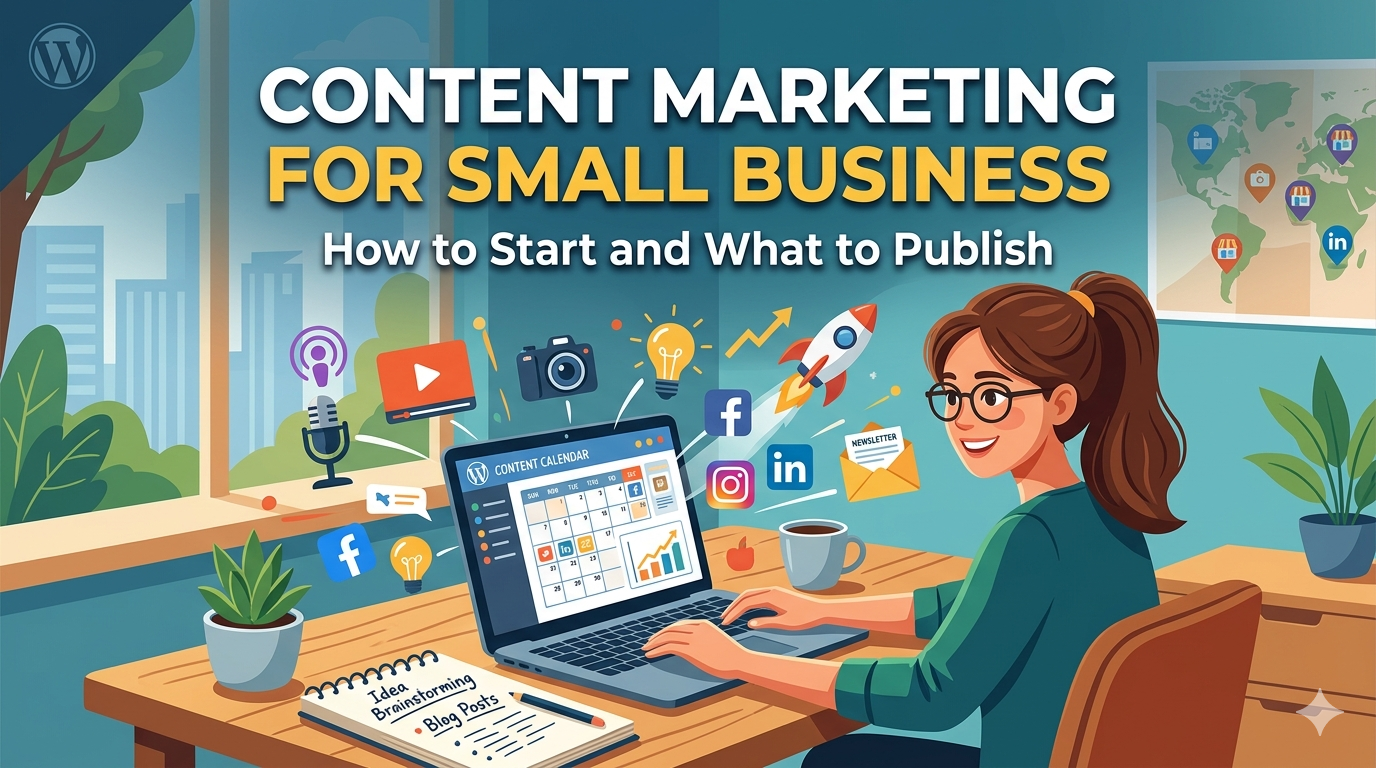
Most small business owners who try content marketing follow the same pattern: publish a few blog posts, see no results in the first few months, and quietly stop. The posts sit there, unread, while the owner concludes that content marketing doesn’t work for their kind of business.
It is not that content marketing for small business does not work. It is that most businesses start without a strategy, publish content that nobody is searching for, and give up before the compounding effects kick in.
Done right, content marketing is the most cost effective long term lead generation system available to small businesses. A well written article targeting the right keyword can generate qualified traffic for years at no ongoing cost. The challenge is knowing what to write, how to optimize it, and how to sustain the effort long enough to see results.
This guide covers the full content marketing playbook for small businesses: how to find topics that will actually drive traffic, what formats work, how often to publish, how to optimize for search, and how to measure whether it is working.
For the broader strategy context, see our complete digital marketing guide for small business.
What Content Marketing Actually Means for Small Business
Content marketing is the practice of creating and publishing valuable content articles, guides, videos, infographics that attracts your target audience, answers their questions, and builds trust before they are ready to buy.
The strategic logic is simple: if you consistently publish content that your potential customers are searching for, Google rewards you with organic visibility. Over time, you become the go to resource in your industry which means when someone is ready to hire or buy, they already know and trust your name.
Content marketing is not:
- Posting promotional content about your products and services
- Publishing blog posts just to have “fresh content”
- Creating thin, low effort articles stuffed with keywords
- Social media posts (those are content distribution, not content marketing in the SEO sense)
Content marketing for SEO purposes specifically means creating substantive, search optimized pages and articles that rank in Google for keywords your customers actually search.
The numbers support this approach. According to HubSpot’s State of Marketing report, businesses that blog consistently generate 67% more leads per month than businesses that do not. The gap is not from any one article it is from the accumulation of ranking pages over time.
Finding Topics That Will Actually Drive Traffic
The most common content marketing mistake is writing about what you find interesting rather than what your customers are searching for. Interest and search volume do not always overlap.
Start With Keyword Research
Every content marketing effort should begin with keyword research identifying the search terms your potential customers use and validating that real search volume exists.
The free way: Type your core service or product into Google and see what the search autocomplete suggests. These are real searches people are making. Check “People also ask” boxes in search results they reveal questions your audience has that you could answer.
Use Google Keyword Planner (free with a Google Ads account) to see monthly search volume for specific terms. A keyword with 500 searches per month in a low competition niche can be more valuable than one with 50,000 monthly searches dominated by massive brands.
For small businesses, focus on:
- Long tail keywords (three to five words): Lower competition, more specific intent. “Accountant for small business in Dallas” is easier to rank for than “accountant.”
- Question based keywords: “How much does [service] cost,” “how to [solve problem],” “what is the best [product] for [use case]” these often match exactly what people type.
- Commercial intent keywords: Terms searched by people actively considering a purchase or hire, not just doing background research.
The Five Buckets of Content Ideas for Small Business
Every small business can generate content from these five categories:
1. Service and product explainers. What do you offer? Who is it for? What problems does it solve? Many businesses underestimate how many potential customers do not know the basics.
2. How to guides. Walk customers through processes related to your industry. A plumber can write about “how to turn off your water in an emergency.” A financial advisor can write about “how to read your investment statement.”
3. Cost and pricing content. “How much does [your service] cost?” is one of the most searched questions in almost every industry. Answering it with context (rather than hiding pricing) attracts highly qualified, ready to buy searchers.
4. Comparison and decision content. Help customers make decisions: “Agency vs. freelancer for [service],” “[Option A] vs. [Option B]: which is right for you?” These target people deep in the consideration phase.
5. Problem solving content. What problems bring customers to your door? Write about those problems in the language customers use to describe them.
What Format to Publish
The format that works best for SEO driven content marketing is the long form written article typically 1,500 to 3,000 words for most topics. This is not arbitrary. Google’s search results favor comprehensive content that thoroughly covers a topic.
That said, different content goals warrant different formats:
Long form articles (1,500-3,000 words): Best for keyword targeted SEO content. Educational guides, comparison articles, how to content. Takes more effort to produce but has the longest lasting organic value.
Short explainer posts (500-1,000 words): Appropriate for simple, specific questions with limited search volume. Faster to produce, less likely to rank for competitive terms.
Pillar pages (2,500-5,000 words): Comprehensive guides on broad topics that serve as the hub of a topic cluster. One pillar page links to multiple related supporting articles.
Video content: YouTube is the second-largest search engine. Video tutorials, product demonstrations, and explainer videos can rank in both YouTube and Google. High production value is not required clarity and usefulness are.
Infographics: Effective for data heavy topics. Earn backlinks when shared by other sites. Require design resources to produce.
For most small businesses starting out, focus on long form written articles. They are the highest ROI format for building organic traffic.
How Often Should Small Businesses Publish?
The most honest answer: as often as you can maintain quality. Consistency matters more than frequency.
Publishing four thin articles per month is worse for your SEO than publishing one thorough, well researched article. Google rewards depth and usefulness not output volume.
A realistic content publishing schedule for small businesses:
- Starting out: One article per month. Focus on quality, optimization, and promoting each piece before publishing the next.
- Building momentum: Two articles per month. At this pace, you will accumulate 24 articles per year a meaningful content library.
- Established program: Four or more articles per month. At this scale, consistent publication begins to produce compounding organic traffic growth.
The most important thing is not to overpromise yourself. A schedule you cannot sustain helps nobody. Start with one article per month and prove the system works before scaling.
How to Write Content That Ranks in Google
Writing content for search engines is different from writing for a general audience. You are not just writing a good article you are writing an article that Google can identify as the best answer to a specific search query.
On-Page SEO Essentials for Content
Include your target keyword in the right places:
H1 heading (your article title)
First 100 words of the article
Two to three H2 subheadings
The conclusion
Meta title and meta description
Structure the article logically. Use H2 headings to organize main sections and H3 headings for subsections. A reader should be able to skim your headings and understand the full scope of the article.
Write a compelling title and meta description. The title determines whether someone clicks your result in Google. The meta description (shown under the title in search results) should include a call to action and be under 160 characters.
Cover the topic thoroughly. Look at the top five ranking pages for your target keyword. What do they cover that you might miss? Google rewards articles that cover the topic more completely than competitors.
Include internal links. Link to other relevant pages on your site. This helps Google understand the structure of your site and keeps readers engaged. Our guide on SEO for small business covers internal linking best practices in more detail.
Cite credible sources. Link out to authoritative external sources (industry studies, Google, trade associations) when supporting data claims. This builds credibility with both readers and Google.
The E-E-A-T Factor
Google evaluates content on Experience, Expertise, Authoritativeness, and Trustworthiness (E-E-A-T). For small business content, this means:
- Writing from genuine experience with your subject matter
- Including specific examples, case studies, or real world context
- Citing credible sources for statistics and claims
- Being transparent about who wrote the content and why they are qualified
- Keeping information accurate and up to date
Content that demonstrates genuine expertise consistently outperforms generic content over time.
Promoting Content: What Happens After You Publish
Publishing an article is not the end of the work it is the beginning. Without promotion, even excellent content can sit unread for months before Google discovers and indexes it.
Content Promotion Tactics That Work
Share on social media. Post your article on every platform where your business has a presence. Do not just drop the link write a brief context post that explains why the article is valuable.
Send to your email list. If you have a customer email list, send a newsletter featuring each new article. Existing customers are your warmest audience and most likely to read and share.
Submit to Google Search Console. After publishing, use the URL inspection tool in Google Search Console to request indexing. This can speed up the time before Google discovers your content.
Share in relevant communities. Industry forums, Facebook groups, LinkedIn groups, and Reddit communities in your niche. Only share when the content is genuinely valuable to the community not as pure self promotion.
Repurpose into other formats. A long form article can become a series of social media posts, a short video, or an email newsletter series. Repurposing extends the reach of content you have already invested in creating.
Reach out to link targets. If your article references other websites, tools, or resources, email the owners. They may share or link to your article if it adds value to their audience.
Measuring Content Marketing Results
Content marketing ROI is not always obvious in the short term. Here is what to track.
Organic traffic. Track total organic visitors and which articles are generating traffic. Google Search Console shows which keywords each article is ranking for and at what position.
Keyword rankings. Are your target keywords moving up in search results over time? Improvement in rankings even without immediate traffic increases is a positive signal.
Lead generation from content. Use UTM parameters in your content URLs and track in Google Analytics whether visitors from organic content complete contact forms, phone calls, or other conversion actions.
Time on page and engagement. Articles where visitors spend more time and engage more deeply signal to Google that the content is valuable which supports rankings over time.
Backlinks earned. When other sites link to your content, it is the strongest possible signal that your content is valuable and authoritative. According to Ahrefs’ content marketing study, the top ranking pages earn significantly more backlinks than pages ranked below position 3 making content quality the single biggest lever for long term organic growth.
A realistic expectation: 6 to 12 months before content marketing produces a meaningful volume of organic traffic. The businesses that succeed at content marketing are the ones that stay consistent through that initial period.
Should You DIY Content Marketing or Hire Help?
The DIY versus professional question in content marketing comes down to two things: do you have the time, and can you write well?
DIY makes sense if you have 4-8 hours per month to dedicate to content, you can write clearly and accurately about your industry, and you are willing to learn the SEO fundamentals. Many small business owners are excellent writers on their industry topics and that authentic expertise shows in the content.
Professional help makes sense if your time is fully occupied running the business, writing is genuinely difficult for you, or your competitors are publishing at a volume and quality that requires professional support to match.
A hybrid approach often works well: you provide industry expertise and article outlines, a professional writer turns them into polished, SEO optimized articles. This preserves authenticity while reducing the time burden.
DevVerx provides digital marketing services that include content strategy and production for small businesses. We handle keyword research, topic planning, article writing, on-page optimization, and performance reporting so you can focus on your business while your content library grows. Our 4.8/5 client rating reflects the consistent quality and results we deliver for every content program we manage.
Content Marketing for Small Business: Getting Started Today
You do not need a full strategy, a content calendar, and a team of writers to start content marketing. You need to publish one good article.
This week: identify one question your customers ask frequently. Research whether people search for it in Google (use Google autocomplete and Keyword Planner). Write a thorough, honest answer – 1,500 words minimum. Optimize it with the keyword in your title, first paragraph, and a few subheadings. Publish it, share it, and request indexing in Google Search Console.
Then do it again next month.
The businesses that build meaningful organic traffic through content marketing are the ones that start simple, stay consistent, and improve their approach over time not the ones that plan for six months and never publish anything.
Ready to build a content marketing program that generates leads while you sleep? Contact DevVerx and let us help you build a content strategy tailored to your business, your audience, and your competitive landscape.