If you are considering hiring a web development agency and are not sure exactly what you would be paying for, you are not alone. The term “web development agency” gets used to describe everything from a two person boutique that builds WordPress sites to a 200 person shop that builds complex enterprise software.
This guide breaks down what a web development agency actually does in clear, non technical language: what services they provide, who does the work, what the project process looks like, and what outcomes you can reasonably expect.
The Core Service: Building Web Based Products
At its most basic, a web development agency designs and builds websites and web based applications. That covers a wide range:
- Business and marketing websites (the most common project type)
- E-commerce stores
- Web applications (software accessed through a browser)
- Customer portals and dashboards
- Landing pages and campaign microsites
- Website redesigns and rebuilds
The common thread is that the output exists on the web and is accessed through a browser. A mobile app is a different product category (though many agencies offer both).
Services a Web Development Agency Typically Provides
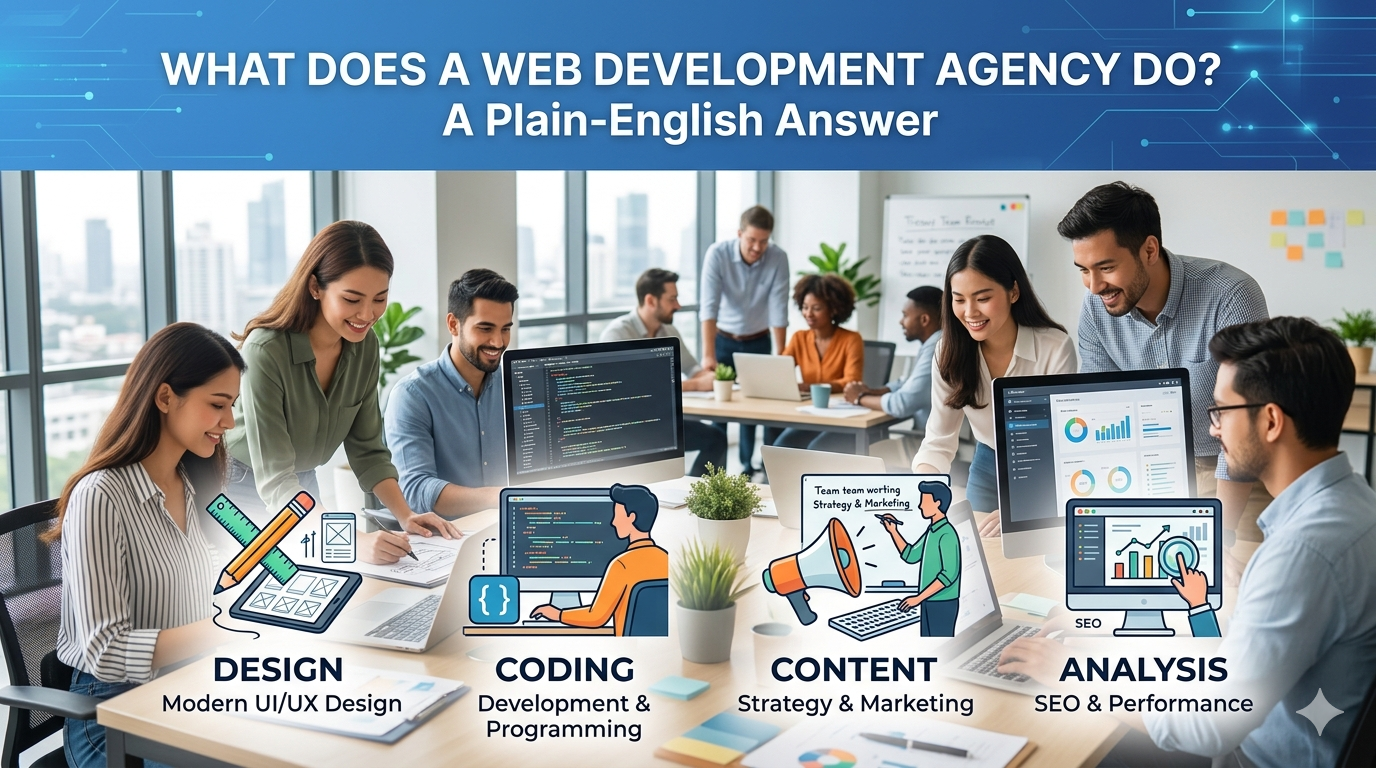
Website Design
Design covers both the visual appearance and the structural layout of the site. An agency’s design team creates what the site looks like: colors, typography, imagery, spacing, and visual hierarchy. They also design the user experience (UX): how navigation works, where calls to action live, how users move through the site toward a goal.
Design is not just aesthetics. Good web design is built around conversion goals. A professional website for a service business should be designed to get visitors to contact you. An e-commerce site should be designed to get visitors to buy. The design decisions that serve those goals are as important as the ones that make the site look good.
Front-End Development
Front-end development is the technical work that turns a design into a functional website. A front-end developer writes the code that your browser renders: the HTML that structures content, the CSS that applies visual styles, and the JavaScript that handles interactive behavior.
Front-end work determines how fast a site loads, how it behaves on mobile devices, and whether animations and interactive elements work correctly. Poor front-end development produces slow sites that look broken on small screens, which affects both user experience and search engine rankings. Google’s Core Web Vitals are now a direct ranking factor, making front-end performance quality a business-critical concern.
Back-End Development
Back-end development covers everything that happens on the server side: databases, business logic, integrations with external services, and the systems that process user inputs. When you fill out a contact form and receive a confirmation email, that is back-end work. When an e-commerce site updates inventory after a purchase, that is back-end work.
Not all websites require custom back-end development. Many business sites are built on WordPress, which provides a content management system and back-end infrastructure out of the box. Custom web applications almost always require meaningful back-end development.
CMS Implementation
A content management system (CMS) is the dashboard that allows non-technical people to update website content without writing code. According to W3Techs, WordPress is the most widely used CMS, powering over 43% of all websites on the internet. Others include Webflow, Shopify (for e-commerce), and Contentful.
Setting up and configuring a CMS is part of most agency website projects. This includes installing and customizing the CMS, building page templates, training the client team to use the system, and documenting how updates should be made.
E-Commerce Development
Building an online store involves more than installing a shopping cart. An agency that does e-commerce work handles product catalog structure, checkout flow design, payment gateway integration (Stripe, PayPal, and others), shipping configuration, tax setup, and often inventory management integration.
E-commerce development requires specific expertise. If your project includes an online store, ask prospective agencies specifically about their e-commerce experience and which platforms they work with.
Integrations
Most business websites need to connect to external tools: a CRM like Salesforce or HubSpot, an email marketing platform, a booking or scheduling system, a payment processor, a live chat tool, or an analytics platform.
Setting up these integrations is development work. The complexity ranges from a simple embed code to a custom API integration that syncs data between systems in real time. Integration complexity is one of the main factors that drives project cost up.
SEO and Performance Optimization
A well built website is the foundation of search engine optimization. Agencies that understand technical SEO build sites with clean code, fast load times, proper heading structure, descriptive meta tags, mobile responsiveness, and correctly configured XML sitemaps and robots files.
Some agencies include SEO strategy as part of their service (keyword research, content structure recommendations, on-page optimization). Others focus on technical correctness and treat SEO strategy as a separate engagement. Clarify what is included before you sign.
Website Maintenance and Support
After a site launches, it requires ongoing maintenance: security updates, platform and plugin updates, backups, performance monitoring, and small change requests. Many agencies offer this as a monthly retainer service.
This ongoing relationship is valuable because the agency already knows your site. When something breaks or needs updating, they do not have to spend time learning the codebase before they can fix it.
Who Does the Work Inside an Agency
Understanding the team structure helps you know who to talk to and what to expect.
Project Manager: Your primary point of contact throughout the project. They own the timeline, manage communication, coordinate deliverables, and run the internal team. A good project manager is what separates a smooth project from a chaotic one.
UX/UI Designer: Responsible for the visual design and user experience. They produce wireframes (structural layouts) and high fidelity mockups (full visual designs) for your review. May also conduct user research and usability testing on larger projects.
Front-End Developer: Builds the client side code that produces the visible website. Works from approved designs to produce the final site in a browser.
Back-End Developer: Builds server side functionality, database structures, and system integrations. More prominent in projects with custom functionality or complex integrations.
QA/Tester: Tests the site across devices, browsers, and use cases before launch. Not every agency has a dedicated QA person; in smaller shops, developers or the project manager handle testing.
SEO Specialist: On agencies that include SEO services, this person handles keyword research, on-page optimization, and technical SEO review.
Boutique agencies often have one person covering multiple roles. Larger agencies have dedicated specialists for each. Both structures work; what matters is that all the necessary skills are represented on your project.
What a Typical Project Looks Like
Discovery and Scoping
The project begins with the agency learning about your business, goals, audience, and technical requirements. This typically involves a kickoff call, a written brief or questionnaire, and a review of your existing website and competitive landscape. The output is a formal proposal with defined scope, timeline, and price.
This phase is where assumptions are surfaced and scope is locked. The more time you invest in clear requirements here, the smoother the rest of the project goes.
Design Phase
The design process typically starts with wireframes: simple structural layouts that show where content lives and how the page flows, without any visual design applied. Wireframes are reviewed and approved before moving to high fidelity mockups.
High fidelity mockups apply the visual design: colors, typography, images, and full styling. These are typically delivered as static files (not yet built in a browser) and go through a defined round of client revisions before being approved for development.
Development Phase
Approved designs are built into a functional website. Front-end developers build the visual layer; back-end developers configure the CMS, build integrations, and add any custom functionality. The site is typically built in a staging environment (a private URL) before it is moved to your live domain.
QA and Testing
Before presenting the site for client review, the agency tests it internally for bugs, broken links, mobile responsiveness, browser compatibility, form functionality, and page speed. A professional agency identifies and fixes issues before the client sees them.
Client review follows, during which you test the site yourself and submit a consolidated list of revisions. How many rounds of revision are included is defined in the contract.
Launch
Launch involves moving the site from staging to your live domain, configuring DNS settings, installing SSL certificates, setting up redirects from any old URLs, and doing a final pre launch checklist. A good agency handles the technical launch and confirms everything is working before handing off to the client.
Post Launch Support
Most agencies provide a short period of post launch support (commonly 30-60 days) to catch and fix issues that emerge after launch. Ongoing maintenance beyond that window is typically a separate retainer agreement.
What an Agency Does Not Do
Understanding the scope limits is as important as understanding what is included.
Most web development agencies do not write your content. Copywriting is either a separate service or the client’s responsibility. Agencies will often help structure the content and provide guidance on what to write, but the writing itself is usually on you unless you specifically engage a content service.
Agencies do not guarantee search engine rankings. Building a well optimized website is part of the job. Earning rankings through content, links, and ongoing optimization is a separate long term effort that no agency can guarantee at the build stage.
Agencies are not on call for free. Post launch changes, new features, and updates outside the initial scope are either covered by a maintenance retainer or billed separately. Expecting ongoing changes at no charge is a common source of client agency friction.
Working with DevVerx
DevVerx is a web development agency that works with small businesses and growth stage companies on custom WordPress development, e-commerce builds, and web applications. We bring a dedicated project manager, experienced design and development staff, and a defined process to every project.
If you want to know what your project would look like with our team, get a free project quote.
For a broader overview of the agency landscape, see Web Development Agency: The Complete Guide for Small Businesses. To understand what an agency costs, see Web Development Agency Pricing: What It Really Costs in 2026. If you want to understand whether hiring an agency makes sense for your situation, see Is It Worth Hiring a Web Development Agency?. For full service options specifically, see Full Service Web Development Agency: What It Means and What You Actually Get.
Frequently Asked Questions
What is the difference between a web developer and a web development agency?
A web developer is an individual with specific technical skills. A web development agency is a team that combines design, development, project management, and quality assurance. An agency manages the full project; a single developer handles their specific skill set and expects the client to coordinate the rest.
Does a web development agency do graphic design?
Most web development agencies include web design (UX/UI design specific to the website) as part of their service. Brand identity design (logos, brand guidelines) is sometimes included and sometimes a separate engagement. Ask specifically what design services are included in a project proposal.
Does a web development agency do SEO?
Technical SEO (fast load times, proper site structure, mobile responsiveness, clean code) is typically built into a professionally built website. SEO strategy, ongoing content creation, and link building are usually separate services. Clarify what SEO is included in any proposal.
How long does it take a web development agency to build a website?
A simple business website typically takes 6-10 weeks from kickoff to launch. A mid-tier website with custom design takes 10-16 weeks. E-commerce projects take 12-20 weeks. Complex web applications may take 4-9 months. The timeline depends heavily on client responsiveness and feedback turnaround.
What should I prepare before working with a web development agency?
A clear description of what you need the website to do, who your audience is, your approximate budget, your timeline, and any examples of websites you like. You do not need a technical specification, but the more context you provide, the more accurate and useful the agency’s proposal will be.