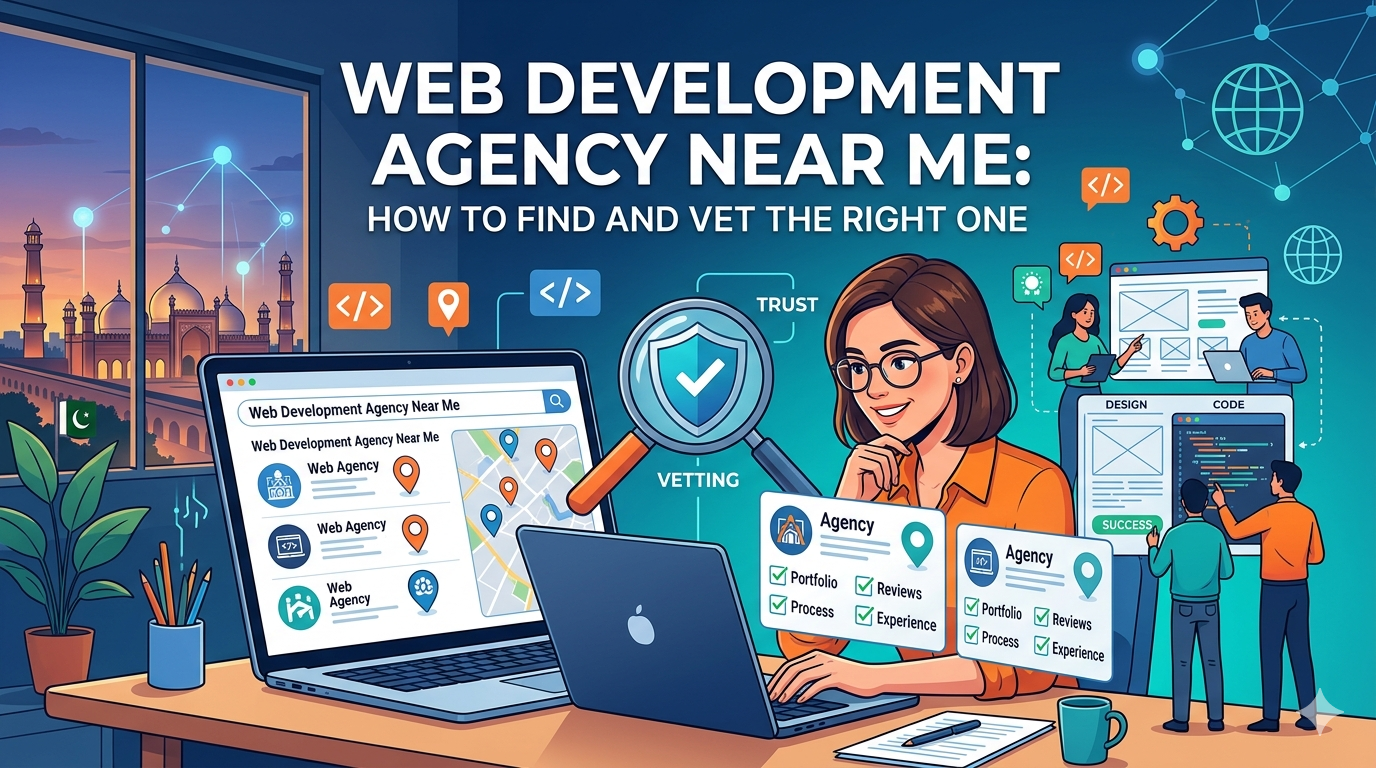
“Web development agency near me” is one of the most common searches from business owners starting the process of hiring someone to build or rebuild their website. The instinct behind it makes sense. Hiring local feels safer. You can meet in person. You share a time zone. If something goes wrong, there is a clear line of accountability.
Those preferences are valid. But “near me” is the wrong first filter for finding a quality agency.
This guide explains how to actually find a reliable web development agency, why geography matters less than most people think, and what criteria to use instead. If you end up hiring locally, great. But if the right agency for your project is in a different city or state, you should know that before you narrow your search.
Why Near Me Is Not the Best Filter
The “near me” instinct assumes that local agencies are more accountable and easier to work with. In practice, the quality of an agency’s work and communication has almost nothing to do with their zip code.
A local agency with poor project management will be just as frustrating in person as they are over video call. A remote agency with excellent communication processes and a disciplined project workflow will feel more present and responsive than a local agency you have to chase for updates.
What actually predicts a good agency experience:
- Communication responsiveness: Do they respond within a business day? Do they answer your questions directly or deflect?
- Portfolio quality: Does their past work look like what you want?
- Project management process: Do they have a defined process for scope, milestones, and reviews?
- References: Do past clients recommend them without hesitation?
- Contract clarity: Is the scope, timeline, and price defined in writing before work starts?
None of these qualities correlate with geography. Use them as your primary filters and treat location as a secondary preference, not a requirement.
When Local Really Does Matter
That said, there are legitimate reasons to prefer a local agency in certain situations.
Face to face collaboration preference: Some clients and some project types genuinely benefit from in person working sessions, particularly for complex discovery phases or design sprints. If you know you work better in person, local makes sense.
Industry specific local knowledge: A local agency that has worked with other businesses in your market may understand your competitive landscape, customer base, and local context in ways an out of market agency would not.
Legal jurisdiction alignment: US-based agencies operate under US contract law. While most well-written agency contracts are enforceable regardless of geography, working with a US-based agency (not necessarily local, but domestic) means disputes are resolved in a shared legal system with shared professional norms.
Time zone alignment: Working with an agency five time zones ahead can make real time feedback and calls difficult. This is a genuine operational consideration, though it applies to domestic remote agencies just as well as local ones.
If local is important to you, search accordingly. Just do not let “local” substitute for a thorough vetting process.
How to Find Quality Agencies in Your Area
Google Search
Search for your city or region plus your project type: “web development agency [city]” or “WordPress agency [state]” or “e-commerce development company [region]”. Review the first few pages of results. Note which agencies appear consistently and which have visible client work.
Do not assume that ranking on the first page of Google means an agency is the best in your market. Agencies that are good at SEO for their own site are not necessarily good at building websites. Treat search results as a starting list, not a recommendation.
Clutch.co and DesignRush
These directories list verified agencies with client reviews, portfolio samples, project size ranges, and hourly rates. You can filter by location, industry, service type, and minimum project size. Reviews on Clutch.co are moderated and require client verification, making them more reliable than general Google reviews. DesignRush offers a similar directory with agency profiles organized by specialization.
Search for agencies in your area with at least five verified reviews and a portfolio that matches your project type.
Search for web development agencies in your city. Look at the company page, team size, and any portfolio content they have shared. LinkedIn also lets you check whether you have shared connections with agency staff, which can open a warmer introduction.
Referrals from Peers
Ask other business owners in your network who built their website and whether they were satisfied. A direct referral from someone who has been through the process is more valuable than any directory listing. Ask specifically about communication, timeline adherence, and how the agency handled problems when they arose.
Website Credits
Look at websites you admire in your industry and check the footer or the “About” page for agency credits. Many agencies include a subtle “built by” credit on client sites. If a site impresses you, the agency behind it is worth investigating.
What to Look for When You Find Candidates
Once you have a list of three to five candidates, evaluate them on the following:
Portfolio match: Do they have examples of projects similar to yours in scope, industry, and technical complexity? An agency that specializes in restaurant websites may not be the right choice for a B2B software company’s marketing site.
Team structure: Who would actually work on your project? Some agencies have senior staff present during sales and junior staff doing the actual work. Ask who you would interact with day to day and who would be building your site.
Process documentation: Ask them to walk you through their project process. A professional agency has a defined discovery phase, design review milestones, development and QA stages, and a launch checklist. If the process is vague, that is a warning sign.
References from similar projects: Ask for two or three client references from projects similar to yours. Talk to those references and ask specific questions: Was the project delivered on time? On budget? How did the agency handle scope changes? Would you hire them again?
Proposal quality: A strong proposal is detailed, itemized, and tied to specific deliverables. It should clearly state what is and is not included, the payment schedule, and what happens if scope changes. Vague proposals lead to disputes.
Questions to Ask Before You Sign
Use these questions with any agency you are seriously considering:
- Who will be my primary point of contact during the project?
- Who will actually be building the website, and what is their experience level?
- What does your process look like from kickoff to launch?
- How do you handle scope changes and change orders?
- What does your post launch support cover, and for how long?
- Can you provide two or three client references from similar projects?
- What are your hourly rates for out of scope work?
- What has caused your projects to go over budget or past deadline in the past?
That last question is particularly valuable. Agencies that have been in business for any meaningful time have had projects go sideways. How they talk about those situations tells you a lot about their honesty and problem solving approach.
Red Flags to Watch For
Slow response during sales: If an agency takes three days to respond to your initial inquiry, they will not suddenly become more responsive once you are a paying client.
No written proposal or contract: Any professional engagement requires a written agreement that defines scope, price, timeline, and ownership of deliverables. Never start a project without one.
Guaranteeing Google rankings: Web development and SEO are related but distinct. An agency that promises first page rankings as part of building your site is making a promise they cannot keep.
No portfolio or vague case studies: Legitimate agencies have visible, verifiable work. Reluctance to share portfolio examples is a significant red flag.
Lowest price in the market: Genuinely cheap agencies in the $500-2,000 range for “complete websites” are almost always cutting corners on quality, using offshore labor without quality control, or delivering templates with minimal customization labeled as custom work.
Payment terms that require full payment upfront: Standard agency payment terms are split across project milestones (typically a deposit, a mid-project payment, and a final payment at launch). Demanding full payment before any work begins is unusual and risky.
Why Remote US Agencies Are Worth Considering
If you expand your search beyond local, you open up a significantly larger pool of quality agencies. A boutique agency in another state may have deeper experience in your industry, a stronger portfolio, and more competitive pricing than any local option.
Working with a remote US agency in practice: most communication happens via email, a project management platform (Basecamp, Asana, Linear), and scheduled video calls. The working relationship is similar to how many internal teams operate today. Time zone alignment within the continental US means you can typically get a same day response to most questions.
The key is choosing an agency with strong asynchronous communication practices, not one that operates on a single time zone’s schedule.
DevVerx Works with Clients Across the US
DevVerx is a US-based web development agency that works with small businesses and growth stage companies remotely. We have worked with clients in multiple states and industries and have developed a project process specifically designed for remote collaboration: clear milestones, a dedicated project portal, weekly status updates, and a commitment to same business day response times.
If you are looking for a reliable agency and have not found the right local fit, we are worth a conversation. Get a free project quote and see what your project would look like with our team.
For the complete agency evaluation framework, see Web Development Agency: The Complete Guide for Small Businesses. For more on choosing the right agency regardless of location, see How to Choose a Web Development Agency: A Practical Guide. For pricing context, see Web Development Agency Pricing: What It Really Costs in 2026. If you are wondering whether hiring an agency is worth it at all, see Is It Worth Hiring a Web Development Agency?.
Frequently Asked Questions
Is it better to hire a local web development agency?
Not necessarily. Local agencies can offer convenient face to face collaboration, but the quality of communication and project management matters more than geography. A remote US-based agency with strong processes often delivers a better client experience than a local agency with poor communication habits.
How do I find a reputable web development agency near me?
Start with Clutch.co or DesignRush and filter by your city or state. Look for verified client reviews, portfolio examples that match your project type, and agencies with a clear process. Follow up by requesting references and talking to past clients directly.
What questions should I ask a local agency before hiring?
Ask who will actually work on your project, how they handle scope changes, what their timeline looks like, and whether they can provide references from similar projects. Also ask to see live examples of sites they have built.
Can a web development agency work remotely?
Yes. Most modern agencies work with clients remotely and have processes built for it. Video calls, project management platforms, and shared document systems make remote collaboration effective for the majority of web development projects.
What is the average cost of hiring a local web development agency?
Local agencies in US markets typically charge similar rates to national boutique agencies: $100-175/hour, with fixed price projects ranging from $3,000 for simple sites to $30,000+ for complex builds. Geographic location within the US has less impact on price than agency size, team structure, and project scope.