When planning a website, one of the earliest structural decisions is one that many small business owners have not thought about: should the site be a single scrolling page, or a traditional multi-page structure?
Both one-page and multi-page websites have legitimate use cases. The right choice depends on the nature of your business, how many services or products you offer, your SEO goals, and how you expect visitors to use your site.
This guide breaks down how each structure works, where each excels, and how to make the right call for your specific situation.
What Is a One-Page Website?
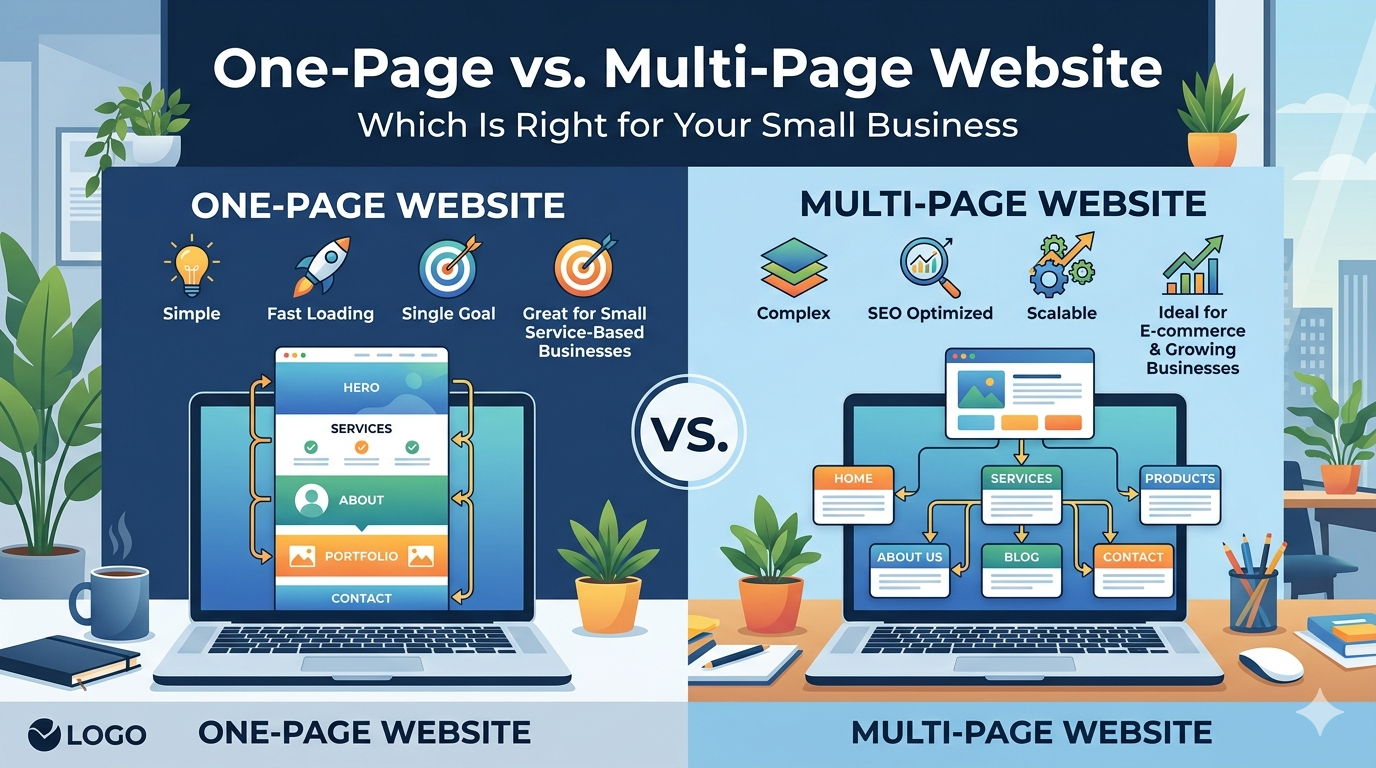
A one-page website (also called a single-page website) contains all content on a single HTML page. Visitors scroll through sections rather than clicking to separate pages. Navigation links scroll the visitor to different sections of the same page rather than loading new pages.
You have seen this format on:
– Simple service businesses (a freelancer, a personal trainer, a photographer)
– Product launch pages
– Event sites
– Restaurant sites
– Portfolios
One-page sites are common in industries where the offer is simple, the audience decision is relatively quick, and the goal is a single conversion action (call, book, buy).
What Is a Multi-Page Website?
A multi-page website contains separate pages for different content areas, homepage, services, about, blog, contact, individual service pages, location pages, case studies, and so on. Navigation links load new pages.
This is the standard structure for most small business websites and almost all established businesses.
Multi-page structure is appropriate when:
You offer multiple services or products
You serve different customer segments
You have significant content to share (blog, resources, case studies)
SEO is an important part of your customer acquisition strategy
Your buying process is research intensive and requires multiple touchpoints
The Case for a One-Page Website
Simplicity and Focus
A one-page site forces you to be ruthless about what matters. With limited space, every word, image, and section has to earn its place. The result is often a tighter, more compelling pitch than a multi-page site where information is spread across many pages.
For businesses with a single, clear offer, one service, one location, one target customer, a one-page site can be more effective than a cluttered multi-page site with half written interior pages.
Lower Cost and Faster Launch
One-page sites are faster to design, build, and launch. For early stage businesses that need a professional web presence quickly and cost effectively, a well designed one-page site is a better investment than a poorly executed multi-page site.
See our website design cost breakdown for context on how structure affects project pricing.
Better Mobile Experience (Sometimes)
Scrolling is the native behavior on mobile devices. A well designed one-page site can deliver a very smooth mobile experience, no page loads, no navigation complexity, just continuous scrolling through a linear story.
The caveat is that this only holds when the one-page site is well designed. A one-page site that tries to cram too much content onto a single scroll becomes frustrating on mobile.
When One-Page Is the Right Choice
- You are a solo service provider with a single offer
- You are launching a product or campaign with a defined endpoint
- You need a digital presence quickly while building toward a full site
- Your conversion goal is a single action (one contact form, one booking widget)
- Your audience makes fast decisions and does not need extensive research material
The Case for a Multi-Page Website
SEO Is a Priority
This is the most significant structural argument for multi-page sites. Each page on a website can rank for a different keyword. A service business with five services can have five separate service pages, each targeting the specific keyword for that service. A one-page site can realistically target one primary keyword.
For any small business where Google search is a meaningful source of customer acquisition, which is most small businesses, a multi-page structure is essential. Our guide on SEO for small business covers why keyword targeting by page is fundamental to organic search performance.
Multiple Services or Products
If you offer more than one service, each deserves its own page. A potential customer searching for “kitchen remodeling contractor in Phoenix” should land on a page specifically about kitchen remodeling, not a home page where kitchen remodeling is one item in a bulleted list of five services.
Separate service pages let you:
Target specific keywords for each service
Provide detailed information appropriate to each offer
Include service specific testimonials and case studies
Track which services generate the most traffic and leads
Content and Authority Building
A blog requires multi-page structure. If content marketing is part of your strategy, publishing articles that answer questions your potential customers search for, building topical authority over time, you need a site architecture that can house and organize that content.
For businesses serious about organic search growth, content is one of the highest ROI investments available. A one-page site cannot support a content strategy.
Complex Buying Journeys
Some purchases require research. A customer considering a $15,000 kitchen remodel will visit your site multiple times, read case studies, review your process, evaluate your team’s credentials, and compare you to competitors before they call. A one-page site cannot support that research journey.
Multi-page sites with dedicated pages for process, team, case studies, and FAQs serve the high consideration buyer, and the businesses that serve high consideration buyers convert better with more content, not less.
When Multi-Page Is the Right Choice
- You offer more than one service or have more than one product category
- You want organic search traffic from Google
- Your customers research before buying
- You plan to publish blog content
- You serve multiple customer segments with different needs
- You are building a brand over time, not just capturing a single conversion
The Hybrid Approach
Some businesses use a hybrid: a visually seamless single-page home experience (scroll based, with all the key information on one long homepage) combined with separate pages for services, case studies, blog, and contact.
This approach captures the clean user experience of single-page design while maintaining the URL structure and content depth that SEO requires. It is often the best of both worlds for service businesses with a small number of offerings.
The homepage functions like a one-page site in presentation but links to deeper content pages for visitors who want more. Google indexes the deeper pages separately, enabling keyword targeting across the site.
Making the Decision: A Simple Framework
Ask yourself these questions:
Do you have more than one service or product? If yes, multi-page.
Is organic search an important source of customers for you? If yes, multi-page.
Is your buying process research intensive (high price, high trust required)? If yes, multi-page.
Are you in the first six months of your business and need something up quickly? One-page may be appropriate as a starting point.
Do you have one very specific offer and a single conversion goal? One-page may work well.
Are you planning to publish blog content? Multi-page.
For most established small businesses, and most businesses with growth goals, multi-page is the right structural choice. One-page sites are appropriate for specific circumstances, but they are a ceiling, not a foundation.
What This Means for Your Website Project
Understanding site structure before starting a website project helps you scope correctly and avoid rebuilding. A one-page site designed when the business was simple often needs to be replaced once growth makes its limitations obvious.
If you are planning a new site or evaluating a redesign, our website design for small business guide provides the full strategic framework. For understanding the cost implications of each approach, see website design cost for small business.
At DevVerx, we work through this decision with every client in the discovery phase, before any design begins. The right structure for your business is the one that serves your customers and supports your growth goals, not the one that is quickest to build or cheapest to launch.
Our UI/UX design services include strategic consultation on structure, content architecture, and user flow, because these decisions shape everything that comes after.
Ready to figure out the right approach for your site? Contact our team. We will help you make the right structural choice before spending a dollar on design.