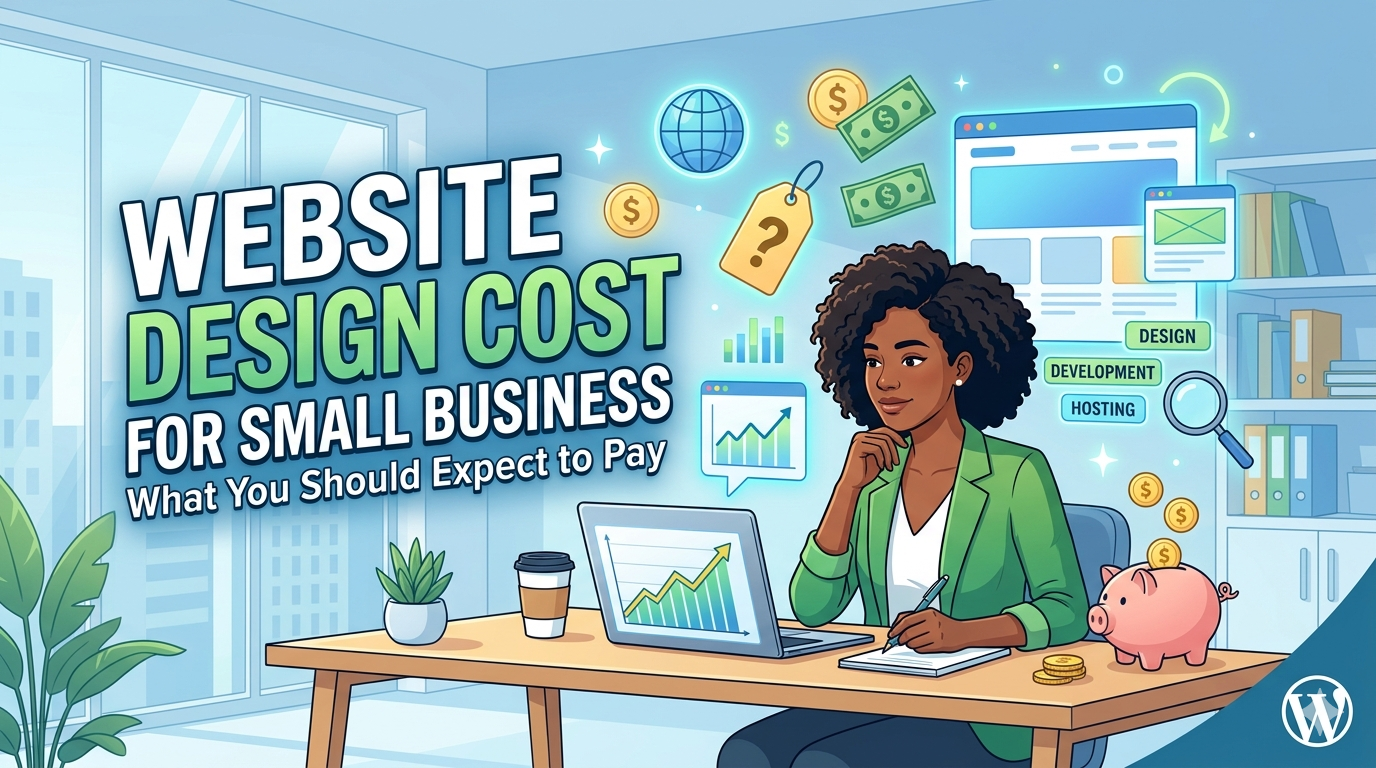
One of the first questions every small business owner asks when starting a website project is also one of the hardest to answer: how much is this going to cost?
Website design cost for small business ranges from essentially free (DIY builders with a learning curve) to tens of thousands of dollars for a fully custom professional build. That range is not a cop out, it reflects genuinely different scopes, skill levels, and outcomes.
This guide breaks down what you actually get at each price point, what drives the cost up or down, and how to figure out which investment level is right for your business right now. No vague ranges. Real numbers, real trade offs.
The Three Tiers of Small Business Website Design
Most small business website projects fall into one of three tiers. Understanding what separates them helps you make an informed decision, and avoid paying for more than you need, or less than you should.
Tier 1: DIY Website Builders ($0-$600/year)
Platforms like Squarespace, Wix, and GoDaddy Website Builder let you create a site using drag and drop tools and pre-built templates. The cost is primarily the platform subscription ($15-$50/month) plus your time.
What you get:
A functional, mobile compatible website
Hosting and basic security included
Template based design with limited customization
Limited SEO capability compared to custom builds
No strategic input on what will actually convert visitors
Best for: Very early stage businesses, side projects, businesses with extremely simple needs (one service, no e-commerce, no serious SEO goals), or businesses that need something up immediately before investing in a professional build.
The real cost: DIY platforms are cheap in dollars and expensive in time. Most small business owners spend 40-80 hours building their first DIY site, and the result often underperforms on mobile and in search because of platform limitations. For businesses where the website is a primary lead source, DIY typically costs more in lost revenue than a professional site would have cost upfront.
Tier 2: Freelance Web Designer ($1,500-$8,000)
An independent web designer or developer who builds sites for small businesses. Quality, experience, and process vary enormously, from recent graduates charging $1,500 to experienced designers charging $7,000-$10,000 for a comparable project.
What you get (at the higher end of this tier):
– Custom design tailored to your brand
– Properly built and mobile responsive site
– Basic on-page SEO setup
– Varies: may or may not include strategy, copywriting, or post launch support
What varies most at this tier:
– Strategic thinking (many freelancers are executional, not strategic)
– Post launch support (many freelancers do not offer ongoing maintenance)
– Project management (communication and timeline adherence vary widely)
– SEO and performance knowledge (design skill does not equal SEO knowledge)
Best for: Businesses that have a clear sense of what they need, have existing brand assets and copy, are comfortable managing the relationship independently, and are working within a tighter budget.
Tier 3: Small Web Design Agency ($5,000-$25,000)
A professional agency with a defined process, a team covering design, development, strategy, and SEO, and ongoing support options.
What you get:
– Full service process from discovery through launch
– Strategic input on site architecture, conversion, and positioning
– Professional design and development under one roof
– Performance optimization built in (Core Web Vitals, mobile first)
– Copywriting support in many cases
– Defined post launch support and maintenance options
– Accountability: a team, not just one person
Best for: Established businesses where the website is a primary or significant revenue driver, businesses with growth goals that require the site to work harder, any business where missing a launch deadline or having a broken site has real cost.
For context on how this compares to the full cost of having a web presence, see our guide on how much a website costs for a small business.
What Drives Website Design Cost Up or Down
Within each tier, specific factors determine where your project lands in the price range.
Scope and Number of Pages
A five page brochure site (home, about, services, blog, contact) costs significantly less than a twenty-page site with individual service pages, location pages, team bios, and a resources section. More pages mean more design work, more copy, and more development time.
For most small businesses, a tightly focused site of seven to twelve pages outperforms a larger site built quickly. Fewer, better pages typically generate more leads than many thin ones.
Custom Features
Standard websites, the kind that display information, have contact forms, and connect to Google Analytics, are straightforward to build. Cost increases when you add:
- E-commerce functionality (product catalogs, shopping carts, payment processing)
- Booking and scheduling systems
- Member portals or gated content
- Custom calculators or interactive tools
- API integrations with CRM, marketing automation, or other software
Each custom feature adds design, development, and testing time. If you need e-commerce, see our guide on e-commerce website development for a dedicated cost breakdown.
Copywriting
Many design quotes do not include copywriting. If you need to provide all the website copy yourself, the cost is lower, but the quality of your copy directly affects how well the site converts. Professional website copywriting typically adds $1,500-$5,000 to a project, depending on scope.
If you have existing content, a brochure, sales deck, or previous website copy, a good designer can work from that as a starting point.
Photography and Visual Assets
Stock photography is included in most projects at no extra cost. Custom photography, a professional shoot of your team, space, or products, adds $500-$3,000 depending on scope and location, but it dramatically differentiates your site from competitors using the same stock images.
Timeline
Rushed projects cost more. A site that needs to launch in two weeks requires more concentrated work and disrupts the agency’s other projects. Standard timelines for small business websites are six to ten weeks from kickoff to launch. If you need faster, expect to pay a premium.
Hidden Costs to Factor In
The design and development quote is not the total cost of a website. These ongoing expenses are easy to overlook when budgeting:
- Domain name: $15-$25/year
- Web hosting: $10-$100/month depending on platform and traffic volume
- SSL certificate: Usually included with hosting, but verify
- WordPress plugins or platform subscriptions: $0-$500/year depending on tools used
- Website maintenance: $50-$300/month for security updates, backups, and monitoring, important to budget for
- Content updates: If you cannot update the site yourself, budget for developer time
For WordPress sites in particular, see our breakdown of WordPress maintenance service costs to understand what ongoing care involves.
How to Get the Most from Your Website Design Budget
Regardless of which tier you work in, these decisions affect how much value you get from your investment.
Know Your Goals Before You Brief
A designer cannot optimize for something you have not specified. Before any design work starts, be clear on: What is the primary action you want visitors to take? What does success look like in six months, leads generated, products sold, appointments booked? What pages are most important?
The clearer you are on goals, the better a designer can make decisions that serve those goals.
Prioritize Conversion Over Visual Complexity
The most beautiful small business website is not the one with the most design elements. It is the one that converts visitors into customers most efficiently. Simple, clean, fast sites consistently outperform visually complex ones in user testing and conversion data.
Do Not Skip the Strategy Phase
Agencies that start with discovery, understanding your business, customers, and competitive positioning before designing anything, produce better sites than those that start with visual design immediately. If a proposal skips directly to mockups, that is a warning sign.
Invest in Quality Photography
Nothing makes a professional website look amateur faster than generic stock photos. A single half day photography shoot is one of the highest ROI investments in a website project.
What DevVerx Charges for Small Business Website Design
At DevVerx, our UI/UX design and web development services are priced to give small businesses professional agency quality at a price that makes financial sense.
We do not publish fixed pricing because every project has different requirements. What we can tell you is that we approach every project with the same strategic framework: what does this business need its website to accomplish, and what is the most efficient design and build to get there?
Our 4.8/5 client rating reflects transparent pricing, honest scope conversations, and a process that delivers what we promise. We do not upsell complexity you do not need, and we do not underbid to win work and then overcharge for changes.
If you want to know what your specific project would cost, the most efficient thing to do is to talk to our team. We will give you a straight answer about what your goals require and what it should cost.
Website Design Cost: The Bottom Line
Here is a simple framework for deciding how much to invest:
- If your website generates less than $5,000/year in business: A DIY or entry level freelance build is reasonable while you validate your model.
- If your website generates or should generate $5,000-$50,000/year: A mid-range freelancer or small agency is the right investment. A $5,000-$10,000 site pays for itself quickly.
- If your website generates or should generate $50,000+/year: Professional agency work is the minimum investment that makes financial sense. The gap between a $3,000 DIY site and a $15,000 professional build is trivial compared to the revenue at stake.
Your website is not an expense. It is an asset. The right investment produces returns that compound over years, through organic search rankings, increased conversion rates, and the credibility that keeps visitors from clicking back to your competitors.
Ready to understand what your website project should cost? Contact DevVerx for a free project consultation. We will tell you exactly what it takes to build the site your business needs.