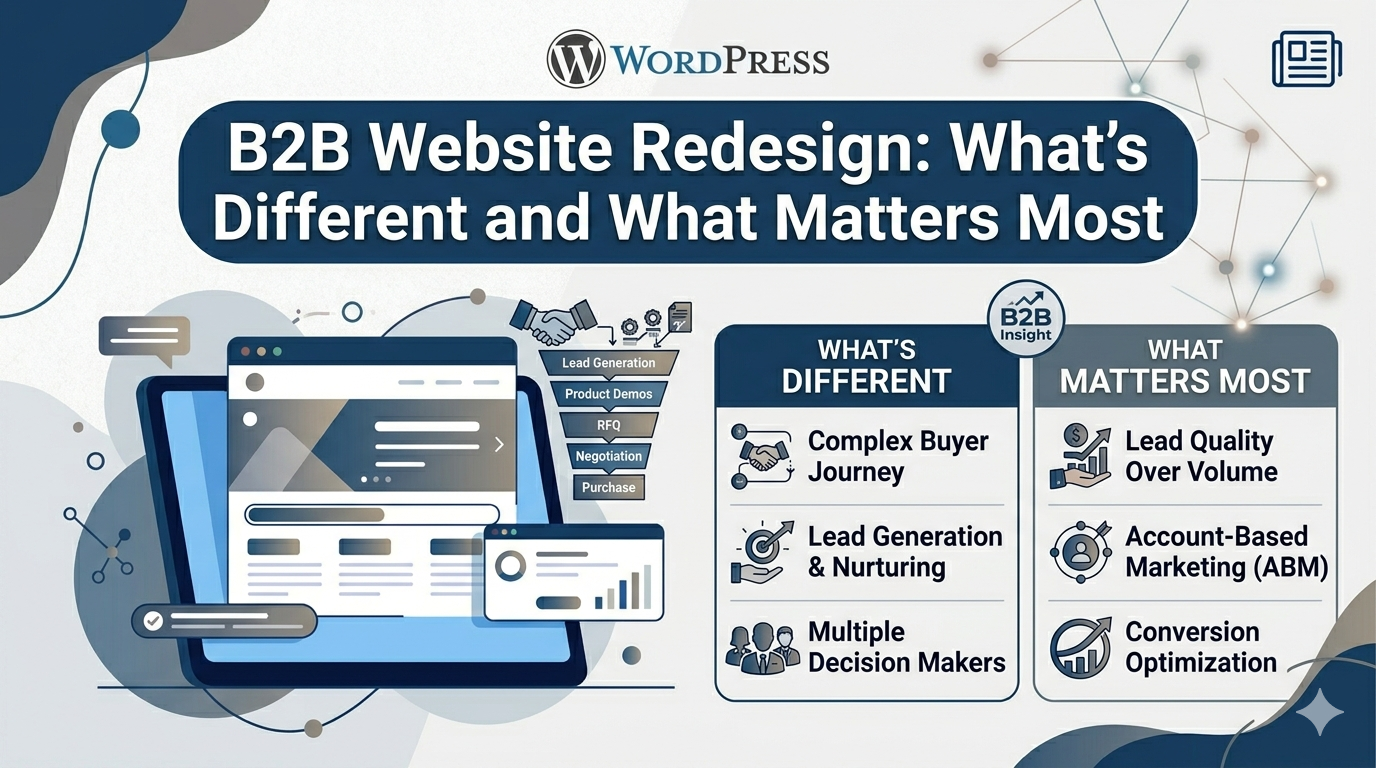
A B2B website redesign isn’t the same as redesigning a consumer site and treating it like one is one of the most common reasons B2B redesigns underperform. The buying journey is longer. The decision involves multiple people. The content needs to justify a larger purchase to an audience that will scrutinize it.
If your business sells to other businesses and your site hasn’t been redesigned in two or more years, the gap between your digital presence and buyer expectations is likely widening. This guide covers what makes B2B redesigns unique, what buyers actually need from your site, and how to get the project right.
Why B2B Website Redesign Requires a Different Approach
In B2C, a strong homepage headline, good product photography, and an easy checkout flow can close a sale. In B2B, that’s the beginning of a much longer process.
B2B buyers typically:
- Research vendors for weeks or months before making contact
- Involve multiple stakeholders in the decision (user, manager, budget holder, IT, legal)
- Need to justify the decision internally which means your site’s content becomes their internal sales deck
- Are risk averse; they’re more afraid of choosing the wrong vendor than of missing a good one
This changes everything about how you design and build your website. The goal isn’t just to look credible it’s to systematically answer every question a buyer has at every stage of their research.
What B2B Buyers Actually Need from Your Site
Before redesigning, understand what you’re designing for. B2B buyers visiting your site are typically asking:
“Can this company actually solve my problem?”
Your site needs to clearly and specifically describe what you do, who you do it for, and what outcomes you deliver. Vague positioning (“we help businesses grow”) doesn’t answer this question. Specific positioning does (“we build custom web applications for professional services firms that need client facing portals”).
Homepage messaging is where most B2B sites fail this test. If a new visitor can’t immediately understand whether you’re relevant to their problem, they leave.
“Have they done this before?”
Case studies and client results are the most powerful content on a B2B site. Not generic testimonials specific stories: what the client needed, what you built or solved, and what changed as a result.
According to the Content Marketing Institute, 73% of B2B buyers say case studies are the most influential type of content in their purchase decision. Yet most small B2B sites have either no case studies or ones so vague they provide no real information.
“Who am I actually working with?”
B2B buyers aren’t just evaluating your product or service they’re evaluating the relationship. Team pages, about pages, and process descriptions matter more in B2B than in consumer contexts. Putting faces to names, sharing the team’s background, and explaining how you actually work all reduce the perceived risk of making contact.
“How does this work and what does it cost?”
B2B buyers want to understand your process and have at least a rough sense of investment level before they’ll give you their time on a call. You don’t need to publish a price list, but a transparent description of your engagement process and a general investment framing (“projects typically start at X”) reduces friction significantly.
Key Differences in B2B Website Structure
Multiple Buyer Personas
Unlike B2C sites that often speak to one audience, B2B sites frequently need to serve multiple personas simultaneously. An enterprise software company’s site might need to speak to: the technical evaluator (CTO or IT director), the business decision maker (CEO or VP), and the day to day user (the operations team). Each has different questions and different priorities.
Good B2B site architecture acknowledges this. Solutions pages organized by role or use case, FAQs structured around common objections, and content hubs serving different stages of the funnel all reflect persona aware design.
Longer Content Depth
B2B content is longer and denser than B2C content because B2B buyers need more information to make a high stakes purchase decision. Service pages of 800–1,200 words. Case studies of 600–1,000 words. Blog content of 2,000+ words on substantive topics. If your B2B site’s pages are thin, they’re not serving the buyer’s research process.
This also matters for SEO. Google favors content depth for B2B searches, which tend to be longer, more specific queries.
Lead Capture, Not Direct Conversion
Most B2B sites don’t convert a visitor directly into a customer they convert a visitor into a lead. The primary conversion goal is getting the visitor to take a qualifying action: book a call, request a proposal, download a resource, or fill out an inquiry form.
This means every page needs a clear, relevant lead capture path and that path needs to match the buyer’s stage. Someone reading a blog post is less ready to “book a call now” than someone on your services page who has clearly self selected as a prospect. Offer softer CTAs earlier in the funnel and harder CTAs on high intent pages.
Trust Architecture
Trust signals carry more weight in B2B because the stakes are higher and the relationship is longer. For a B2B redesign, prioritize:
- Client logos: A strip of recognizable client logos on your homepage is one of the highest converting trust elements you can add
- Case studies with numbers: “We increased their lead volume by 40%” beats “we helped them grow” every time
- Reviews and ratings: Even in B2B, third party validation (Google reviews, Clutch, G2) matters enormously
- Process transparency: Describing how you work reduces buyer uncertainty and signals professionalism
- Team visibility: Named people with real photos create more trust than generic stock images
Common B2B Website Redesign Mistakes
Messaging Designed for the Designer, Not the Buyer
Beautiful B2B sites with vague messaging consistently underperform plainer sites with specific, benefit focused copy. “We craft transformative digital experiences” is a phrase that sounds good in a pitch and means nothing to a buyer. “We build web applications for healthcare providers that need HIPAA compliant patient portals” tells a buyer everything they need to know in one sentence.
Ignoring the Middle of the Funnel
Most B2B site redesigns focus heavily on the homepage and the contact page. The middle of the funnel where buyers research, compare, and qualify vendors is often neglected. This means no resources section, no FAQ, no detailed service pages, no case studies.
Build your site for the buyer who has been researching for three weeks and is almost ready to reach out. That buyer needs depth, specificity, and answers to every objection they’ve already encountered in their research.
Not Designing for Mobile
B2B buyers are increasingly doing research on mobile devices. According to Google’s B2B research, 50% of B2B queries are made on smartphones. If your B2B site provides a poor mobile experience, you’re losing a meaningful percentage of your most active researchers.
This is particularly true for executive level buyers who are more likely to browse on phones during commutes, between meetings, and outside office hours.
Weak or Missing CTAs
B2B sites often have weak calls to action because the designer didn’t want to seem “salesy.” The result is a visitor who has read everything, is genuinely interested, and doesn’t know how to take the next step.
Every key page needs a clear, specific CTA: “Book a Free Strategy Call,” “Request a Custom Proposal,” “Download the Case Study.” Make it easy to take the next step.
The B2B Redesign Process: What to Expect
A B2B website redesign follows the same general phases as any professional redesign discovery, UX design, visual design, development, content, QA, and launch but the discovery phase tends to be more involved because of the complexity of the buyer journey.
Expect discovery conversations around:
Buyer personas and their decision making process
Competitive positioning relative to specific named competitors
Sales team input on the questions prospects most commonly ask
Content audit of existing sales materials that should inform site content
For a general overview of the full redesign process and timeline, read our complete guide to website redesign for small businesses.
For B2B specifically, timelines are often slightly longer than comparable B2C projects because of content depth requirements and the need for more page templates to serve different buyer personas.
For cost context, see our website redesign cost guide. B2B redesigns typically fall in the $8,000–$25,000 range for small to mid size businesses, reflecting the additional content strategy and development work involved.
Choosing the Right Agency for a B2B Redesign
Not every web agency understands B2B. The best indicator is whether they ask about your buyer’s journey in the initial conversation. If the first question is about colors and aesthetics rather than about your target customer and their decision making process, that agency is optimizing for visual output rather than business outcomes.
When evaluating agencies, ask:
- “Can you show me examples of B2B sites you’ve redesigned and the results they delivered?”
- “How do you approach messaging and buyer persona work in discovery?”
- “How do you handle the gap between brand focused design and conversion focused design?”
- “What does your process look like for a company in [your industry]?”
Our guide on how to choose a web development agency covers this vetting process in more detail.
Rated 4.8/5 by verified clients, DevVerx has built and redesigned websites for B2B clients including 1World Resources an enterprise services company that needed a site that spoke credibly to enterprise buyers while reflecting a strong brand identity. The result: a site that communicates expertise, process, and capability at a level that matches the expectations of their buyers.
Our web development services are built for exactly this kind of work strategy first, conversion focused, and executed by a full team that handles design, development, and SEO under one roof.
Ready to Redesign for Your B2B Buyers?
Your B2B website should be your best salesperson available 24 hours a day, answering buyer questions before your team ever gets on a call, and positioning you as the credible, capable choice in your market.
Contact DevVerx for a free strategy call. We’ll review your current site through the lens of your B2B buyer’s journey and tell you exactly what needs to change and why.
B2B buyers are doing their homework. Make sure your website answers the test.