Two tabs open. One is a quote from a full service web development agency. The other is an Upwork profile with a 4.9 star developer charging $40 an hour. If you have ever faced the Upwork vs. web development agency choice, the freelancer looks like the obvious, cheaper option.
Most small business owners make the same call. And most regret it, not because freelancers are bad, but because the wrong hire for the wrong project costs more in the end than the “expensive” option would have.
This guide cuts through the noise on the web development agency vs. freelancer decision. If you are asking yourself “should I hire a freelancer or agency for my website?”, you are in the right place. You will get an honest breakdown of what each option actually costs, when each genuinely makes sense, and the questions to ask before you commit to either.
What You Are Really Comparing: Agency vs. Freelancer
The surface level comparison when deciding to hire a web developer vs. agency is simple: agencies charge more upfront, freelancers charge less. But that framing skips the part that actually matters.
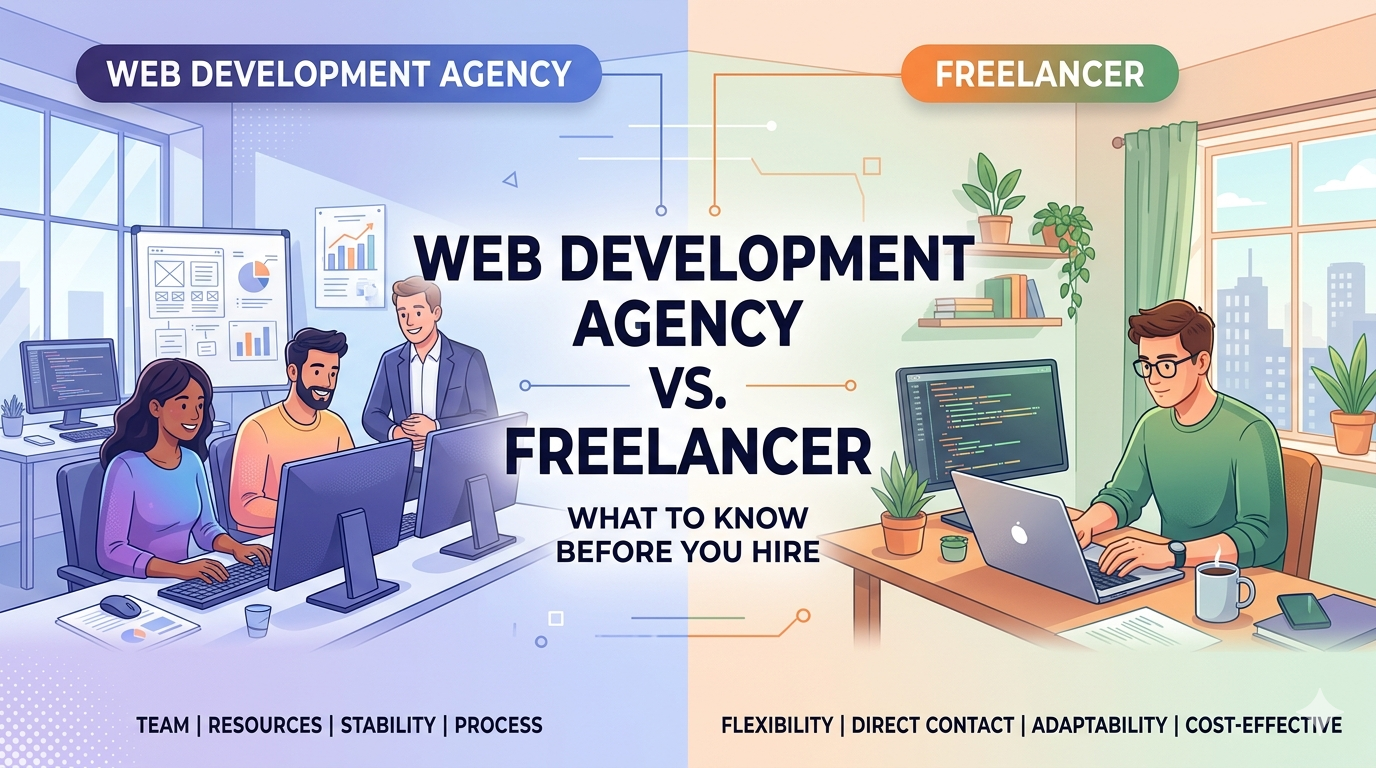
When you hire a web development agency, you are buying a system. There is a project manager keeping things on track, a developer (or multiple) writing the code, a designer handling the visuals, a QA engineer catching the bugs before you do, and usually an account manager you can call when something goes wrong. The agency is accountable as a business, they have reviews, contracts, and a reputation to protect.
When you hire a freelancer, you are hiring a person. A skilled person, often a very good one, but still one individual with a limited scope of expertise, limited availability, and no backup plan if they get sick, take another project, or stop responding to your messages.
Neither is inherently better. The decision comes down to matching the option to the project, and understanding what you are actually paying for in each case.
What a web development agency delivers:
A coordinated team covering design, development, QA, and project management
Fixed or scoped pricing with defined deliverables
Strategic input, not just task execution
Accountability and continuity, the agency does not disappear mid project
Post-launch support built into the relationship
What a freelancer delivers:
One person, usually specializing in one area (front-end, back-end, WordPress, etc.)
Lower hourly rate, typically $25 $100/hr on established platforms like Upwork
Flexible scope, you can start small and add on
Variable availability, communication, and reliability
The Full Cost Picture: Agency vs. Freelancer Web Development
The freelancer’s hourly rate is not the cost of hiring a freelancer. That is the cost of their time on productive tasks. The real cost includes everything that does not show up in the initial quote.
Take a realistic example. You find a web developer on Upwork charging $50 per hour. Your project looks like 150 hours of work, call it $7,500. Here is what that number does not capture:
Scope creep. Your spec had gaps. The developer completes exactly what was written, but what was written was not complete. More hours. More money.
Your management time. Without a project manager, you are the project manager. Two to five hours a week of your time spent on task reviews, requirement clarification, and chasing status updates, at your hourly rate, that adds up fast.
Design gaps. Most freelance developers are not designers. If your project needs visual design, that is a second freelancer to hire, vet, and coordinate with the first.
QA failures. Most solo freelancers do not run a formal QA process. You find the bugs after launch, when fixing them costs the most.
The disappearance. It happens more often than anyone talks about. A developer goes quiet two weeks before launch. They took another project. Or just stopped responding. You are stuck with an incomplete build, no documentation on the codebase, and a deadline approaching fast.
Agency pricing builds in all of the above. Project management, design coordination, QA, and account management are not overhead you are absorbing, they are services included in the scope.
For simple, isolated projects, the agency premium can feel unjustified. For anything where failure has a real business cost, it is insurance.
Trying to figure out what your project actually needs? See what DevVerx’s custom web development service covers and compare it to what a solo freelancer would need to deliver the same result.
When Hiring a Freelancer Makes Sense
Freelancers are not the wrong choice. They are the wrong choice for the wrong project. There are legitimate, smart reasons to hire a freelance web developer instead of an agency.
The task is isolated and well defined. You need a specific plugin fixed. One landing page built to a tight spec. A bug resolved in existing code. When the scope is small, clear, and self contained, the agency’s overhead is not worth the premium.
Budget is the absolute constraint. If your total budget is $1,000 and you need functional web presence, a freelancer may be your only viable option. That is a real constraint and an honest reason.
You have strong technical oversight in house. If your team includes someone who can write specs, review code quality, and manage the freelancer’s output, the accountability gap narrows significantly. The risk is there, but it is managed.
You are building a prototype to test a concept. Fast and inexpensive validation before committing to production quality development is a legitimate strategy. The bar is different for throwaway code.
The pattern: freelancers work well when the risk of failure is low, the scope is tight, and the project does not need to scale or perform long term.
When a Web Development Agency Is the Right Call
For a web development agency serving small business clients, the calculus shifts when the cost of failure outweighs the cost of the premium.
Your website is a primary revenue driver. If site performance, uptime, and user experience directly affect leads, bookings, or sales, and for most businesses they do, you cannot afford the reliability gamble a freelancer represents. According to Think With Google, 53% of mobile users abandon a site that takes more than 3 seconds to load, a problem agencies are built to prevent at the architecture stage.
The project requires multiple disciplines. Strategy, UI/UX design, development, QA, and SEO optimization. A freelancer specializes in one, maybe two of these. An agency brings them all. Coordinating four separate freelancers yourself is not cheaper than hiring an agency, it is often more expensive and substantially more stressful.
You need post launch support. Websites are not finished on launch day. They need updates, security patches, performance monitoring, and ongoing optimization. Agencies build long term relationships. Most freelancers move to the next project.
You have been burned before. A past bad experience, scope creep, missed deadlines, an abandoned project, is a signal, not bad luck. The accountability structure of an agency is designed specifically for the situations where individual freelancers fail.
The project needs to work right the first time. A business launching a new site before a major campaign, event, or product release does not have the margin to rebuild after a bad first pass. Agencies deliver on defined scope. The process is built around it.
When DevVerx worked with Dubai Fun Tour on their site rebuild, the goal was not just a new design, it was a performance optimized platform that could handle international traffic and convert visitors into bookings. That required coordinated work across development, UX, and SEO, delivered as a unit. A solo freelancer cannot execute that. DevVerx holds a 4.8/5 verified client rating precisely because this kind of coordinated, accountable delivery is what the agency is built to provide.
If your website is already a primary revenue driver, it may already be costing you more than you realize, see the warning signs that your site is losing customers before deciding how to approach the rebuild.
What Really Happened When She Hired on Upwork
Maria ran a specialty retail business in Austin. In mid 2024, she needed her WooCommerce store rebuilt, the existing site was slow, not mobile friendly, and her checkout flow was leaking customers. She found a developer on Upwork with a 4.8 star rating, 47 completed jobs, and a $48/hour rate.
She hired him. Things started fine. Then, six weeks in, with roughly 60% of the project complete, communication slowed. Messages took two days to get replies. Then three days. Then silence.
The developer had taken on a larger contract and effectively deprioritized her project. She spent three weeks trying to revive the engagement, then another two weeks finding a replacement developer who had to reverse engineer the original work before adding to it. The replacement charged $70/hour.
By the time the rebuild launched, she had paid 38% more than the original quote, lost eleven weeks she had planned to spend on a marketing push, and missed the spring shopping season she had targeted for the relaunch.
This is not a rare story. According to Clutch’s research on small business web projects, project abandonment and missed deadlines are the most frequently cited complaints about freelance web developers. An agency’s project management structure, accountability, and business continuity exist precisely to prevent this outcome.
The Real Cost Comparison: Web Development Agency vs. Freelancer
| Freelancer (Upwork/Fiverr) | Web Development Agency (DevVerx) | |
|---|---|---|
| Upfront quote | Lower ($25-$100+/hr) | Higher (fixed project price) |
| Project management | You | Included |
| UI/UX design | Extra hire | Included |
| QA testing | Rarely included | Included |
| Post launch support | Negotiate separately | Built into the relationship |
| Communication | Varies widely | Dedicated point of contact |
| Abandonment risk | High | Low |
| Strategic input | Task execution only | Business outcome focus |
| Full-service scope | One specialty | Dev + design + SEO + marketing |
| Total cost (complex project) | Often comparable or higher | Predictable |
The freelancer column looks cheaper until you populate the total cost row honestly. For complex projects, the gap between the quote and the final invoice is where agencies consistently outperform the freelancer vs. agency comparison, because agencies price the full scope upfront.
If you want more detail on what web development actually costs for a small business, our complete website cost breakdown walks through real numbers across different project types.
Five Questions to Ask Before You Decide
These questions will surface the right answer for your specific project before you commit either way.
1. What happens if this project stalls for two months?
If a delay would damage your business, missed launch, lost revenue, a campaign going live without the site, freelancer risk is not acceptable. If you can absorb it, the calculus is different.
2. How complex is the scope?
Single function task with a clear, complete spec? Freelancer candidate. Multi page site with custom functionality, design work, and ongoing support? Agency territory. The web development agency vs. freelancer decision often comes down to this one question.
3. Do you have technical capacity to manage a freelancer?
No internal developer to review code quality and manage the relationship? The accountability gap falls on you. If you have that capacity in house, the risk narrows considerably.
4. What does this project need six months from now?
If you will need updates, new features, SEO support, or performance monitoring post launch, building that relationship with an agency from day one is more cost effective than re-engaging a new vendor later.
5. Is this site your hardest working salesperson?
According to BrightLocal, 98% of consumers used the internet to find local business information in 2023. Your website makes the first impression on every one of those potential customers. If it is that important, and for most businesses it is, treat the hiring decision accordingly.
Before signing any contract, it is also worth reading our guide on how to choose a web development agency. It covers exactly what to ask during vetting, the red flags that should end a conversation, and the process signals that distinguish reliable agencies from the ones that oversell and underdeliver.
The Bottom Line on Agency vs. Freelancer Web Development
The web development agency vs. freelancer decision is not a cost comparison. It is a risk and fit comparison.
Freelancers are the right call for isolated, well defined, lower stakes tasks. When scope is tight, risk of failure is manageable, and budget is the hard constraint, a skilled freelancer is often the most efficient path.
Agencies are the right call when your site is mission critical, the project requires multiple disciplines, you need reliability you can plan around, and you want a partner still in your corner six months after launch. When you factor in management time, revision cycles, QA failures, and the real risk of abandonment, the agency’s premium often disappears, and what you are left with is a better result with less stress.
Most businesses reading this are in the second category. They just have not fully priced the freelancer risk into their thinking until after they have experienced it firsthand.
DevVerx is a web development agency for small business and mid size companies across the US, covering everything from first professional websites to complex e-commerce platforms and custom web applications, all under one roof from strategy through post launch support. With a 4.8/5 verified client rating, the track record backs the promise. If you are at the decision point, book a free strategy call and we will help you figure out exactly what your project needs and whether we are the right fit to build it.